
 Abdul Moeed
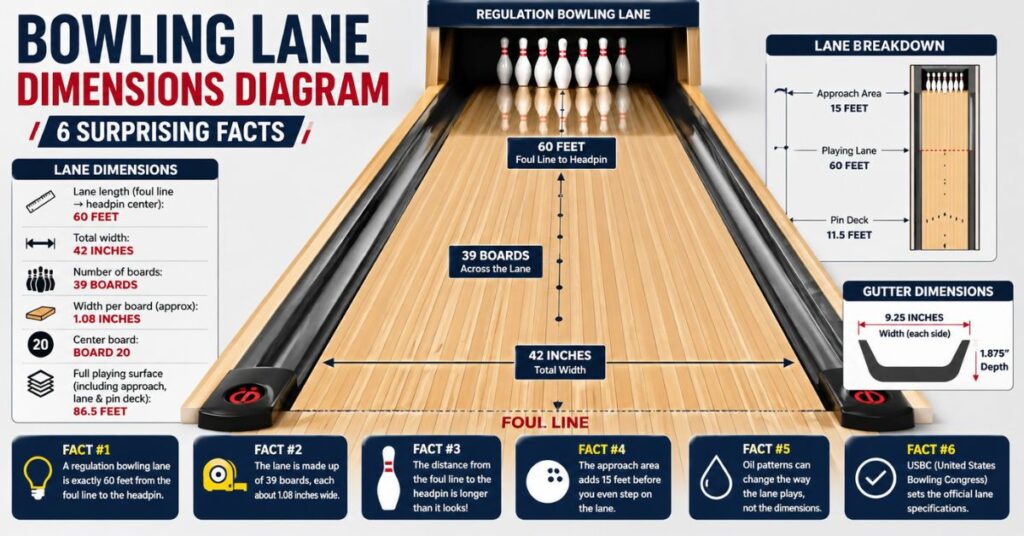
A regulation bowling lane measures 60 feet from the foul line to the head pin, is about 41.5 inches (roughly 42 inches) wide, and is built from 39 individual boards, according to United States Bowling Congress (USBC) specifications shown in any official bowling lane dimensions diagram.
That single sentence answers the question most people search for, but it only scratches the surface. A bowling lane dimensions diagram actually maps out several zones: the approach, the foul line, the lane itself, the gutters, and the pin deck and each one has its own exact measurement, down to fractions of an inch. Most articles online only mention the 60-foot length and stop there, which is one detail competitors rarely explain clearly.
This guide breaks the whole layout into six easy-to-understand sections, using real examples from ten-pin bowling centers, USBC rulebooks, and lane manufacturers like Brunswick and QubicaAMF. Whether you’re curious about standard bowling lane size for a trivia question, comparing bowling alley dimensions before building a home lane, or just want to know how wide a bowling lane really is compared to your hallway, you’ll find every number here, in feet, inches, meters, and centimeters, along with practical comparisons that make the numbers easier to picture.
Read More About: Basketball Court Dimensions The Complete Measurement Guide for Homeowners
How Big Is a Bowling Lane?
When people ask “how long is a bowling lane,” they’re usually picturing just the flat wooden or synthetic surface where the ball rolls. In reality, a full bowling alley dimensions layout includes the approach area behind the foul line, the lane surface itself, the gutters running along both sides, and the pin deck at the far end. Add those sections together and a complete lane setup, from the back of the approach to the back of the pin deck, stretches close to 80 feet.
The core measurement most bowlers care about is foul line to head pin, is fixed by USBC bowling lane specifications at exactly 60 feet, regardless of whether the lane is in a small-town bowling center or a professional tournament venue. That consistency is what makes ten-pin bowling lane dimensions comparable across every certified house in the country, and it’s also what allows a bowler’s average score to mean the same thing whether they’re playing in Ohio or Nevada.
It helps to think of a bowling alley as several stacked measurements rather than one single number. The approach gives players room to walk and swing the ball, the lane carries the ball toward the pins, the gutters catch mistakes, and the pin deck holds the target. A regulation bowling lane dimensions diagram lines all four of these zones up in a straight, narrow strip, which is part of why bowling centers with 20, 40, or even 60 lanes can fit so many side by side under one roof.
Quick Conversion Table
| Unit | Bowling Lane Length (Foul Line to Head Pin) |
| Feet | 60 ft |
| Inches | 720 in |
| Yards | 20 yd |
| Meters | 18.29 m |
| Centimeters | 1,828.8 cm |
| Millimeters | 18,288 mm |
For lane width, the same conversion logic applies: 41.5 inches equals about 3.46 feet, 1.05 meters, or 105.4 centimeters. Keeping both sets of numbers side by side makes it easier to compare bowling lane measurements against other familiar spaces, like doorways, hallways, or parking spots.
Quick Reference Table
| Item | Approx. Measurement | Closeness Score (X/10) | Best Situation/Use |
| Total Lane Length (Foul Line to Head Pin) | 60 ft (18.29 m) | 10/10 | Understanding official play distance |
| Lane Width | 41.5 in (105.4 cm) | 9/10 | Comparing to a hallway or narrow room |
| Approach Area | 15 ft (4.57 m) | 8/10 | Planning your steps before release |
| Pin Deck | 41.5 in x 36 in | 7/10 | Visualizing where pins are spotted |
| Gutters | 9.25 in wide, 5.75 in deep | 7/10 | Judging how forgiving a lane feels |
| Lane Boards | 39 boards total | 6/10 | Reading ball path and lane targeting |
The closeness score above reflects how tightly regulated each measurement is across every certified bowling center. Total lane length scores a perfect 10 because USBC allows almost no variation, while board count scores lower simply because it matters more for strategy than for basic certification.
Detailed Bowling Lane Dimension Breakdown

Total Lane Length: Foul Line to Head Pin
The most quoted number in any bowling lane dimensions diagram is the distance from the foul line to the head pin, which USBC bowling lane specifications fix at exactly 60 feet, with a tolerance of less than half an inch. This measurement never changes between a neighborhood bowling center and a Professional Bowlers Association tournament lane, which is why scores are comparable across different bowling alleys nationwide. Brunswick and QubicaAMF, two of the largest lane manufacturers, both build their synthetic lanes to this exact regulation bowling lane length, and USBC-certified inspectors re-measure lanes periodically to confirm nothing has shifted.
Knowing this distance matters because it’s the number bowlers actually use to plan their approach and release point. If you’re new to the sport, picturing 60 feet is easier than it sounds it’s roughly the length of two school buses parked end to end, or about four mid-size cars nose to tail. This is the foul line distance every serious player memorizes early, since misjudging it by even a few feet changes how a ball reacts before it reaches the pins.
Recreational bowlers rarely think about this number consciously, but it shapes almost everything about the sport’s physics. A ball that hooks late on a 60-foot lane might barely start turning on a shorter surface, which is one reason regulation length is non-negotiable at any certified bowling center.
Read More About: Parking Space Dimensions: The Mistake Most Drivers Make
Lane Width: How Wide Is a Bowling Lane?
A regulation lane is 41.5 inches wide, which USBC rounds to about 42 inches in general references, and this figure is measured between the two gutters, not including them. That width stays constant along the entire 60-foot length, giving the lane its narrow, corridor-like shape. Bowling lane measurements for width are strict because even a half-inch of variation can shift how a ball reacts with the boards, especially on lanes with heavier oil patterns near the edges.
This is roughly the same width as a standard doorway plus a few inches, which helps explain why the margin for error feels so tight when you’re aiming at the head pin. Something no competitor explained clearly: lane width is measured at the foul line and again near the pins, and USBC requires both readings to match within a tiny tolerance before a lane can be certified. A lane that’s slightly wider at one end than the other can throw off ball reaction just enough to matter in competitive ten-pin bowling.
For anyone picturing this at home, imagine placing two standard office desks end to end across the lane, that’s roughly how much space a bowler has to work with from gutter to gutter. It’s a narrow window, which is exactly why professional bowlers train so heavily on consistent footwork and release angles.
Approach Area: The Space Behind the Foul Line
Before the foul line even begins, bowlers get a 15-foot approach area to build speed, take their steps, and release the ball. This zone is part of the full bowling approach dimensions required by USBC, and it’s just as regulated as the lane itself, with markings called dots and arrows to help with aim and footwork. Most home bowling lane dimensions setups shrink this section first because it takes up the most floor space without touching actual gameplay, which is also why many home installations feel rushed compared to a real bowling center.
Losing approach length is one reason home lanes feel cramped compared to a real bowling center. Key distinction: the approach isn’t optional cushion space USBC treats it as a required part of certified bowling lane construction, not an afterthought. Certified centers must maintain the full 15 feet, along with a slightly raised, non-slip surface, so that four- or five-step approaches feel identical from lane to lane.
Many casual bowlers never notice the approach dots because they’re focused on the pins, but experienced players use them constantly to line up their starting position before every throw, adjusting a board or two based on how the lane is playing that day.
Pin Deck: Where the Pins Stand
At the far end of the lane sits the pin deck, measuring about 41.5 inches wide by 36 inches deep, matching the lane’s own width. This is where all ten pins are spotted in the familiar triangle, spaced 12 inches apart center to center, per official bowling pin deck dimensions. Manufacturers like Brunswick calibrate automatic pinsetters to place pins within fractions of an inch inside this zone, and USBC inspectors periodically verify pin spotting accuracy at certified bowling centers.
Because the pin deck sits right before a padded pit at the very end, its exact size affects how consistently pins scatter after a strike. Ten-pin bowling lane dimensions require this precision so no house gains an unfair scoring advantage over another, whether it’s a small-town alley or a nationally televised tournament venue. A pin deck that’s even slightly misaligned can cause uneven pin carry, which is one reason lane certification inspections happen on a regular schedule.
Gutters: The Channels Along the Sides
Running the full length of the lane on both sides are the gutters, each about 9.25 inches wide and 5.75 inches deep, built to catch missed shots and funnel the ball into the return system. These bowling gutter dimensions are standardized so every certified lane offers the same margin for error, whether it’s a wooden bowling lane or a newer synthetic surface. Older bowling centers with wooden lanes and newer ones with synthetic lanes both follow this same gutter specification, which keeps the sport consistent as technology changes.
For casual and recreational bowling especially, gutter depth matters more than most players realize deeper, steeper gutters catch a wandering ball faster, while shallower designs can occasionally let a ball wobble back onto the lane. Either way, understanding gutter size helps explain why some lanes feel more forgiving than others, and why bumper bowling, which temporarily blocks the gutters with inflatable barriers, has become so popular for young or first-time bowlers.
Read More About: Slim Jim Trash Can Dimensions The Surprising Real Sizes
Lane Boards: The 39-Board Layout
A regulation lane is built from 39 individual boards, laid side by side across its 41.5-inch width, whether the surface uses real wood or a synthetic composite. Bowling lane boards are numbered from one gutter to the other, and this numbering system is the foundation of how bowlers read lane oil patterns and pick a target line toward the pins. Synthetic lanes reproduce this same 39-board layout even though the surface is a single continuous sheet rather than individual planks, preserving the same targeting system players have used for decades.
Board count matters for strategy more than most beginners expect. Bowlers reference specific boards, like “boards 10 to 15,” when describing where they’re aiming, making this one of the more technical bowling lane measurements once you move past casual play. Coaches often teach new players to watch the arrows near the foul line, which sit above specific boards, rather than trying to track individual board numbers by eye from 60 feet away.
Bowling Lane Materials and Construction

Traditional bowling lane construction used solid maple and pine boards, with harder maple placed near the foul line and pin deck to handle heavy impact, and softer pine used in the middle sections. These wooden bowling lanes required regular sanding, refinishing, and careful oiling to stay smooth and consistent, and many older bowling centers around the country still operate on original wood surfaces that are decades old.
Since the 1980s, most new construction has shifted toward synthetic lanes made from layered resin and fiberglass materials. Synthetic lanes hold up better over time, need less maintenance, and are less sensitive to humidity changes than wood, though they still follow the same 60-foot length, 41.5-inch width, and 39-board layout as traditional lanes. Companies like Brunswick and QubicaAMF manufacture most of the synthetic lane surfaces used in bowling centers today, and both wood and synthetic lanes must pass the same USBC certification process regardless of material.
Whether wood or synthetic, the lane surface itself sits on a supporting subfloor structure that keeps it perfectly flat across the full 60-foot length, since even a slight dip or rise could visibly affect how a ball rolls.
Lane Conditioning and Oil Patterns
A bowling lane isn’t just a bare wood or synthetic surface, it’s conditioned with a thin layer of oil in a specific pattern before every league or tournament session. Oil pattern length typically runs somewhere between 32 and 43 feet down the 60-foot lane, though exact lengths vary by house and event, with professional tournaments often using longer, more challenging patterns than a typical Friday night league.
This oil pattern is what makes lane conditions feel different from one center to another, even though the physical bowling lane dimensions never change. A “house pattern” designed for casual bowling is usually more forgiving toward the edges, while sport-style patterns used in tournaments demand much more precise targeting. Lane maintenance machines redistribute and reapply this oil daily, which is one reason serious bowlers pay close attention to lane conditioning before adjusting their approach or ball choice.
Where Do Bowling Lane Dimensions Appear in Daily Life?
Beyond the bowling center itself, these numbers show up more often than people expect. A 60-foot lane length is comparable to a small backyard swimming pool or roughly two city buses parked bumper to bumper. A 41.5-inch lane width is close to the width of a standard patio door. Home renovators researching home bowling lane dimensions often use these everyday comparisons to figure out whether a basement or garage could realistically fit a private lane, since a full-size setup with approach and pin deck needs close to 80 feet of usable length.
Architects and sports facility designers also reference professional bowling lane size when planning multi-lane bowling centers, since aisle spacing, ball return placement, and seating areas all depend on these fixed measurements repeating down the building. A typical 24-lane bowling center, for example, needs enough combined width for 24 sets of lane-plus-gutter measurements side by side, which quickly adds up to well over 80 feet of building width alone.
How Bowling Lane Dimensions Compares to Other Sports Facility Dimensions
Compared to other indoor sports, a bowling lane is long and narrow rather than wide and open. A regulation basketball court runs about 94 feet long and 50 feet wide, giving players room to move in every direction, while a bowling lane is nearly as long but a small fraction as wide, since players only need to send a ball in one straight path. A badminton court, by contrast, measures just 44 feet long, shorter than a single bowling lane’s foul-line distance.
This narrow, corridor-style layout is part of what makes athletic court measurements for bowling so different from most other indoor sports facility dimensions. It also explains why bowling centers can pack dozens of lanes into one building far more easily than a facility hosting basketball or tennis courts, which each need much more open floor space per court.
Bowling Lane Maintenance and Certification

Keeping a bowling lane within official bowling lane dimensions isn’t a one-time job, it’s an ongoing process. USBC-certified inspectors visit bowling centers on a regular schedule to re-measure lane length, width, and pin deck placement, since flooring can shift slightly over years of use, heavy foot traffic, and seasonal humidity changes. Lanes that fall outside acceptable tolerance are flagged and repaired before league or tournament play can continue on them.
Day-to-day lane maintenance focuses mostly on oil pattern application and gutter cleaning, using specialized machines that redistribute conditioner evenly across the 60-foot surface. Staff also inspect the approach area for wear, since a worn or uneven approach can throw off a bowler’s footwork just as much as an incorrect lane width would. This combination of periodic certification checks and daily upkeep is what keeps regulation bowling lane dimensions consistent from one bowling center to the next, year after year.
How to Measure a Bowling Lane Without Official Equipment
Most casual bowlers will never need to measure a lane themselves, but understanding the process helps explain why the numbers stay so consistent. Professional inspectors use certified steel tapes and laser measuring tools to check the 60-foot length, the 41.5-inch width, and the exact spacing between pin spots, comparing every reading against USBC’s published tolerances.
For a rough, informal comparison at home, say, checking whether a garage or basement could fit a shortened lane a standard 25-foot tape measure works fine for shorter sections like the pin deck or gutters, while a longer contractor’s tape or measuring wheel is more practical for the full 60-foot length. Marking out the approach, foul line, and lane width with painter’s tape beforehand can also help visualize how much floor space a home bowling lane project would actually require before committing to construction.
Extra Bowling Terms Worth Knowing
A few related terms come up constantly alongside bowling lane dimensions, and knowing them makes the numbers easier to picture. The ball return is the mechanical track that carries a bowling ball back to the approach area after each throw, running underneath or beside the lane rather than through it. Lane conditioning, mentioned earlier, refers to the oil applied before play, while lane targeting describes how bowlers use board numbers and arrows to line up their shot.
Duckpin and candlepin bowling, both popular in parts of the Northeast, use the same 60-foot lane length and general layout as ten-pin bowling but with smaller pins and balls, along with slightly different gutter and pin deck details depending on local house rules. Recognizing these variations helps explain why “bowling lane dimensions” can mean slightly different things depending on which style of bowling someone is asking about, even though ten-pin remains the standard most people picture first.
FAQ’s
How long is a regulation bowling lane?
A regulation bowling lane is 60 feet long, measured from the foul line to the head pin, according to USBC bowling lane specifications.
How wide is a bowling lane?
A bowling lane is 41.5 inches wide, often rounded to about 42 inches, measured between the inner edges of the two gutters.
What are the official bowling lane dimensions in meters?
The official bowling lane dimensions convert to about 18.29 meters long and 1.05 meters wide..
How far is the foul line from the pins?
The foul line sits exactly 60 feet from the head pin, which is the same as the total regulation lane length.
Are home bowling lane dimensions the same as regulation lanes?
Most home bowling lane dimensions are shortened, especially the 15-foot approach area, to fit residential spaces.
How many boards are on a bowling lane?
A regulation bowling lane has 39 boards running across its 41.5-inch width, whether it’s a wooden or synthetic surface.
How wide are bowling gutters?
Bowling gutters are about 9.25 inches wide and 5.75 inches deep, running the full length of the lane on both sides.
Final Thoughts
A bowling lane dimensions diagram tells a more detailed story than most people expect: a 60-foot lane, a 41.5-inch width, a 15-foot approach, a precisely sized pin deck, matching gutters, and 39 numbered boards all working together. These six sections are what turn a simple wooden or synthetic surface into a regulation ten-pin bowling lane recognized by USBC standards everywhere. Whether you’re comparing bowling alley dimensions for a home project or just settling a bet about how long a lane really is, these numbers give you the full, accurate picture, right down to the oil pattern and construction materials underneath. Next time you step up to the foul line, you’ll know exactly how much space stands between you and a strike.