
 Abdul Moeed
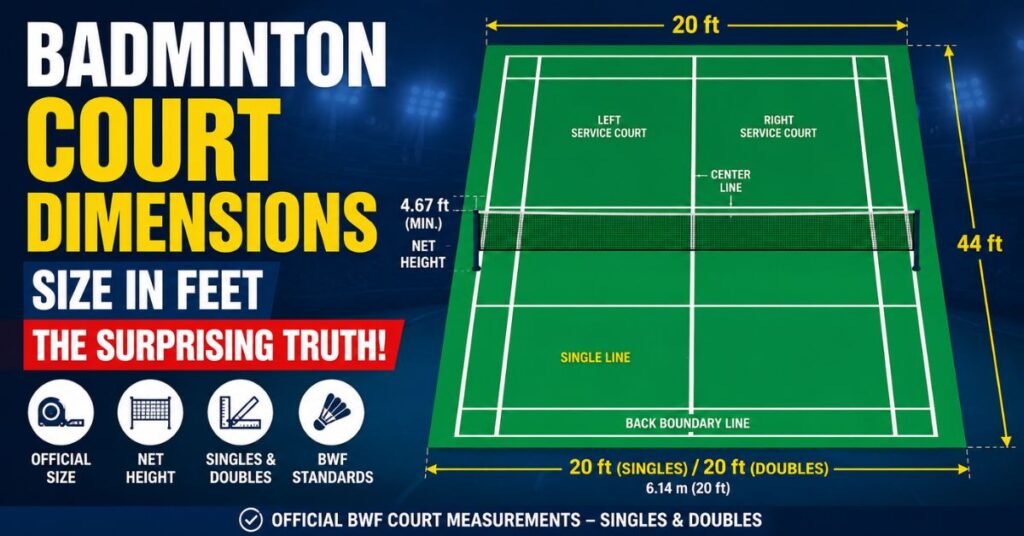
A regulation badminton court measures 44 feet long by 20 feet wide for doubles play, and 44 feet by 17 feet for singles. That’s the official badminton court dimensions set by the sport’s governing body.
If you’ve ever stood on a badminton court and wondered why the sidelines seem to shift depending on whether you’re playing singles or doubles, you’re not imagining things. The badminton court size in feet actually changes shape between formats, and most casual players never notice until they step outside the lines and lose a point.
This guide breaks down every measurement that matters from the full playing area to the short service line, net height, and even ceiling clearance for indoor halls. Most articles online only give you the outer boundary numbers. We’ll also cover something competitors skip: the actual court clearance space required around and above the court for safe, regulation play.
What Is the Standard Badminton Court Size?
The standard badminton court size follows specifications set by the Badminton World Federation (BWF), the sport’s international governing body. Every official badminton court dimensions chart whether for a school gym or an Olympic arena traces back to this single standard.
A full doubles court covers 880 square feet of playing surface. Singles matches use a narrower version of that same rectangle, cutting off about 1.5 feet on each side. This is one of the more confusing parts of badminton court measurements for beginners, since the outer doubles sidelines stay painted on the court even during a singles match they just aren’t in play.
Read More About: Bowling Lane Dimensions Diagram 6 Surprising Facts
Quick Conversion Table
| Unit | Doubles Court | Singles Court |
| Feet | 44 ft x 20 ft | 44 ft x 17 ft |
| Meters | 13.4 m x 6.1 m | 13.4 m x 5.18 m |
| Yards | 14.67 yd x 6.67 yd | 14.67 yd x 5.67 yd |
| Inches | 528 in x 240 in | 528 in x 204 in |
| Centimeters | 1340 cm x 610 cm | 1340 cm x 518 cm |
Quick Reference Table: Court Dimensions at a Glance
| Court Feature | Approx. Measurement | Closeness Score (X/10) | Best Situation/Use |
| Doubles Court Width | 20 feet | 10/10 | Club and tournament doubles |
| Singles Court Width | 17 feet | 10/10 | Tournament singles matches |
| Full Court Length | 44 feet | 10/10 | All match formats |
| Net Height (center) | 5 feet | 9/10 | Regulation net setup |
| Service Court Depth | 6.5 feet approx. | 8/10 | Short-to-long service play |
| Ceiling Clearance | 30 feet recommended | 7/10 | Indoor tournament venues |
Detailed Breakdown of Every Court Section

The Doubles Court (Full Playing Area)
The doubles badminton court dimensions define the largest legal playing surface in the sport: 44 feet long and 20 feet wide. This outer rectangle is marked by the back boundary line and the doubles sideline, and it’s the version used in nearly every professional and club-level doubles match, according to BWF’s official equipment and court specifications.
Knowing this full badminton court width and length matters if you’re building a home or community court, since it determines how much floor space and buffer room you’ll actually need before construction begins.
The Singles Court (Narrower Sidelines)
Singles badminton court dimensions trim the width down to 17 feet, while keeping the same 44-foot length. The doubles sidelines remain painted but simply go unused, which is why singles badminton court size sometimes confuses new players watching the lines during a match.
Key distinction: many players assume singles courts are physically smaller structures, but they’re really just a narrower zone marked inside the same badminton playing area used for doubles.
The Service Courts and Center Line
Each side of the net is split into two service boxes by the center line, with boundaries set by the short service line and the singles or doubles sideline depending on match type. Badminton service court dimensions run roughly 6.5 feet deep from the short service line to the back service line in doubles.
This badminton court layout is critical for scoring a serve landing outside its designated service box, even by an inch, resulting in a fault under official rules.
The Net and Net Posts
The badminton net height stands at 5 feet at the posts and dips slightly to 5 feet at the center, per BWF badminton court dimensions standards. Net posts sit directly on the doubles sidelines, even during singles play, keeping the net dimensions consistent across formats.
Something no competitor explained clearly: the net’s slight center sag (about 2 inches lower than the posts) is intentional, not a setup error, and referees check it before matches begin.
Read More About: Basketball Court Dimensions The Complete Measurement Guide for Homeowners
Court Clearance and Ceiling Height
Beyond the painted lines, regulation badminton court dimensions also require open space above and around the court. BWF recommends a minimum ceiling height of 30 feet for tournament venues, since a lofted shuttlecock can travel higher than most indoor sports flooring setups allow for casual play.
Recreational spaces often use lower ceilings, around 20 feet, which works fine for social games but isn’t suitable for a true regulation badminton court used in competitive events.
The Playing Surface and Flooring
Indoor badminton court size specifications typically pair with wooden badminton court flooring or synthetic badminton flooring designed to reduce joint strain during quick lateral movement. Outdoor badminton court dimensions follow the same line measurements but skip specialized flooring, using concrete or asphalt instead.
Court construction for a home badminton training court often shrinks the surrounding clearance space, even while keeping the official 44-by-20-foot playing area intact a common trade-off for backyard installations.
Where Does This Court Size Appear in Daily Life?

Beyond formal badminton arenas, these badminton court measurements show up in school gyms, community centers, and even converted garages. A regulation badminton court fits inside most standard basketball courts with room for the surrounding clearance zone, which is why many multi-sport facilities mark badminton lines directly on top of existing hardwood flooring.
Read More About: Parking Space Dimensions: The Mistake Most Drivers Make
FAQ’s
What is the badminton court size in feet for doubles?
A doubles badminton court measures 44 feet long by 20 feet wide. This full-width court is used for all official doubles matches, including tournament and Olympic-level play sanctioned by the BWF.
How wide is a singles badminton court?
A singles court is 17 feet wide, narrower than the 20-foot doubles version, while keeping the same 44-foot length. The extra width on each side is only used when doubles are being played.
What is the standard badminton net height?
The badminton net stands 5 feet tall at the posts and dips to about 4 feet 11.6 inches at the center. This slight dip is a regulation feature, not a flaw in setup.
Is the badminton court size the same indoors and outdoors?
Yes, the line measurements stay identical whether the court is indoors or outdoors. What changes is the flooring material and required ceiling clearance, which only applies to indoor venues.
How much space do you need for a home badminton court?
You need at least 44 by 20 feet of clear floor space, plus a few extra feet of buffer on each side for safe movement. Ceiling height should ideally reach 20 feet or more for smooth shuttlecock flight.
Final Thoughts
Understanding the badminton court size in feet makes it much easier to follow match rules, set up a home practice space, or simply watch a game without second-guessing the lines. From the 44-by-20-foot doubles court to the narrower 17-foot singles boundary, every measurement serves a specific purpose in how the game is played.
Whether you’re a coach marking out a school gym or a homeowner converting a garage, sticking close to official badminton court dimensions ensures the space actually plays like the real thing.