
 Abdul Moeed
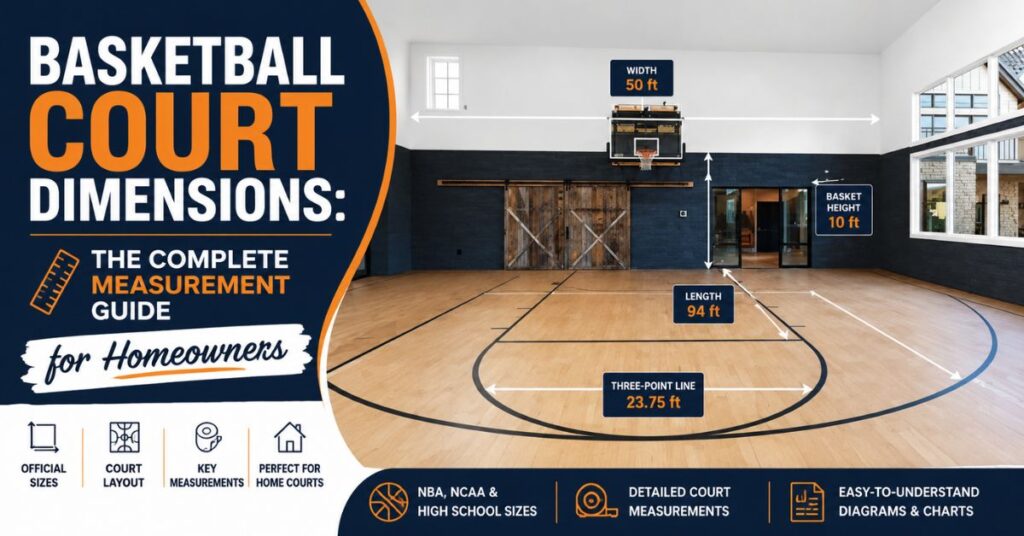
A full NBA basketball court measures 4,700 square feet (94 feet by 50 feet). That single number, though, hides a lot of variation once you look at other leagues and age groups.
This guide breaks down how many square feet a basketball court covers across every major level of play NBA, FIBA, high school, college, youth, and backyard courts. You’ll get exact basketball court measurements in feet and meters, plus the basketball court dimensions in feet for the key, free throw line, and three-point arc.
Most articles stop at the NBA number. What they skip is how much smaller a youth court really is, why FIBA basketball court dimensions differ from NBA ones, and what happens to the standard basketball court size when you shrink it for a driveway. We’ll cover all of that here.
Think about it in everyday terms. A 4,700-square-foot NBA court is roughly the size of eight two-car garages parked side by side, or about the footprint of a modest house measured twice over. A backyard half-court, by comparison, is closer to the size of one large two-car garage combined with a small patio. Seeing the numbers this way makes the gap between “how many square feet is a basketball court” at the pro level versus the driveway level much easier to picture.
Coaches, architects, and parents building a home court all ask some version of the same question: what basketball court size in feet do I actually need for my situation? A school district planning a new gymnasium needs different basketball court specifications than a family measuring a backyard slab, even though both are technically basketball courts. This guide separates those use cases clearly instead of treating every court as identical.
Read More About: Parking Space Dimensions: The Mistake Most Drivers Make
How Big Is a Basketball Court? The Six Main Sizes
Before the detailed breakdown, here’s the short version. When people ask how many square feet is a basketball court, the answer depends entirely on which league or setting they mean:
- NBA court: 4,700 square feet
- FIBA (international) court: roughly 4,520 square feet
- High school court: 4,200 square feet
- College (NCAA) court: 4,700 square feet
- Youth court: around 3,108 square feet
- Backyard half-court: around 2,350 square feet
Each of these uses a different basketball court width and basketball court length, which is why the total square footage shifts so much. The rest of this article walks through where each figure comes from and why it matters.
Quick Conversion Table Basketball Court Dimensions in Feet and Meters
Because basketball court dimensions in meters matter for anyone reading international rules, here’s a quick reference for converting the standard full-court and half-court measurements.
| Measurement | Feet | Meters | Yards | Square Feet |
| NBA full court length | 94 ft | 28.65 m | 31.3 yd | |
| NBA full court width | 50 ft | 15.24 m | 16.7 yd | |
| NBA full court area | 4,700 sq ft | |||
| FIBA full court length | 91.86 ft (28 m) | 28 m | 30.6 yd | |
| FIBA full court width | 49.2 ft (15 m) | 15 m | 16.4 yd | |
| FIBA full court area | ~4,520 sq ft | |||
| Half court (typical) | 47 ft | 14.3 m | 15.7 yd | 2,350 sq ft |
This table shows why comparing basketball court dimensions in feet directly to basketball court dimensions in meters can get confusing. The NBA works in feet, while FIBA basketball court dimensions are defined in meters first, then converted.
Quick Reference Table: Court Sizes Ranked by Closeness to Regulation
| Court Type | Approx. Measurement | Closeness Score (X/10) | Best Situation/Use |
| NBA Court | 94 x 50 ft (4,700 sq ft) | 10/10 | Professional games, televised arenas |
| College (NCAA) Court | 94 x 50 ft (4,700 sq ft) | 10/10 | University athletics, NCAA tournaments |
| FIBA Court | 28m x 15m (~4,520 sq ft) | 9/10 | International and Olympic competition |
| High School Court | 84 x 50 ft (4,200 sq ft) | 8/10 | NFHS varsity and JV games |
| Youth Court | 74 x 42 ft (3,108 sq ft) | 6/10 | Middle school and youth leagues |
| Backyard Half-Court | 47 x 50 ft (2,350 sq ft) | 4/10 | Home driveways, recreational shooting |
The closeness score reflects how near each court type sits to the full official basketball court size used by the NBA. Lower scores don’t mean worse; a smaller court is often exactly right for the players using it.
Detailed Breakdown: 6 Basketball Court Sizes Explained

The NBA Court
An official NBA court measures 94 feet long by 50 feet wide, which multiplies out to 4,700 square feet of playing surface. The NBA rulebook sets this as the standard basketball court size for every arena hosting a regular-season or playoff game. That’s roughly the footprint of eight standard two-car garages laid side by side.
This matters because NBA court dimensions have become the reference point everyone else measures against. When someone says a court is “regulation size,” they usually mean it matches or approaches this 94-by-50 layout, even though several other leagues use slightly different specs.
Every NBA arena, from Madison Square Garden to Crypto.com Arena, uses this identical 4,700-square-foot footprint, which is part of why televised games look so consistent no matter which city is hosting. The league treats this basketball court size as non-negotiable a court built even a few inches short would fail official inspection before a single game could be played there.
The FIBA International Court
FIBA basketball court dimensions are set at 28 meters by 15 meters, which converts to about 4,520 square feet. FIBA, the sport’s global governing body, uses this size for the Olympics, World Cup, and most professional leagues outside the United States. Converting basketball court dimensions in meters to feet gives roughly 91.86 feet long and 49.2 feet wide.
The practical difference shows up mostly at the edges. FIBA courts are slightly shorter and narrower than NBA ones, which changes spacing near the baseline and sideline during international games. Players moving from the NBA to European leagues often mention needing a few games to adjust to the tighter FIBA court measurements.
FIBA also governs the Basketball World Cup and every Olympic tournament, meaning national teams from dozens of countries all practice and compete on this identical international basketball court size. Because FIBA courts run about 180 square feet smaller than NBA courts, spacing for pick-and-rolls and perimeter shooting feels noticeably tighter for American players competing abroad for the first time.
Read More About: Slim Jim Trash Can Dimensions The Surprising Real Sizes
The High School Court
Under NFHS rules, a high school basketball court dimensions standard runs 84 feet by 50 feet, totaling 4,200 square feet. That’s 10 feet shorter than an NBA court but the same width. Many gymnasiums built decades ago still use this size because retrofitting a longer floor means rebuilding the entire gym.
Key distinction: the shorter length isn’t random it reflects that high school players generally cover less ground per possession than college or pro athletes, so the smaller footprint keeps spacing proportional. This is one basketball court comparison most guides skip entirely.
Because so many American gymnasiums were built decades before NCAA and NBA courts settled on 94 feet, thousands of NFHS-sanctioned high schools still play on the shorter 4,200-square-foot layout today. A gym renovation to stretch a court to full 94-foot length often requires knocking out a wall or extending a building’s footprint entirely, which is why most schools simply keep the existing high school basketball court dimensions instead.
More Posts: [How Long Is an NBA Basketball Court in Feet and Meters?]
The College (NCAA) Court
College basketball court dimensions match the NBA almost exactly: 94 feet by 50 feet, or 4,700 square feet of regulation court measurements. The NCAA adopted the longer 94-foot length years after high schools standardized on 84 feet, aligning college play more closely with the professional game.
Where NCAA courts differ from the NBA isn’t in total square footage but in specific markings the three-point line distance and lane width have shifted over the years as the NCAA adjusted rules independently of the NBA. Someone measuring only the outer boundary lines would find identical basketball court measurements between the two levels.
Division I, II, and III programs all follow the same 94-by-50 standard, meaning a mid-major college gym and a major conference arena share identical basketball court dimensions in feet even though attendance and production value differ enormously. This consistency helps players transition smoothly from college basketball straight into the NBA without needing to adjust to a new playing surface size.
The Youth Court
Youth basketball court size varies by organization, but a common recommendation from USA Basketball for younger age groups is 74 feet by 42 feet, or about 3,108 square feet. This scaled-down layout keeps the court proportional to shorter players and slower ball movement, especially for players under age 12.
Something no competitor explained clearly: the reduction isn’t just length; the width often shrinks too, which changes basketball lane dimensions and free throw line distance for younger players. A youth free throw line typically sits closer to the basket than the standard 15 feet used at higher levels, making basketball court planning for youth gyms genuinely different from simply shrinking an adult court.
Recreation departments and YMCA leagues frequently paint these smaller dimensions directly onto a full-size gym floor using different colored lines, letting one gymnasium serve both adult leagues and youth basketball court size needs without building a separate facility. This overlapping-lines approach is common in multi-purpose gyms across the country and explains why a single gym floor sometimes looks like it has two or three courts stacked on top of each other.
The Backyard or Outdoor Recreational Court
Backyard basketball court dimensions vary the most of any category because homeowners build to fit available space. A common outdoor basketball court dimensions choice for a half-court driveway setup is 47 feet by 50 feet, covering about 2,350 square feet exactly half of a regulation full court. Some homeowners go smaller, using a 30-by-30-foot pad for casual shooting.
Indoor basketball court dimensions for home gyms tend to be even more compact, sometimes under 1,000 square feet, focused on a single hoop and free throw area rather than full-court play. Anyone doing basketball court planning for a home installation should measure available square footage first, then choose hoop height and lane markings that fit proportionally.
Contractors building recreational basketball court surfaces for homeowners often recommend adding at least 5 to 10 extra feet of buffer space beyond the playing lines on every side. That buffer keeps players from running into fences, landscaping, or parked cars when chasing a loose ball, and it’s a detail that basketball court construction guides frequently leave out of their basic square footage recommendations.
Where Does a Basketball Court’s Layout Come From? Key Markings Explained

Beyond the outer boundary lines, every regulation basketball court shares a similar basketball court design, even when total square footage differs. Understanding this layout helps explain basketball court markings that often confuse first-time viewers.
At center, the center circle (also called the jump circle) marks where the game begins with a jump ball. Moving toward each end, the free throw circle sits at the top of the key, also known as the lane or painted area; this rectangular zone under the basket is where three-second violations get called. NBA lane width is 16 feet; college and high school lanes are narrower.
The restricted area is a small semicircle directly under the basket, used to judge charging and blocking calls. Around the perimeter, the three-point arc curves from one sideline to the other, with the three-point line distance ranging from about 22 feet in the corners to 23.75 feet at the top for the NBA, and shorter distances for high school and youth play.
Standard hoop height is 10 feet at every level from high school through the NBA, mounted on a backboard measuring 6 feet wide by 3.5 feet tall, with a rim diameter of 18 inches. Youth leagues often lower the basketball goal to 8 or 9 feet. Court flooring materials also vary; hardwood basketball court surfaces are standard indoors, while acrylic outdoor court coatings handle weather for backyard and park installations. Whether it’s a full gymnasium court, a school athletic facility, or a portable basketball hoop in a driveway, these markings and court safety zones stay proportionally consistent with the space available.
Basketball court blueprint drawings used by architects typically start with the outer boundary lines, then work inward: sideline and baseline first, then the key, then the free throw circle, and finally the three-point arc. This layered basketball court layout means a designer can scale an entire regulation basketball court down for a smaller gym without breaking the proportional relationship between the lane, the free throw line, and the hoop. It’s also why basketball court lines explained in one league’s rulebook usually still make sense when compared side by side with another league’s diagram.
Read More About: 25 Food Can Dimensions Common Can Sizes in Inches and Centimeters
How a Basketball Court Compares to Other Common Sports Court Measurements

Basketball court dimensions look large in isolation, but they’re actually mid-sized compared to other indoor sports courts. An NBA basketball court’s 4,700 square feet is noticeably bigger than a regulation volleyball court, which covers about 1,800 square feet. It’s smaller, though, than a full ice hockey rink, which typically runs around 17,000 square feet more than three and a half times the size of a basketball playing surface.
Compared to a tennis court, which measures about 2,808 square feet for singles play, an NBA basketball court is roughly 67% larger. This kind of basketball court comparison helps put the standard basketball court size into perspective for anyone converting a multi-purpose gym or outdoor athletic facility design between sports, since flooring, boundary lines, and safety zones all need to be re-measured for each use.
FAQ’s
Is 30×30 big enough for a basketball court?
No. A 30×30-foot area is too small for a full basketball court but can work for a single hoop or half-court practice and shooting drills.
How many sq ft is a basketball court?
A standard full basketball court measures 94 × 50 feet, totaling 4,700 square feet. High school courts are often 84 × 50 feet, or 4,200 square feet.
How many sqft is in an NBA?
An official NBA court covers 4,700 square feet. It measures 94 feet long and 50 feet wide.
Why is a basketball court 94 ft?
The 94-foot length was standardized to provide enough space for fast-paced play while balancing offense and defense. It has been the NBA regulation court size for decades.
Final Thoughts
So, how many square feet is a basketball court? The honest answer is “it depends on the level,” ranging from 4,700 square feet for NBA and college courts down to roughly 2,350 square feet for a typical backyard half-court. FIBA, high school, and youth courts each land somewhere in between, shaped by basketball court width, basketball court length, and the age or skill level of the players using them.
Whether you’re comparing regulation basketball court specifications for a school gym or measuring a driveway for a portable hoop, matching the square footage to the actual use case matters more than chasing NBA-sized numbers. Start with your available space, then scale the key, free throw line, and three-point arc proportionally from there.
If you’re planning new construction, remember that total square footage is only the starting point. Basketball court construction also depends on ceiling height for indoor gyms, drainage and surface material for outdoor courts, and enough buffer space around the boundary lines to keep players safe during fast breaks. A youth court built at 3,108 square feet doesn’t need NBA-level clearance, but a full 4,700-square-foot college or NBA court absolutely does, since players are covering more ground at higher speeds.