Kitchen Trash Can Dimensions: Complete Size Guide for Every Home
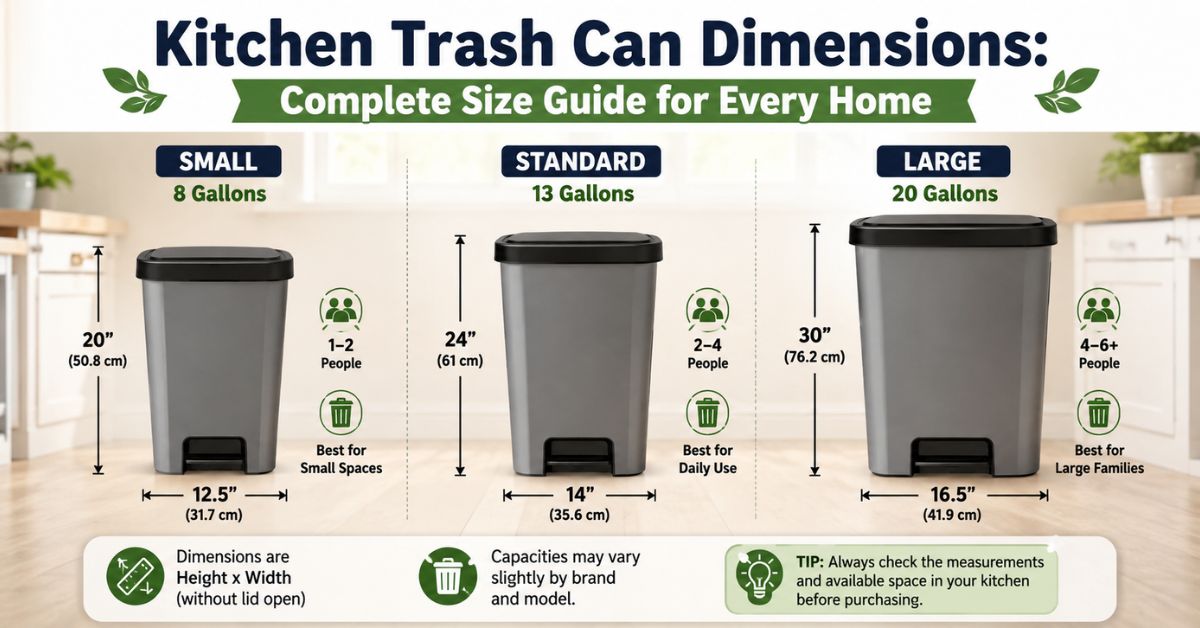
A standard kitchen trash can holds 13 gallons and measures roughly 25 inches tall, 15 inches wide, and 11.5 inches deep the most common size found in American kitchens.
But “standard” doesn’t mean “right for you.” A studio apartment kitchen and a family home with five people have very different waste needs, and a trash can sizes chart makes that comparison easy instead of guessing at the store. This guide breaks down kitchen trash can dimensions across six real, commonly sold styles from tiny under-sink bins to large dual-compartment models so you can match the container to your cabinet space, your household size, and your trash bag budget.
Most articles on this topic just list a single “standard size” and stop there. What they skip is how depth and width matter just as much as height when a bin has to fit into a narrow cabinet gap or slide under a sink without hitting the pipes. We’ll cover that here, along with trash bag compatibility, capacity in real-world terms, and how kitchen trash can dimensions compare to other household waste bins.
Think about the last time you shopped for a kitchen garbage bin. Maybe you measured the corner of your kitchen, walked into a store, and picked up a box that looked about right only to get home and find the lid hit the underside of a cabinet, or the bin barely fit between the fridge and the wall. That’s the exact problem a proper trash can measurements guide is supposed to prevent. Kitchen bin dimensions aren’t one-size-fits-all, and the difference between a 10-gallon and a 20-gallon kitchen trash can can mean several extra inches in every direction.
This guide is built specifically for people comparing options before a purchase, a kitchen remodel, or a small apartment move.Kitchen Trash Can Dimensions We’ll walk through six real trash can styles sold today, show their exact measurements side by side, and explain which kitchen layout each one solves best. Whether you’re outfitting a tiny galley kitchen or a large family home, you’ll walk away knowing exactly which numbers to check before you buy.
How Big Is a Kitchen Trash Can?
Kitchen trash cans in the U.S. generally range from 2 gallons to 20+ gallons, with the bulk of household models falling between 10 and 13 gallons. Height typically runs 20 to 28 inches, while width and depth vary more widely depending on whether the can is rectangular, round, or slim.
Three measurements matter most when shopping from a trash can sizes chart:
- Height determines whether the lid clears an overhead cabinet or counter lip.
- Width and depth determine whether the bin fits a corner, a cabinet interior, or a narrow gap between appliances.
- Capacity (gallons or quarts) determines how often you’ll be taking out the trash and which liner size to buy.
Kitchen organization experts and home organization publications like The Container Store and Real Simple regularly note that mismatched trash can dimensions are one of the most common kitchen layout mistakes homeowners make during a kitchen remodel.
There’s also a fourth measurement people forget: lid clearance, meaning the extra space a swing-lid or step-on lid needs to open fully. A bin that technically fits a cabinet niche can still be unusable if the lid can’t lift without hitting a shelf above it. When you’re comparing indoor trash can dimensions on a product page, always check whether the listed height includes the lid in the open or closed position manufacturers aren’t consistent about this, and it’s one of the most common return reasons for kitchen trash containers bought online.
Trash can capacity also isn’t purely about volume. A tall, narrow 10-gallon bin and a short, wide 10-gallon bin hold the same amount of household waste, but they behave very differently in daily use. Narrow bins fill up faster near the top and can topple more easily, while wide bins distribute weight better but need more floor footprint. Keeping both capacity and physical footprint in mind not just the gallon number on the box is the real key to picking the right kitchen waste bin size.
Read More: Jerry Can Sizes 6 Surprising Dimensions You’re Probably Guessing Wrong
Quick Conversion Table Trash Can Capacity Across Units
| Gallons | Liters | Quarts | Cubic Feet | Cubic Inches |
| 2 gal | 7.6 L | 8 qt | 0.27 ft³ | 462 in³ |
| 8 gal | 30.3 L | 32 qt | 1.07 ft³ | 1,848 in³ |
| 10 gal | 37.9 L | 40 qt | 1.34 ft³ | 2,310 in³ |
| 13 gal | 49.2 L | 52 qt | 1.74 ft³ | 3,003 in³ |
| 20 gal | 75.7 L | 80 qt | 2.67 ft³ | 4,620 in³ |
This conversion table is useful when comparing U.S. trash can dimensions to European or Canadian bins, which are frequently labeled in liters rather than gallons.
Quick Reference Chart: Common Kitchen Trash Can Sizes
| Trash Can Type | Approx. Dimensions (H x W x D) | Closeness Score (Household Fit) | Best Situation |
| Standard 13-Gallon Rectangular | 25″ x 15″ x 11.5″ | 9/10 | Average family kitchen |
| 10-Gallon Slim | 24″ x 8.75″ x 20″ | 8/10 | Narrow gaps, small kitchens |
| 20-Gallon Large/Dual | 27″ x 16″ x 14.5″ | 7/10 | Large families, heavy cooking |
| Under-Sink Compact (2.6 gal) | 10″ x 9″ x 7″ | 6/10 | Small apartment storage |
| Pull-Out Cabinet Dual Bin | 21″ x 15″ x 18″ | 8/10 | Hidden waste + recycling |
| Round 13-Gallon | 25″ x 13″ (diameter) | 7/10 | Corners, tight floor space |
Common Kitchen Trash Can Sizes and Dimensions
1. The Standard 13-Gallon Kitchen Trash Can
The most widely sold kitchen trash can size in the U.S. holds 13 gallons and measures about 25 to 26 inches tall, 15 inches wide, and 11.5 inches deep. Brands like Simplehuman and Rubbermaid build entire product lines around this exact standard kitchen trash can size because it matches the most common trash bag size sold at Target, Walmart, and grocery chains nationwide. Most step-on and touchless kitchen trash can models default to this footprint.
This size works for households of two to four people who take out the trash every two to three days. It’s the safest default if you’re shopping without knowing your exact space constraints, since kitchen cabinet trash can inserts and freestanding floor models are both commonly built around 13-gallon dimensions.
The 13-gallon standard also dominates the trash liner size market. Walk down the household essentials aisle at any major retailer and you’ll notice “tall kitchen bag” is almost always printed on boxes sized specifically for this can usually listed as fitting 13 to 16 gallon bins with dimensions around 24 x 27 inches when flat. That consistency is a real practical advantage: you’re never stuck hunting for an odd-sized liner, and multi-packs are cheaper per bag than specialty sizes.
Placement matters too. Because a standard 13-gallon rectangular kitchen trash can needs roughly 15 inches of width and close to 12 inches of depth, it typically anchors in a corner, beside a base cabinet, or inside a pantry nook. If your kitchen layout has at least a 16 x 13-inch open footprint near the sink or prep area, this size will almost always work without modification.
2. The 10-Gallon Slim Kitchen Trash Can
A slim kitchen trash can trades width for height, typically measuring 23 to 24 inches tall, 8.75 inches wide, and 20 inches deep. This shape holds roughly 10 gallons but fits into narrow spaces beside a refrigerator, in a tight galley kitchen, or against a cabinet end panel where a standard rectangular bin simply won’t fit. Simplehuman’s slim step trash can line popularized this compact kitchen trash can profile.
The tradeoff is that a slim trash can needs emptying slightly more often than a full-width 13-gallon model, since the total trash can capacity is lower even though the height looks similar. It’s a strong pick for small apartment storage where floor space is scarce but wall height is available.
Slim models are also popular for households that recycle heavily and want two side-by-side bins without eating up an entire wall..Kitchen Trash Can Dimensions Placing two 8.75-inch-wide slim cans next to each other takes up roughly the same width as one standard 15-inch rectangular can, but doubles your sorting capacity for household waste versus recycling and composting. This makes slim trash bin dimensions a favorite in modern kitchen designs where dual-stream waste sorting is built into the layout from the start.
One detail often missed: slim cans require a specific narrow trash liner size, usually labeled 10 to 12 gallon “slim” or “tall kitchen” bags with a taller-than-wide shape. Using a standard 13-gallon bag in a slim can leaves excess plastic bunching at the top, which looks messy and can catch on the lid mechanism over time.
3. The 20-Gallon Large Kitchen Trash Can
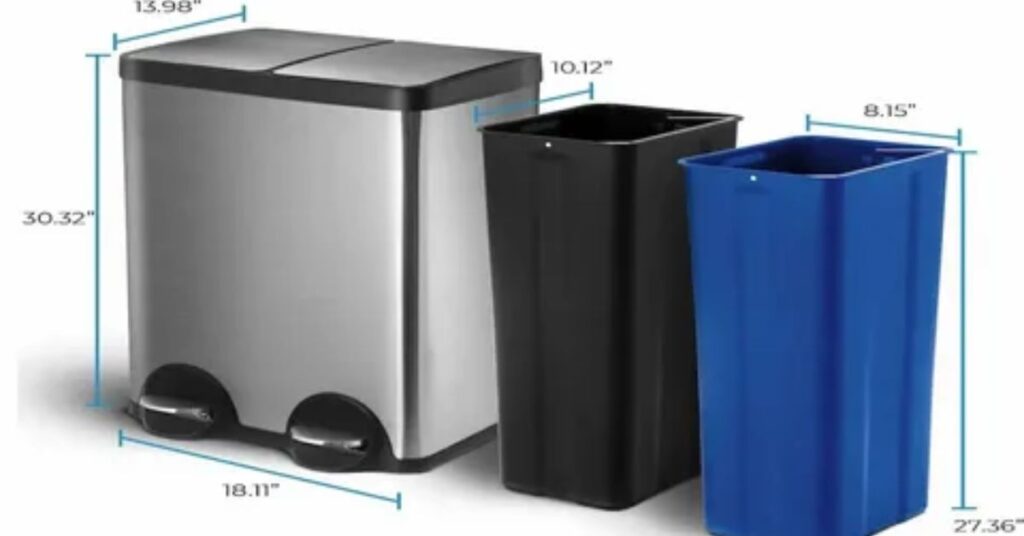
For bigger households, a large kitchen trash can holds 20 gallons or more, with dimensions around 27 inches tall, 16 inches wide, and 14.5 inches deep. Many 20-gallon kitchen trash can models are actually dual compartment trash can designs, splitting the interior into two 10-gallon sections one for general waste and one for recycling and composting.
Families of five or more, or households that cook frequently and generate more food waste, benefit from this size because it reduces how often bags need changing. Key distinction: unlike smaller bins, most 20-gallon models require a specific extra-large trash liner size rather than the standard tall kitchen bag, so check trash bag compatibility before buying.
Weight is another factor people underestimate with a large kitchen trash can. A fully loaded 20-gallon bin of food scraps and packaging can weigh 25 to 35 pounds, which is noticeably heavier than a full 13-gallon bin at 15 to 20 pounds..Kitchen Trash Can Dimensions If mobility matters say, you’re carrying the bag down a flight of stairs to outdoor residential trash bins a dual compartment trash can that splits 20 gallons into two smaller 10-gallon bags can actually be easier to manage than one giant liner, even though the outer trash can dimensions stay the same.
Because of the larger footprint, this size is less common in apartments and more common in single-family homes with dedicated kitchen storage solutions like a pantry corner or laundry-adjacent utility space. Before buying, measure both the floor footprint (16 x 14.5 inches) and the vertical clearance (27+ inches) to make sure nothing overhead a counter overhang, upper cabinet, or shelf blocks the lid.
4. The Under-Sink Compact Trash Can
Under sink trash can size is intentionally small to work around plumbing typically 9 to 11 inches tall, 8 to 9 inches wide, and 6 to 7 inches deep, holding about 2 to 3 gallons. These compact bins are designed to sit inside a cabinet next to the drain trap rather than take up open floor space, making them popular in small apartment storage setups and secondary kitchen prep stations.
Something no competitor explained: under-sink models need at least 2 inches of clearance on every side to avoid contact with pipes, garbage disposal units, or cabinet hinges a detail rarely mentioned in general kitchen storage solutions guides but critical for a proper cabinet dimensions check before purchase.
Because base cabinets under a sink are rarely perfectly rectangular once you account for the drain trap, water supply lines, and any garbage disposal wiring, it helps to measure in three separate zones rather than one block: the open floor space to the left of the pipes, the space to the right, and the vertical clearance to the bottom of the sink basin. Most under-sink trash cans are designed as slim rectangular buckets specifically so they can tuck into whichever of those zones is largest.
This compact kitchen trash can style is rarely a household’s only bin it’s typically a secondary container for quick scraps while cooking, paired with a larger 13-gallon can elsewhere in the kitchen. Because of the small trash can capacity, it needs emptying daily in an active kitchen, which is a tradeoff worth knowing before relying on it as a primary waste bin.
Read More: 24 Inches 6 Surprising Things That Are This Size
5. The Pull-Out Cabinet Trash Can
A pull-out trash can dimensions profile is built to slide on a track inside a base cabinet, usually measuring 20 to 22 inches tall, 14 to 15 inches wide, and 17 to 18 inches deep to accommodate one or two bins side by side. These dual-bin cabinet trash can systems, made by brands like Rev-A-Shelf, are popular in modern kitchen remodels because they hide waste completely from view and free up countertop space.
Because these units mount inside existing cabinetry, the trash can dimensions must be measured against your actual cabinet interior not just the can itself including door swing clearance..Kitchen Trash Can Dimensions This makes them less flexible than freestanding trash can options but far better for kitchen layout aesthetics.
Installation typically requires a base cabinet at least 15 inches wide internally, with the sliding track mounted to the cabinet floor or side panels. Most kitchen remodel professionals recommend measuring the cabinet’s interior width at its narrowest point often near the hinges or a center stile rather than the outer cabinet door width, since that narrower measurement determines whether the bin assembly will actually slide freely.
Pull-out systems are especially popular for households that want to separate general waste from recycling and composting without extra bins cluttering the counter or floor. Because the two-bin trays sit side by side inside one pull-out frame, total trash can capacity is usually split evenly between two 17.5-quart (about 4.4-gallon) bins for a combined 35-quart, or roughly 8.75-gallon, system..Kitchen Trash Can Dimensions That’s smaller than a single 13-gallon standalone can, so larger households sometimes pair a pull-out system with a secondary freestanding bin for overflow.
6. The Round Kitchen Trash Can
Round trash can dimensions typically list a 13-inch diameter and 25-inch height for a 13-gallon capacity, though smaller 8-gallon round bins run closer to 11 inches in diameter and 22 inches tall. The circular shape fits corners and awkward angles better than a rectangular trash can dimensions layout, which is why round bins are common in older homes with less standardized kitchen layout dimensions.
Stainless steel trash can versions of this shape are popular for their fingerprint-resistant coatings and step-on lid mechanisms. The main downside compared to rectangular kitchen waste container designs is slightly reduced trash bag compatibility, since round liners are sold in fewer size variations at most grocery and home stores.
Round bins also tend to be the default choice in kitchens with limited straight-wall space but generous corner space a common layout in older homes built before open-concept kitchen design became standard..Kitchen Trash Can Dimensions Because a round trash can’s diameter is its widest single measurement, it’s often easier to visually estimate fit in an irregular room than a rectangular bin, where you need to account for both width and depth simultaneously.
For anyone comparing a round versus rectangular trash can dimensions for the same 13-gallon capacity, expect the round version to take up a slightly smaller footprint on paper (roughly 133 square inches for a 13-inch diameter circle versus about 173 square inches for a 15 x 11.5-inch rectangle) but slightly less usable width for stacking flattened boxes or larger trash items against the inside wall.
How Kitchen Trash Can Dimensions Compare to Other Household Waste Bins
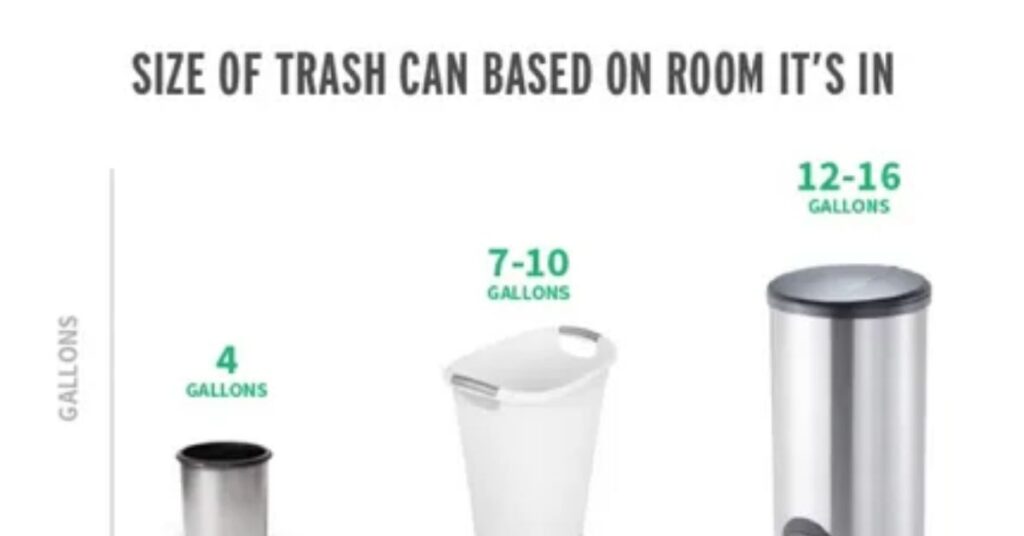
Outdoor residential trash bins dwarf kitchen models, typically holding 32 to 96 gallons and standing 36 to 46 inches tall three to four times the capacity of even a large kitchen trash can. Bathroom bins sit at the opposite end, usually under 2 gallons with dimensions closer to 8 inches tall and 6 inches wide. Office trash cans commonly split the difference at 5 to 7 gallons.
Understanding this range helps when planning household waste collection systems: a single 13-gallon kitchen bin paired with a 32-gallon outdoor bin covers most single-family homes, while apartments often rely on smaller kitchen units paired with shared building disposal.
Recycling bin dimensions specifically tend to mirror whatever kitchen trash can size a household already owns, since most people prefer matching sets for a cleaner kitchen accessories look..Kitchen Trash Can Dimensions A household running a standard 13-gallon kitchen trash can will typically pair it with a similarly sized 13-gallon recycling bin, while a pull-out cabinet trash can system usually integrates recycling directly into the second compartment rather than using a separate freestanding container.
How to Measure Trash Can Dimensions Without a Tape Measure
If you’re standing in a store aisle without a tape measure, a few household reference points can get you close enough to judge fit. A standard sheet of printer paper is 11 inches long useful for estimating a bin’s depth..Kitchen Trash Can Dimensions A dollar bill measures 6.14 inches long, handy for smaller measurements like under-sink clearance. Most kitchen chairs sit about 18 inches from floor to seat, giving a rough height benchmark for comparing taller bins.
For width, your own forearm from elbow to wrist averages 10 to 11 inches for most adults close enough for a quick gut check against a cabinet opening. None of these substitute for an actual tape measure when making a final purchase, but they’re reliable enough to rule out obviously wrong sizes before you commit to a cart.
Smartphone measurement apps, which use a phone’s camera and augmented reality sensors, have also become a common workaround. While not perfectly precise, most are accurate within half an inch close enough for comparing kitchen bin dimensions against a cabinet or corner space in real time while shopping.
Read More: Magazine Dimensions 6 Surprising Sizes You’re Guessing Wrong
FAQ’s
What are the sizes of trash cans?
Trash cans commonly range from 3 to 32 gallons (11–121 liters) for household use. The most popular kitchen size is 13 gallons (49 liters).
What are the 4 types of waste bins?
The four common waste bins are general waste, recycling, organic/compost, and hazardous waste bins. They help separate waste for proper disposal and recycling.
What are standard bin sizes?
Standard household bin sizes include 5L, 10L, 20L, 30L, 50L, and 60L, while outdoor bins are often 120L or 240L. The right size depends on your household and usage.
How big is a 20 L garbage can?
A 20-liter garbage can typically measures about 16–20 inches (40–50 cm) tall and 10–12 inches (25–30 cm) wide. Exact dimensions vary by brand and shape.
What is the standard kitchen trash can size?
The standard kitchen trash can size is 13 gallons, measuring approximately 25 inches tall by 15 inches wide by 11.5 inches deep. This size matches the most widely available trash bag size in U.S. stores, making it the default choice for most household waste bins.
How do I measure a trash can without a tape measure?
Use a standard piece of printer paper (11 inches long) as a rough guide, or compare the bin visually to a kitchen chair seat, which typically sits 18 inches off the ground. For accurate kitchen trash can dimensions, however, a tape measure remains the most reliable option before a purchase.
What size trash can fits under a kitchen sink?
Under-sink trash cans typically measure 9 to 11 inches tall and hold 2 to 3 gallons, small enough to clear plumbing and garbage disposal units. Always measure the actual cabinet interior first, since pipe placement varies by kitchen.
Is a 13-gallon trash can a lot for one person?
For a single person, a 13-gallon trash can is often more than needed, typically lasting 4 to 7 days before requiring a bag change. A 10-gallon slim kitchen trash can or an 8-gallon round model is usually a better space-saving trash can fit for solo households.
What’s the difference between trash can capacity and trash can dimensions?
Capacity measures volume in gallons or liters, while dimensions measure physical height, width, and depth. Two bins can share the same 13-gallon capacity but have very different footprints a slim tall model versus a wider, shorter one so a trash can sizes chart should always list both.
What size trash can fits a small apartment kitchen?
A 10-gallon slim trash can or an 8-gallon round bin usually fits small apartment kitchens best, since both prioritize a narrow footprint over raw capacity. Look for models under 9 inches wide if floor space is limited near cabinets or appliances.
How much clearance does a step-on trash can lid need?
Most step-on lids need 3 to 5 inches of clearance above the can to swing fully open without hitting a countertop or cabinet. Always check the manufacturer’s listed “open height,” not just the closed measurement, before placing the bin under any overhang.
Final Thoughts
From the compact under-sink bin to the 20-gallon dual compartment model, kitchen trash can dimensions vary far more than most shoppers expect. The standard 13-gallon rectangular can remains the safest default for average households, while slim, round, pull-out, and large-capacity options each solve a specific space or family-size problem.
Every kitchen has its own quirks a tight corner, a cabinet with plumbing in the way, a family that generates more waste than average and the right bin comes down to matching those quirks against real numbers rather than guessing. That’s the whole point of a trash can sizes chart: it turns a vague sense of “something that’ll fit” into an actual measurement you can check against your kitchen before you buy.
Using a trash can sizes chart before buying rather than guessing at the store saves a returned box and a mismatched cabinet fit. Measure your space first, match it against the dimensions above, and pick the trash bag size that pairs with your final choice.