
 Abdul Moeed
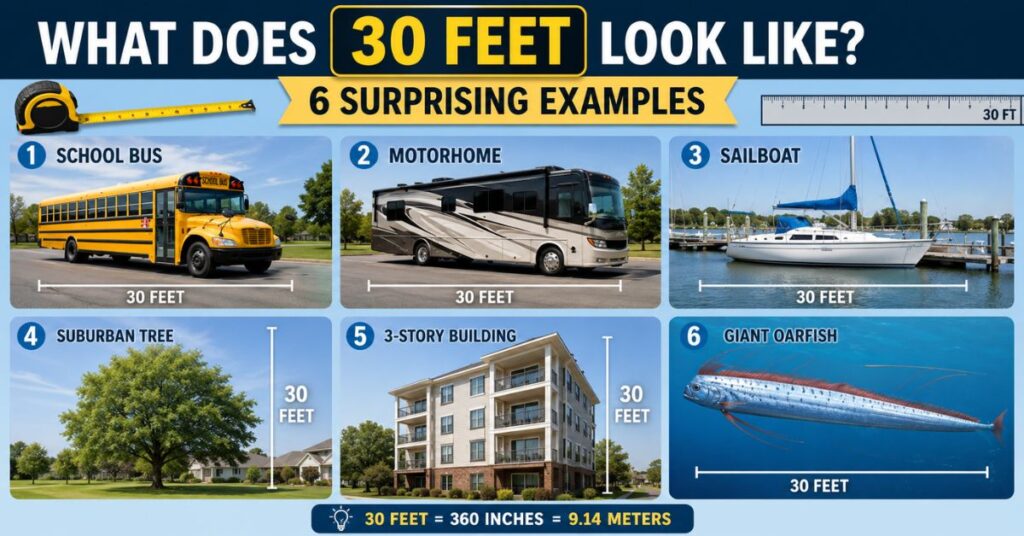
30 feet equals 360 inches, 10 yards, or about 9.14 meters roughly the length of a small travel trailer or two mid-size cars parked bumper to bumper. That’s the short answer, but numbers on a page rarely tell the full story.
This guide breaks down what does 30 feet look like using everyday objects you’ve probably stood next to without realizing the measurement. We’ll compare 30 feet to a killer whale, a utility pole, a three-story building, and a few other things most people walk past daily. Most size guides stop at a single comparison; this one gives you six, plus a conversion chart and a reference table, so you can picture 30 feet in whatever context you need construction, travel, sports, or just settling an argument with a friend.
By the end, you’ll have a solid mental ruler for 30 feet that doesn’t require pulling out a tape measure.
How Big Is 30 Feet?
Thirty feet sits right between “big enough to notice” and “small enough to fit on a suburban lot.” It’s longer than most living rooms but shorter than a basketball court. Understanding 30 feet distance in practical terms helps with everything from parking an RV to estimating how far away a car is on the road.
For a length comparison that actually sticks, it helps to anchor the number to something physical. A 30 ft measurement is close to the height of a three-story building or the length of a large recreational vehicle both of which most Americans have seen up close.
Read More: Beer Can Label Dimensions Explained: Size Chart for Every Can
Quick Conversion Table
| Unit | Equivalent to 30 Feet |
| Inches | 360 in |
| Yards | 10 yd |
| Meters | 9.14 m |
| Centimeters | 914.4 cm |
| Millimeters | 9,144 mm |
| Miles | 0.00568 mi |
Whether you’re working in the imperial system for a home project or need the metric conversion for an international spec sheet, this chart covers the basics of 30 feet in meters, inches, and cm without any extra math.
Quick Reference Table
| Object | Approx. Measurement | Closeness Score (X/10) | Best Situation/Use |
| Travel trailer/RV | 28–30 ft | 9/10 | Road trips, camping |
| Wooden utility pole | 30–35 ft | 8/10 | Neighborhood streets |
| Adult orca (killer whale) | Up to 32 ft | 8/10 | Marine wildlife comparison |
| Two mid-size cars, end to end | ~30 ft | 9/10 | Parking lots, driveways |
| Half a bowling lane | 30 ft | 10/10 | Indoor distance reference |
| Three-story building | 30–33 ft | 8/10 | Urban height comparison |
Everyday Objects That Are 30 Feet Long or Tall
A Travel Trailer or Small RV

Many popular travel trailers, including several Airstream and Jayco models, run close to 28 to 30 feet from hitch to bumper. This size hits a sweet spot for road trips because it’s long enough to sleep a family but still fits in most standard campground spots and highway lanes without needing special permits.
This matters practically because RV length limits vary by state, and a 30-foot trailer is usually the largest size drivers can tow without extra licensing hassle. If you’re picturing 30 feet visualized as a moving object, a trailer rolling down the highway is one of the clearest everyday examples.
A Wooden Utility Pole

Standard wooden utility poles used by power companies across the U.S., often rated Class 5 under American National Standards Institute (ANSI) specifications, are commonly 30 to 35 feet tall, with about 6 feet buried underground for stability. You’ll spot these lining almost every residential street in the country.
Key distinction: unlike most objects on this list, a utility pole shows 30 feet as a vertical distance rather than a horizontal one, which makes it a useful height comparison when picturing 30 feet standing straight up instead of laid flat.
Read More: How Far Is 20 Feet Visually? The Surprising Truth
An Adult Orca (Killer Whale)

According to NOAA Fisheries, adult male orcas can reach lengths of up to 32 feet, making them one of the largest animals that naturally approaches the 30-foot mark. Females are typically smaller, averaging closer to 23 to 28 feet.
This is a favorite in size comparison content because it’s dramatic and memorable few people expect an animal to stretch nearly as long as a city bus lane. It’s also a solid example when explaining how far is 30 feet in a way that isn’t tied to construction or vehicles.
Two Mid-Size Cars Parked Bumper to Bumper

The average mid-size sedan, such as a Toyota Camry or Honda Accord, measures roughly 15 feet from front to back. Line up two of them nose to tail in a parking lot, and you’ve got almost exactly 30 feet.
Something no competitor explained: this comparison works especially well for estimating distance in parking lots or driveways, since most drivers already have an intuitive sense of a single car’s length. Doubling that mental image is an easy way to estimate 30 feet without pulling out a measuring tape.
Half a Bowling Lane

A regulation bowling lane, as defined by the United States Bowling Congress, measures 60 feet from the foul line to the head pin. Split that distance exactly in half, and you land on 30 feet the same distance as the “arrows” markers many bowlers use to aim their shots.
For anyone who’s ever bowled, this gives an instant, physical sense of the distance. It’s one of the more precise everyday objects 30 feet long comparisons available, since bowling lane dimensions are standardized nationwide.
A Three-Story Building

Most residential and light commercial buildings allocate about 10 feet per floor, including ceiling height and structural space between levels, per general guidance used in U.S. building codes. Stack three stories, and the building reaches roughly 30 to 33 feet tall.
This 30 foot height comparison is especially useful in urban or suburban settings, where a three-story apartment building or small office is common on almost every block. It gives a fast way to judge building height comparison without needing blueprints.
Where Does 30 Feet Appear in Daily Life?
Thirty feet shows up more often than most people notice. It’s roughly the distance a basketball free-throw shooter stands from a wall behind the hoop, the width of a two-lane residential street including curbs, and a common setback distance required between a house and the property line in many U.S. zoning codes.
Construction and home improvement projects frequently use 30-foot measurements too a standard extension ladder often reaches close to 28 to 32 feet, and many above-ground pool decks are built around a 30-foot diameter. Once you start looking, this measurement guide’s reference points pop up constantly in outdoor measurements and everyday scale comparison.
Read More: How Tall Is 80 Feet? 6 Surprising Everyday Examples
FAQ’s
What does 30 feet look like compared to a person?
30 feet is about five times the height of an average adult, since most people stand between 5 and 6 feet tall. Picture five people stacked head to toe, or roughly the height of a three-story building, to visualize this human height comparison.
How long is 30 feet in a car length?
30 feet equals about two mid-size sedans parked end to end, since the average car measures close to 15 feet long. This makes parking lots one of the easiest places to spot a real-world 30-foot distance.
How far is 30 feet in steps?
30 feet is roughly 10 to 12 average adult walking steps, based on a typical stride length of about 2.5 to 3 feet. This is a handy way to estimate 30 feet outdoors without a measuring tape.
What is 30 feet in meters?
30 feet converts to approximately 9.14 meters. This 30 feet in meters conversion is useful for international travel, home renovation specs, or comparing measurements with metric-system countries.
Is 30 feet a lot for a room or yard?
30 feet is considered a generous distance for most residential spaces, since it exceeds the length of a typical living room and covers a sizable chunk of an average suburban backyard. It’s large enough to comfortably fit a small pool, patio, or garden bed.
Final Thoughts
From a travel trailer rolling down the highway to an orca cruising through coastal waters, these six examples show that 30 feet is a surprisingly common measurement once you know where to look. Whether you needed 30 feet in meters for a project spec or just wanted a mental image for a road trip trailer, this length comparison guide covers the everyday objects that make the number easier to picture.
The next time someone asks what does 30 feet look like, you’ll have six solid, real-world answers ready no measuring tape required.