
 Abdul Moeed
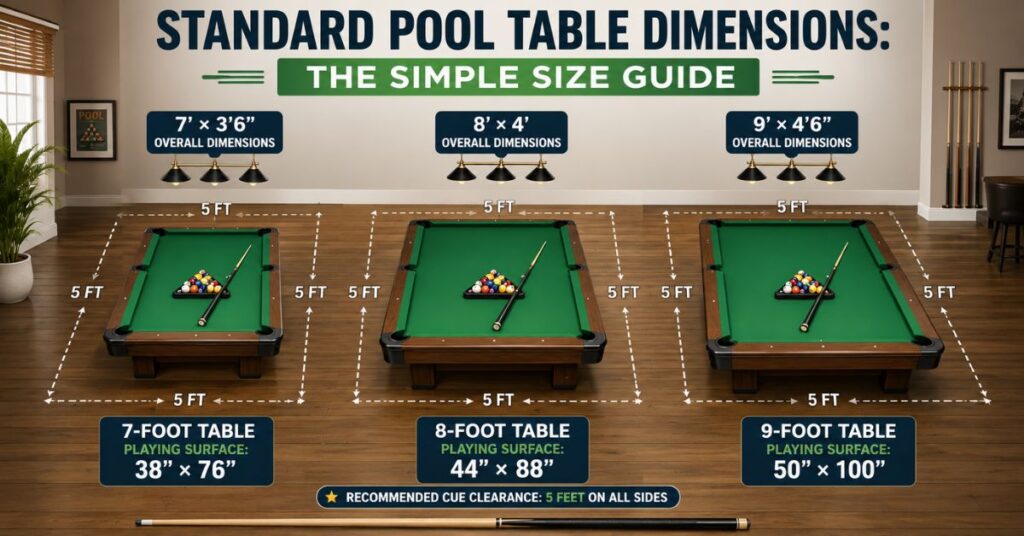
A standard pool table measures 8 feet long and 4 feet wide, with a playing surface of roughly 44 by 88 inches. That’s the most common size found in homes, bars, and rec rooms across the country. Standard pool table dimensions actually shift depending on the table type, ranging from compact 6-foot models to full 9-foot tournament tables.
This guide breaks down every common pool table size, from the small bar-box tables squeezed into apartments to the 9-foot tables used in professional competition. You’ll see exact lengths, widths, and playing surface measurements for each, plus how much room you actually need around the table to swing a cue without hitting a wall.
Most size charts only list the outer table dimensions. What they skip is the playing surface size (the part inside the rails where the balls actually roll) and the real clearance space a room needs details that matter more than the table’s outer frame when you’re planning a game room.
What Are Standard Pool Table Dimensions?
Pool tables are measured two ways: by their overall footprint (including the wooden cabinet and rails) and by their playing surface (the cloth-covered area inside the cushion rails). The playing surface is always a 2:1 ratio twice as long as it is wide. A table’s “size” name, like “8-foot” or “9-foot,” refers to the approximate length of that playing surface, not the full cabinet.
Read More About: King vs. California King Dimensions Complete Comparison With Size Chart
Rail width, apron height, and pocket openings add extra inches to the outer footprint. That’s why an “8-foot” table can actually measure closer to 8 feet 8 inches from end to end once you include the rails and cabinet. Understanding this difference is the first step in getting accurate pool table dimensions for room planning.
Quick Conversion Table
| Unit | 7-Foot Table | 8-Foot Table | 9-Foot Table |
| Feet (playing surface) | 3.5 x 7 ft | 4 x 8 ft | 4.5 x 9 ft |
| Inches (playing surface) | 42 x 84 in | 44 x 88 in | 50 x 100 in |
| Centimeters | 106.7 x 213.4 cm | 111.8 x 223.5 cm | 127 x 254 cm |
| Meters | 1.07 x 2.13 m | 1.12 x 2.24 m | 1.27 x 2.54 m |
Quick Reference Table
| Object | Approx. Measurement | Closeness Score (X/10) | Best Situation/Use |
| 6-Foot Pool Table | 3 x 6 ft playing surface | 3/10 | Small apartments, kids’ rooms |
| 7-Foot Pool Table | 3.5 x 7 ft playing surface | 6/10 | Bars, taverns, tight game rooms |
| 8-Foot Pool Table | 4 x 8 ft playing surface | 8/10 | Home game rooms, most garages |
| 8.5-Foot Pool Table | 4.25 x 8.5 ft playing surface | 7/10 | Serious hobbyists, league play |
| 9-Foot Pool Table | 4.5 x 9 ft playing surface | 10/10 | Tournaments, pro competition |
| 12-Foot Snooker Table | 6 x 12 ft playing surface | 4/10 | Dedicated snooker rooms |
7-Foot Pool Table Dimensions

The 7-foot pool table has a playing surface of about 42 by 84 inches, making it the smallest table you’ll find in most commercial settings. This is the classic “bar box” size used in taverns, pubs, and league bar tables across the U.S. Brunswick and Valley, two of the biggest commercial table manufacturers, both build 7-foot models specifically for coin-op bar use. The outer cabinet typically adds several inches, landing the full footprint closer to 4.5 by 8.5 feet once rails and pockets are included.
This size matters because it’s often the entry point for casual players learning pool table room size requirements before upgrading. A 7-foot table needs roughly 13 by 16 feet of open floor space to allow a full cue swing on every side, which makes it a realistic option for finished basements or smaller game rooms where an 8-foot table simply won’t fit.
Read More About: Kitchen Island Dimensions The Ultimate Guide to Size, Seating & Spacing
8-Foot Pool Table Dimensions
Ask most players what a full-size pool table looks like, and they’ll picture the 8-foot model. Its playing surface runs 44 by 88 inches, and it’s the size most commonly sold for home use by brands like Brunswick, Olhausen, and American Heritage Billiards. This table strikes a balance between shot difficulty and available space, which is why it dominates residential sales in the U.S. market. The full cabinet, including apron and rails, generally measures close to 4.5 by 9 feet.
Because it’s the most widely manufactured size, replacement parts, cloth, and cushion rails are easier to find for 8-foot tables than for any other size. If you’re weighing home pool table dimensions against your available square footage, this is usually the safest middle-ground choice. Something no competitor explained: the 8-foot “pro” and 8-foot “home” cabinets can differ by a few inches even though the playing surface size stays identical, so always confirm the footprint before buying.
8.5-Foot Pool Table Dimensions
Sitting between the standard 8-foot and full 9-foot models, the 8.5-foot table has a playing surface around 46 by 92 inches. This size is less common in casual retail but shows up frequently in dedicated pool halls and league play, where players want a table that’s noticeably tougher than a standard 8-footer without committing to full regulation pool table dimensions. Valley-Dynamo has produced 8.5-foot commercial models aimed at this exact middle-tier market.
Key distinction: the extra 2 to 4 inches of playing surface length might sound minor, but it meaningfully increases the distance balls travel and the precision required for long rail shots. Serious hobbyists moving up from an 8-foot table often use the 8.5-foot size as a stepping stone before playing on a full 9-foot professional pool table size.
9-Foot Pool Table Dimensions
The 9-foot table is the official regulation pool table dimensions used in World Pool-Billiard Association (WPA) sanctioned tournaments, with a playing surface of 50 by 100 inches. This is the size seen on televised professional 9-ball and straight pool competitions. The WPA equipment specifications call for this exact ratio to keep shot difficulty and pocket sizing consistent across every sanctioned event worldwide.
For a home buyer, a 9-foot table demands serious commitment: the outer cabinet stretches close to 5 by 10 feet, and WPA-style clearance guidelines recommend roughly 5 feet of open space on all sides for a proper cue swing. That means a dedicated room of at least 13 by 16 feet, and realistically closer to 14 by 18 feet for comfortable cue clearance around table edges. This is the benchmark table most pool table dimensions in feet charts use as their reference point.
6-Foot Pool Table Dimensions
The 6-foot table, sometimes labeled a “compact” or “space-saver” table, has a playing surface of roughly 36 by 72 inches. It’s designed for apartments, condos, and smaller rec rooms where an 8-foot table would overwhelm the space. Brands like Hathaway and Fat Cat sell 6-foot models specifically marketed toward first-time buyers and families with limited square footage.
Read More About: King Size VS California King Size Dimensions 10 Explained with Comparison Table
While it sacrifices some of the shot difficulty and long-rail challenge of larger tables, a 6-foot table still uses the standard 2:1 playing surface ratio, so gameplay mechanics stay familiar. This makes it a practical entry point for people comparing different pool table sizes before deciding whether to eventually upgrade to a full 8-foot model.
12-Foot Snooker Table Dimensions

Snooker tables are a different animal entirely, with a playing surface of 72 by 144 inches nearly double the length of a 9-foot pool table. Official snooker table dimensions follow World Snooker Tour specifications, and the table’s pockets are noticeably narrower than pool table pockets, which is part of why snooker is considered a harder precision game. Riley and Rasson are two manufacturers widely recognized for building tournament-grade snooker tables to these specs.
Comparing a snooker table to a standard pool table highlights just how much pool table dimensions in inches can vary across cue sports. A dedicated snooker room typically needs at least 22 by 16 feet of clear floor space, which is why full-size snooker tables are rare outside dedicated clubs and specialty home installations.
How Pool Table Dimensions Compare to Other Common Measurements
Lining these tables up side by side makes the size differences easier to picture. A 6-foot table is close in length to a standard entry door laid on its side. An 8-foot table is roughly as long as a compact car. A 9-foot regulation table stretches close to the length of a mid-size SUV, and a 12-foot snooker table is longer than most single-car garage bays.
Room size, not just table size, ends up being the real deciding factor for most buyers. A table that fits against a wall on paper might still leave no space for a proper cue swing once you measure pool table dimensions with room requirements in mind. Always measure the full room, not just where the table itself will sit.
FAQ’s
Can a pool table fit in a 12×12 room?
A 12×12 room is too small for most standard pool tables if you use full-length cues. A 6-foot table may fit with shorter cues, but gameplay will be limited.
Which is better, a 6ft or 7ft pool table?
A 7-foot pool table offers a better playing experience and is the standard for many home and bar settings. A 6-foot table is better if you have limited space.
Should I get an 8 or 9-ft pool table?
Choose an 8-foot table for most home game rooms because it balances playability and space. A 9-foot table is ideal for tournament-style play and larger rooms.
Is a 7 foot pool table standard?
Yes, a 7-foot pool table is considered the standard size for bars and many home game rooms. Professional tournaments, however, typically use 9-foot tables.
Final Thoughts
Standard pool table dimensions aren’t one fixed number; they shift from the compact 6-foot apartment table up through the full 9-foot tournament size used in professional play, with 7-foot, 8-foot, and 8.5-foot models filling the space in between. The playing surface, not just the outer cabinet, is what determines the real difficulty and footprint of each table.
Before buying, measure your room first, then match it to the closest standard size rather than picking a table and hoping it fits. Whether it’s a 6-foot table in a spare bedroom or a full 9-foot regulation table in a dedicated game room, getting the dimensions right up front saves you from an expensive resizing headache later.