
 Abdul Moeed
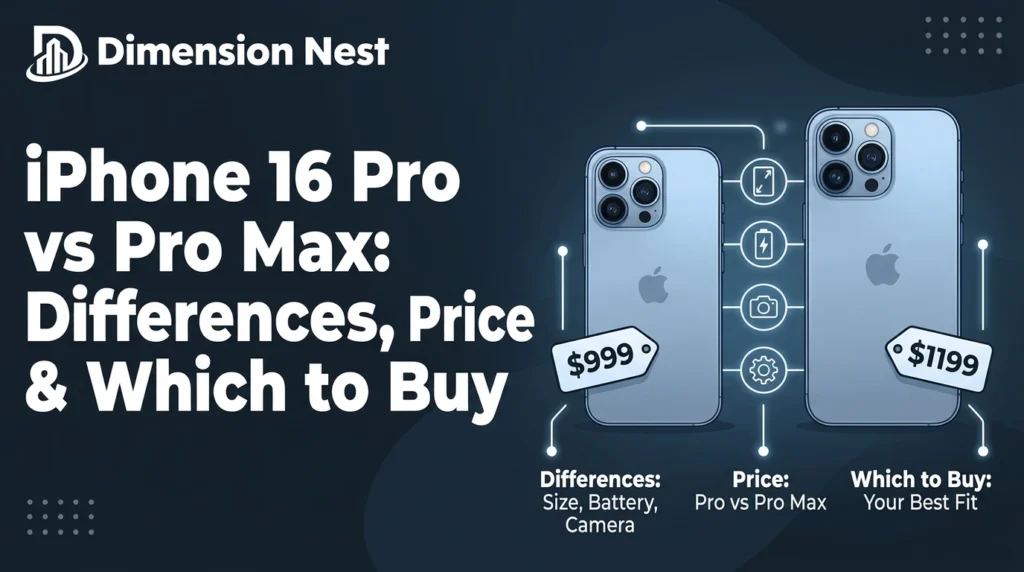
Shoppers comparing iPhone 16 Pro vs Pro Max face a simple question about size and stamina. Both phones share the A18 Pro chip, the same cameras, and a titanium frame. The differences come down to screen size, weight, battery life, storage, and price.
Apple announced both models on September 9, 2024, and released them on September 20. Apple discontinued both in September 2025, when the iPhone 17 Pro arrived. Today buyers find them mostly as used, refurbished, or leftover new stock.
This guide compares price, display, design, performance, cameras, and battery life for both phones. It also explains which buyers should choose each model in October 2026.
Quick Answer: Which Is Better, the iPhone 16 Pro or the Pro Max?
The iPhone 16 Pro suits most buyers, while the iPhone 16 Pro Max suits big-screen and battery priorities. Both share the A18 Pro chip, cameras, and titanium frame, so performance matches. The Pro Max adds a 6.9-inch screen, longer battery life, and a heavier body. At launch, matching 256GB models differed by $100, while entry models differed by $200.
iPhone 16 Pro vs Pro Max at a Glance
The table below lists the specifications that separate the two models most clearly.
| Feature | iPhone 16 Pro | iPhone 16 Pro Max |
|---|---|---|
| Screen size | 6.3 inches | 6.9 inches |
| Resolution | 2622 x 1206 | 2868 x 1320 |
| Chip | A18 Pro | A18 Pro |
| Memory (third-party reports) | 8GB | 8GB |
| Rear cameras | 48MP, 48MP, 12MP 5x | 48MP, 48MP, 12MP 5x |
| Front camera | 12MP | 12MP |
| Video playback (Apple) | Up to 27 hours | Up to 33 hours |
| Battery capacity (teardowns) | 3,582 mAh | 4,685 mAh |
| Weight | 199 g | 227 g |
| Storage | 128GB to 1TB | 256GB to 1TB |
| Launch price | From $999 | From $1,199 |
Overall, the two phones differ in size, battery, storage entry point, and price.
In simple words: the Pro Max is the same phone in a bigger body.
What Are the iPhone 16 Pro and iPhone 16 Pro Max?
What Is the iPhone 16 Pro?
The iPhone 16 Pro is Apple’s 6.3-inch Pro model from the 2024 lineup. It uses a titanium frame, the A18 Pro chip, and a triple rear camera. The base model carries 128GB of storage, which suits users with modest photo libraries.
What Is the iPhone 16 Pro Max?
The iPhone 16 Pro Max is the 6.9-inch version with the largest battery in the 2024 iPhone lineup. It shares the same chip, cameras, and titanium frame as the smaller Pro. Storage starts at 256GB and reaches 1TB, because Apple sold no 128GB version of this model.
Both phones launched with iOS 18 and later received the iOS 26 update.
How Do the iPhone 16 Pro and Pro Max Compare With the 2024 Lineup?
Apple sold four main models in the 2024 lineup, and the two Pro models sit at the top. The standard iPhone 16 and 16 Plus use the A18 chip and a dual rear camera. Only the Pro models add the telephoto lens, the A18 Pro chip, and a titanium frame. The Pro models also add ProMotion refresh rates up to 120Hz, which the standard models lack.
| Model | Screen | Chip | Rear cameras | Apple video playback |
|---|---|---|---|---|
| iPhone 16 | 6.1-inch | A18 | Dual | Up to 22 hours |
| iPhone 16 Plus | 6.7-inch | A18 | Dual | Up to 27 hours |
| iPhone 16 Pro | 6.3-inch | A18 Pro | Triple | Up to 27 hours |
| iPhone 16 Pro Max | 6.9-inch | A18 Pro | Triple | Up to 33 hours |
Overall, the Pro models share nearly every major feature, so size and battery separate them.
How Do the iPhone 16 Pro and Pro Max Compare on Price?
What Were the Launch Prices?
At launch, the iPhone 16 Pro started at $999 with 128GB of storage. The Pro Max started at $1,199 because Apple sold it only from 256GB. Matching storage tiers carried a steady $100 gap in the United States. Prices in other regions followed a similar pattern, though taxes and currency changed the totals.
| Storage | iPhone 16 Pro | iPhone 16 Pro Max |
|---|---|---|
| 128GB | $999 | Not offered |
| 256GB | $1,099 | $1,199 |
| 512GB | $1,299 | $1,399 |
| 1TB | $1,499 | $1,599 |
Each Pro Max costs $100 more than a Pro with equal storage, and entry models differ by $200.
What Do the Phones Cost in October 2026?
Apple discontinued both models in September 2025, so Apple no longer sells either phone. Buyers now compare used, refurbished, and leftover new units across resellers and marketplaces. A Swappa guide places a typical used iPhone 16 Pro near $650 and calls it a rough range.
Used prices vary by storage, battery condition, carrier lock status, and seller reputation. Reports say Apple raised the iPhone 17 to $899 in the United States in September 2026. A used Pro near $650 sits well below that current standard model price.
Do not treat any quoted price as final before checking live listings.
How Does Resale Value Compare?
Resale prices usually track launch prices, so the Pro Max usually sells for more than the Pro. Storage size, color, and battery health also move the price on each listing. Sellers who list a Pro Max with high battery health often ask for a premium.
Display and Size: How Different Do They Look?
Screen Size and Resolution
The iPhone 16 Pro has a 6.3-inch OLED display with 2622 by 1206 pixels. The Pro Max has a 6.9-inch OLED display with 2868 by 1320 pixels. Both run at 460 pixels per inch, so text and photos look equally sharp.
Brightness and Refresh Rate
Both phones use ProMotion with refresh rates up to 120Hz and an Always-On display. Apple lists 1,000 nits typical brightness, 1,600 nits peak HDR brightness, and 2,000 nits outdoors. Image quality stays the same, and only the amount of screen changes.
Which Screen Suits Which Buyer?
The larger screen helps with video, split-screen apps, reading, and mobile games. It also shows more of a webpage and a larger keyboard, which some typists prefer. The smaller screen fits one-handed use, narrow pockets, and small bags more easily. Text size settings let buyers on the smaller phone read comfortably, though less content fits on screen.
| Display detail | iPhone 16 Pro | iPhone 16 Pro Max |
|---|---|---|
| Size | 6.3-inch OLED | 6.9-inch OLED |
| Pixels per inch | 460 | 460 |
| Refresh rate | Up to 120Hz | Up to 120Hz |
| Typical brightness | 1,000 nits | 1,000 nits |
| Outdoor peak brightness | 2,000 nits | 2,000 nits |
Overall, screen quality matches, and the choice depends on comfort and viewing habits.
Design and Build: Size, Weight, and Handling
Materials and Durability
Both phones use a titanium frame with a Ceramic Shield front cover and an IP68 rating. Apple lists water resistance to 6 meters for up to 30 minutes. Buyers get the same drop protection and the same water rating, whichever size they pick.
Weight and Dimensions
The iPhone 16 Pro measures 149.6 by 71.5 by 8.25 millimeters and weighs 199 grams. The Pro Max measures 163.0 by 77.6 by 8.25 millimeters and weighs 227 grams. Thickness matches, but the Max is 28 grams heavier and 6.1 millimeters wider.
That weight gap shows during long video calls, one-handed typing, and pocket carry. Smaller hands usually find the Pro easier to hold securely during long calls. Larger hands often prefer the Max for reading, watching video, and mobile gaming.
Colors and Controls
Both phones come in Black Titanium, White Titanium, Natural Titanium, and Desert Titanium. Both phones include the Action button, Camera Control, and the Dynamic Island cutout. Controls sit in the same places, so habits transfer between the sizes.
| Design detail | iPhone 16 Pro | iPhone 16 Pro Max |
|---|---|---|
| Frame | Titanium | Titanium |
| Dimensions | 149.6 x 71.5 x 8.25 mm | 163.0 x 77.6 x 8.25 mm |
| Weight | 199 g | 227 g |
| Water resistance | IP68, 6 m for 30 min | IP68, 6 m for 30 min |
| Colors | Four titanium finishes | Four titanium finishes |
Overall, the Max adds size and weight, while build quality stays identical.
Performance: Is the Pro Max Faster?
The iPhone 16 Pro and Pro Max run the same A18 Pro chip, so speed is nearly equal. Apple lists a 6-core CPU, a 6-core GPU, and a 16-core Neural Engine for both. Spec databases list 8GB of memory for each phone, though Apple does not publish memory figures.
Games, video exports, and Apple Intelligence features should run at similar speeds on both models. Mobile gamers sometimes choose the Max for the larger touch area and longer sessions. Frame rates and graphics settings stay the same because the GPU and chip match.
Heat can differ slightly because the larger body spreads warmth across more surface area. That difference stays small and depends on workload, case, and room temperature.
Both phones support USB-C with USB 3 speeds for faster file transfers. Apple says USB 3 transfers run up to 20 times faster than USB 2. Creators who move large video files gain equally on either screen size.
Buyers should not pay extra for the Max while expecting faster performance.
Cameras: Do the Two Phones Shoot Differently?
Rear Camera System
Both phones carry a 48MP Fusion main camera, a 48MP ultra-wide camera, and a 12MP telephoto lens. The telephoto lens reaches 5x optical zoom, which suits portraits, stage shows, and distant subjects. Optical zoom options include 0.5x, 1x, 2x, and 5x on both models.
Photographic Styles, macro photography, ProRAW, and spatial photos also appear on both phones. Image quality should look nearly identical in normal lighting, because the sensors and processing match.
Video Recording
Both phones record 4K Dolby Vision video at up to 120 frames per second on the main camera. Both support ProRes recording up to 4K at 120 fps with external storage. Filmmakers get the same tools, so screen size should decide the purchase.
Front Camera
The front camera uses a 12MP TrueDepth sensor on both models, with matching video call quality. Selfies and video calls look the same on both phones, since the hardware matches.
| Camera feature | iPhone 16 Pro | iPhone 16 Pro Max |
|---|---|---|
| Main camera | 48MP Fusion | 48MP Fusion |
| Ultra Wide | 48MP | 48MP |
| Telephoto | 12MP, 5x optical | 12MP, 5x optical |
| Front camera | 12MP TrueDepth | 12MP TrueDepth |
| Video | 4K Dolby Vision, 120 fps | 4K Dolby Vision, 120 fps |
| ProRes (external storage) | Up to 4K, 120 fps | Up to 4K, 120 fps |
Overall, the cameras match, so a larger body brings no photography advantage.
Battery Life: How Much Longer Does the Pro Max Last?
Apple rates the iPhone 16 Pro for up to 27 hours of video playback. The Pro Max earns a higher rating of up to 33 hours of video playback. Teardown listings show roughly 3,582 mAh for the Pro and 4,685 mAh for the Max.
Tom’s Guide recorded 14 hours and 7 minutes of web browsing on the Pro. The Pro Max lasted more than 17 hours in the same test. That gap equals roughly three hours of extra browsing for the larger phone.
Battery results vary with signal strength, screen brightness, app choice, and usage habits. Aging also matters, because used units carry batteries that have already lost some capacity. A used Max with 90 percent battery health may still outlast a fresh Pro in heavy use.
| Measure | iPhone 16 Pro | iPhone 16 Pro Max |
|---|---|---|
| Apple video playback | Up to 27 hours | Up to 33 hours |
| Listed capacity | 3,582 mAh | 4,685 mAh |
| Web browsing test (Tom’s Guide) | 14:07 | More than 17 hours |
Overall, the Max offers the clearest and most useful advantage in this comparison.
Charging, Connectivity, and Safety Features
Both phones use a USB-C port with USB 3 speeds for charging and file transfers. Both also support MagSafe wireless charging and a wide range of MagSafe cases and wallets. Apple lists Emergency SOS via satellite and Crash Detection for both models.
Charging speed in watts varies by charger, so buyers should check the charger rating. Cases and screen protectors do not transfer between sizes, so accessory budgets matter.
Storage and Software
The iPhone 16 Pro offers 128GB, 256GB, 512GB, and 1TB of storage. The Pro Max offers 256GB, 512GB, and 1TB, with no 128GB entry model. Neither phone has a card slot, so buyers should pick enough storage at purchase. Storage fills fastest with 4K video, ProRAW photos, and offline media, so heavy creators should plan ahead.
Both phones support Apple Intelligence features because the A18 Pro chip meets Apple’s requirements. Used buyers should still confirm the current iOS version and update status before paying.
iPhone 16 Pro vs Pro Max Pros and Cons
The table below summarizes the main strengths and trade-offs of each model.
| Model | Strengths | Trade-offs |
|---|---|---|
| iPhone 16 Pro | Lighter body, easier one-handed use, lower price, 128GB option | Shorter battery life, smaller screen |
| iPhone 16 Pro Max | Larger 6.9-inch screen, longer battery life, 256GB minimum | Heavier body, higher price, harder pocket carry |
Each model wins in a different area, so the best pick depends on daily habits.
Who Should Buy the iPhone 16 Pro and Who Should Buy the Pro Max?
Who Should Buy the iPhone 16 Pro?
Most buyers should choose the iPhone 16 Pro because it offers the same hardware for less. Commuters, students, and anyone with smaller hands gain comfort from the lighter body. The Pro also costs less used, which leaves room for a case or a storage upgrade.
Who Should Buy the iPhone 16 Pro Max?
The Pro Max suits readers, gamers, video watchers, and travelers who spend long hours away from chargers. The larger screen improves maps, documents, split-screen work, and long reading sessions. Heavy users who value stamina over portability should accept the extra weight. Buyers who use one phone for work, video, and games may prefer the larger screen.
Should Buyers Choose an Older Pro or a Newer iPhone in 2026?
Apple launched the iPhone 18 Pro in September 2026 at a starting price of $1,199. Apple also discontinued the iPhone 17 Pro, and reports say the standard iPhone 17 now costs $899. Those prices make a used iPhone 16 Pro look attractive for buyers with tight budgets.
Newer models bring faster chips and longer software support, which matters for long ownership. A used 16 Pro still runs current apps smoothly and keeps the 5x telephoto lens. Buyers who keep phones for five years may prefer a newer model with warranty.
Swappa’s 2026 guide recommends used iPhone 16 and 17 models for most buyers over the iPhone 18 Pro. That advice depends on live prices, so buyers should compare current listings.
How to Choose Between the iPhone 16 Pro and Pro Max
Step 1: Set a Realistic Budget
Add the phone price, a case, a charger, and any storage upgrade to the total. The Pro usually leaves more room in the budget for accessories and a warranty.
Step 2: Check Hand Size and Pocket Space
Hold both phones in a store for several minutes before making any decision. A 28-gram difference seems small on paper, yet it changes one-handed comfort and pocket carry.
Step 3: List the Daily Screen Tasks
Reading, video, maps, and gaming gain the most from a 6.9-inch display. Messaging, calls, and quick browsing work well on the smaller 6.3-inch display.
Step 4: Estimate Battery Needs
Review typical screen time and access to chargers during a normal day. A gap of roughly three hours in browsing tests matters more for travelers than for office workers.
Step 5: Choose Storage Carefully
Pick 256GB or more when recording lots of 4K video, since neither phone has a card slot. The Pro Max starts at 256GB, while the Pro offers a 128GB entry model.
Step 6: Inspect Used Units
Check Battery Health, serial numbers, and carrier lock status before handing over any money. Test every camera, both speakers, Face ID, and charging during the same inspection.
Step 7: Compare Warranties and Returns
Prefer sellers that offer a clear return window and written warranty terms. Refurbished units from established sellers often cost slightly more but reduce risk.
How to Test Each Phone in Person
A ten-minute test session reveals comfort problems that spec sheets cannot show. First, type a long message with one hand on each phone and note thumb reach. Second, play a two-minute video clip and judge whether the larger screen adds real value.
Third, carry each phone in a pocket for a few minutes and notice any bulk. Finally, open the camera and compare 2x and 5x shots on both phones.
Used buyers should also run a battery drain test by streaming video for thirty minutes. A large drop in that window may signal a worn battery, so buyers should compare units.
Real-World Example: Two Buyers, Two Different Choices
Consider a student who commutes by bus, takes notes, and streams video on breaks. That student values a lighter phone that fits a small bag, so the Pro suits that routine.
Now consider a delivery coordinator who navigates all day and rarely sits near a charger. That worker gains hours of extra battery and a larger map from the Pro Max. For that routine, the extra weight becomes a fair trade for the added battery.
Finally, consider a photographer who wants the 5x telephoto lens on a tight budget. Both phones deliver identical zoom quality, so the cheaper Pro saves money without costing image quality. That photographer could spend the savings on extra storage or a spare battery pack.
These three examples are illustrations, not survey results, but they reflect common buyer needs.
Best Practices for Buying a Used iPhone 16 Pro or Pro Max
Open Settings, tap General, and compare the model number, storage size, and serial number with the listing. Check Battery Health in Settings, and confirm the seller has turned off Find My and Activation Lock.
Test Face ID, both speakers, the Action button, and Camera Control on every unit. Try each rear camera at 0.5x, 1x, 2x, and 5x zoom levels. Plug in a USB-C cable and a MagSafe charger to confirm both work.
Do not pay in advance to unverified sellers, and keep receipts and serial number records.
Common Mistakes When Choosing Between the iPhone 16 Pro and Pro Max
1. Expecting Better Cameras From the Max
Some buyers assume the larger phone carries a better camera system than the smaller one. Both phones share the same sensors and the same 5x telephoto lens, so photos look nearly identical.
2. Ignoring Weight
Spec sheets list weight, but buyers often skip that row until the phone arrives. A 28-gram difference changes comfort during long calls, travel days, and one-handed use.
3. Overpaying for 128GB or Too Little Storage
The Pro starts at 128GB, which fills quickly with 4K video and large apps. Heavy shooters should price a 256GB or 512GB model before committing to any purchase.
4. Skipping the Battery Health Check
Used phones carry aged batteries, and a Max with low battery health may lose its advantage. Always check the battery health percentage in Settings before paying for any used phone.
5. Trusting a Single Battery Number
Apple’s playback ratings use a fixed test, while real days mix calls, maps, camera use, and games. Read independent tests and note that results differ by network and brightness.
6. Paying New-Phone Prices for Old Stock
Leftover new units can cost more than a good used phone in similar condition. Compare at least three sellers before paying, and avoid prices that sit near a newer model’s cost.
Buying Checklist for the iPhone 16 Pro and Pro Max
Run through this checklist before paying for either the iPhone 16 Pro or the Pro Max:
- Confirm the total budget, including a case, a charger, taxes, and any storage upgrade.
- Hold both phones to judge the 28-gram weight gap and the 6.1 millimeter width difference.
- Estimate daily screen time and compare it with the 14-hour and 17-hour browsing results.
- Decide whether 128GB is enough, or whether 256GB or more suits the video habits.
- Check Battery Health, serial number, Find My status, and carrier lock on every used unit.
- Test Face ID, all three rear cameras, speakers, buttons, and charging before leaving.
- Verify the return window and the written warranty terms with the seller.
- Compare live prices with the $899 iPhone 17 before deciding on an older Pro.
What Should Buyers Do Next?
Shortlist two listings for each model and compare total cost, battery health, and warranty. Visit a store or a seller’s pickup point to hold both sizes before paying. Buyers who cannot test in person should confirm a clear return policy first.
Frequently Asked Questions
What is the main difference in the iPhone 16 Pro vs Pro Max comparison?
The main difference is size, because the Pro Max has a 6.9-inch screen and a larger battery. Chip, cameras, and build quality match on both phones, so the choice depends on comfort.
Is the iPhone 16 Pro Max faster than the iPhone 16 Pro?
No, both phones use the A18 Pro chip with the same CPU, GPU, and Neural Engine. The iPhone 16 Pro Max delivers no extra speed during normal daily use.
Which phone has the better camera, the iPhone 16 Pro or the Pro Max?
Neither phone wins, because both carry 48MP main and ultra wide cameras and a 12MP 5x telephoto lens. Photo and video quality should look nearly identical across both models in most scenes.
Does the iPhone 16 Pro Max have better battery life?
Yes, the iPhone 16 Pro Max lasts longer, with Apple rating video playback at up to 33 hours. The iPhone 16 Pro earns a lower rating of up to 27 hours.
How much heavier is the iPhone 16 Pro Max?
The iPhone 16 Pro Max weighs 227 grams, while the iPhone 16 Pro weighs 199 grams. That makes the Max 28 grams heavier, and it is also wider and taller.
How much did each phone cost at launch?
The iPhone 16 Pro started at $999 for 128GB, and the Pro Max started at $1,199 for 256GB. Matching storage tiers differed by $100, and entry models differed by $200.
Can buyers still purchase the iPhone 16 Pro new from Apple?
No, Apple discontinued the iPhone 16 Pro and Pro Max in September 2025. Buyers now find them used, refurbished, or as leftover stock from resellers.
Is the iPhone 16 Pro still worth buying in 2026?
For many buyers, yes, because a used iPhone 16 Pro keeps the A18 Pro chip. It also keeps the 5x telephoto camera, and prices depend on battery health.
Do the iPhone 16 Pro and Pro Max have the same screen quality?
Yes, both use OLED displays with ProMotion up to 120Hz and the same brightness ratings. Only the screen size and pixel count differ between the two models.
Which storage size is best for each phone?
The 256GB tier suits most buyers on either phone, while heavy 4K video shooters should consider 512GB. The iPhone 16 Pro also offers a cheaper 128GB model for light users.
Key Takeaways
- The iPhone 16 Pro and Pro Max share the A18 Pro chip and the same cameras.
- The Pro Max adds a 6.9-inch screen, while the Pro keeps a 6.3-inch display.
- Apple rates video playback at up to 27 hours versus up to 33 hours.
- Tom’s Guide browsing tests showed roughly three extra hours on the larger Pro Max.
- The Pro weighs 199 grams, which is 28 grams less than the Pro Max.
- Launch prices started at $999 for the Pro and $1,199 for the Pro Max.
- Matching storage tiers carried a $100 gap, while entry models differed by $200.
- Only the Pro offered a 128GB model, since the Pro Max started at 256GB.
- Both phones use titanium frames, ProMotion displays, IP68 ratings, and USB 3 speeds.
- Apple discontinued both phones in September 2025, so buyers rely on resellers.
- Most buyers should choose the iPhone 16 Pro for its lower price and lighter body.
- Travelers, gamers, and heavy video viewers gain the most from the Pro Max.
- Used buyers should check Battery Health, Activation Lock, and warranty terms before paying.
- A used iPhone 16 Pro may beat newer models on price, depending on live listings.
Conclusion
The iPhone 16 Pro vs Pro Max decision comes down to screen size, weight, battery life, and budget. Performance, cameras, and build quality match, so the Pro suits most buyers for less money. The Pro Max rewards heavy users who value stamina and a larger screen.
Apple’s discontinuation of both phones makes careful shopping and battery checks more important. Check live prices, inspect battery health, and confirm warranty terms before paying.
Explore more smartphone guides on Dimension Nest.