
 Abdul Moeed
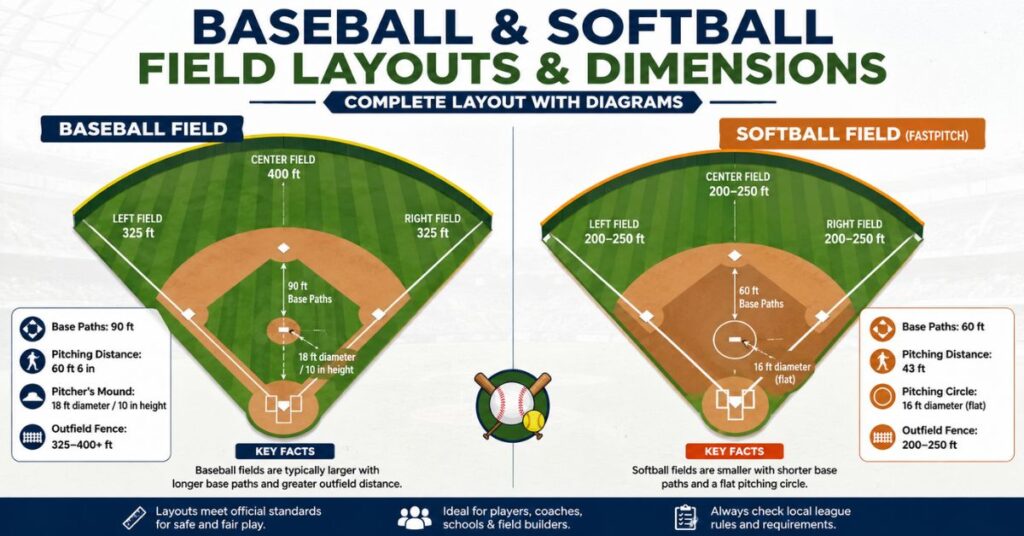
A regulation baseball field covers roughly 90,000 to 120,000 square feet of total playing surface, with most Major League parks landing close to 108,000 square feet (about 2.5 acres). The exact number changes because outfield fence distances are not fixed the way infield dimensions are.
That single fact answers the headline question, but the full story is more interesting. Baseball field dimensions and softball field dimensions look similar at a glance a diamond, a pitcher, four bases yet the actual square footage, base paths, and pitching distances shift dramatically depending on the level of play. baseball softball field layouts dimensions A Little League outfield fence sits far closer than an MLB fence, while a softball pitching circle sits much closer to home plate than a baseball pitching rubber does.
This guide breaks down baseball field measurements and softball field measurements side by side, using real specifications from the governing bodies that set them: Major League Baseball, Little League Baseball Incorporated, the NFHS, the NCAA, and USA Softball. Most comparison articles only list one or two dimensions. Here, you’ll also get the actual square-foot math, a conversion table, and a side-by-side reference chart most sites skip entirely.
Read More About: Left Chest Logo Size and Placement Professional Printing & Embroidery Guide
How Big Is Baseball & Softball Field Layouts & Dimensions
The short answer: a baseball field is almost always bigger. Baseball diamond dimensions use a 90-foot base path, while softball diamond layout typically uses a 60-foot base path. That 30-foot difference compounds across the whole field, which is why baseball field size in square feet usually runs 30–50% larger than a comparable softball field.
Below is a quick way to picture it. baseball softball field layouts dimensions If you took a standard 60-foot softball base path and stretched it to match a baseball infield, you’d need to add half again as much dirt and grass just for the diamond before even touching the outfield.
Quick Conversion Table: Square Feet to Other Units
| Square Feet | Square Yards | Square Meters | Acres |
| 90,000 sq ft | 10,000 sq yd | 8,361 sq m | 2.07 acres |
| 100,000 sq ft | 11,111 sq yd | 9,290 sq m | 2.30 acres |
| 108,000 sq ft | 12,000 sq yd | 10,033 sq m | 2.48 acres |
| 120,000 sq ft | 13,333 sq yd | 11,148 sq m | 2.75 acres |
These conversions matter for anyone planning field construction or comparing baseball field dimensions in feet and meters against international sports facilities, most of which are measured in the metric system.
Quick Reference Table: Field Sizes by League
| Field Type | Approx. Total Square Footage | Closeness to MLB Size (X/10) | Best Situation/Use |
| MLB Baseball Field | ~108,000 sq ft | 10/10 | Professional and televised play |
| NCAA Baseball Field | ~100,000 sq ft | 8/10 | College-level competitive play |
| High School Baseball Field | ~95,000 sq ft | 7/10 | Varsity and junior varsity programs |
| Little League Baseball Field | ~45,000 sq ft | 4/10 | Youth players ages 9–12 |
| NCAA/Fastpitch Softball Field | ~65,000 sq ft | 5/10 | College and competitive fastpitch |
| Slowpitch Softball Field | ~85,000 sq ft | 6/10 | Adult recreational leagues |
Baseball and Softball Field Dimensions, Explained

Major League Baseball Field
Major League Baseball sets the 90-foot base path as the standard, measured from the back point of home plate to the front edge of first and third base. Outfield fences, per official MLB rules, must sit at least 325 feet down the foul lines and 400 feet to center field, though most modern ballparks exceed this minimum. baseball softball field layouts dimensions Combined, these standard baseball field dimensions produce a total playing surface for most groundskeeping references, including the Sports Turf Managers Association, estimated at around 108,000 square feet.
Read More About: Stairs Dimensions 6 Surprising Sizes You Should Know
This matters practically because MLB fields aren’t identical; Fenway Park’s short left-field wall and Coors Field’s deep outfield both fit within the rules while producing very different square footage. baseball softball field layouts dimensions Understanding this baseline helps explain why “how many square feet is a baseball field” doesn’t have one fixed number, only a typical range.
Little League Baseball Field

Little League Baseball Incorporated shrinks the entire diamond for younger players. baseball softball field layouts dimensions The base paths measure 60 feet, the pitching rubber sits 46 feet from home plate, and outfield fences are set at roughly 200 to 225 feet. These youth baseball field dimensions bring total field size down to around 45,000 square feet, less than half the footprint of an adult MLB field.
The smaller scale isn’t arbitrary it matches the throwing distance and running speed of players aged 9 to 12, keeping the game fair and safe. baseball softball field layouts dimensions Baseball field construction for Little League fields also uses shorter warning track distances and smaller dugouts to match the reduced scale of the whole layout.
NCAA and High School Baseball Fields
College and high school programs use dimensions close to MLB but with a few adjustments. NCAA baseball field dimensions keep the 90-foot base path and 60-foot, 6-inch pitching distance, but permit shorter minimum outfield fences, often around 300 feet down the lines and 380–400 feet to center. baseball softball field layouts dimensions High school baseball field dimensions, governed by the NFHS, follow a similar layout with slightly more flexibility for fence distance based on available land.
This difference in outfield depth is the main reason NCAA and high school fields tend to measure 95,000 to 100,000 square feet total smaller than MLB, but still built around the same 90-foot infield arc and base path structure that defines “real” baseball at every level above Little League.
Fastpitch Softball Field
Fastpitch softball field dimensions differ from baseball in a way many fans don’t expect: the pitching distance is much shorter relative to the base paths. USA Softball and the NCAA set the pitching circle at 43 feet from home plate for fastpitch, with base paths of 60 feet, matching Little League’s baseball diamond size but with closer pitching. Outfield fences for NCAA softball typically sit 220 to 250 feet from home plate.
The tighter pitching distance is a defining feature of fastpitch softball field dimensions, and it’s a key distinction that separates softball from baseball more than any other single measurement. The total playing surface for a fastpitch field runs around 65,000 square feet, noticeably smaller than even a high school baseball field.
Slowpitch Softball Field

Slowpitch softball field measurements stretch back out again. baseball softball field layouts dimensions Because slowpitch pitches arc rather than fire in flat, the pitching rubber sits 50 feet from home plate, and outfield fences for adult slowpitch leagues commonly reach 275 to 300 feet, longer than fastpitch but still shorter than MLB. Base paths remain at 60 to 65 feet depending on the league.
This combination of longer outfield fences but shorter base paths gives slowpitch softball field size a unique profile: roughly 85,000 square feet, larger than fastpitch but still well under a full baseball field. Recreational leagues favor this layout because it rewards power hitting without demanding the running speed of a 90-foot base path.
Home Plate, Infield Arc, and the Pitching Circle
Beyond the big numbers, both sports share smaller standardized zones that shape how the field plays. Home plate dimensions are identical across baseball and softball: a five-sided slab 17 inches wide at the front edge. baseball softball field layouts dimensions The infield arc, batter’s box dimensions (roughly 3 feet by 7 feet in baseball), and catcher’s box all follow official specifications set by their respective governing rulebooks, whether it’s MLB, USA Softball, or the NFHS.
Read More About: 1 Inch 6 Surprising Things That Are Exactly 1 Inch
The pitching mound also deserves its own mention. Baseball’s pitching rubber sits atop a raised mound 10 inches high at the professional level, while softball’s pitching rubber sits flat on the ground another detail that changes the feel of the game far more than raw square footage does. This is something few competitor articles explain clearly, even though it directly affects how “big” a field feels to the players standing on it.
How Baseball Field Size Compares to Other Common Fields
Stacked against other American sports, a baseball field’s square footage falls in an unusual middle ground. A football field, including end zones, measures about 57,600 square feet — smaller than an MLB baseball field but with a far more rigid, rectangular shape. A soccer pitch can range from 64,000 to 100,000 square feet depending on the league, putting it roughly in line with a fastpitch softball field or a smaller baseball diamond.
What makes baseball and softball field measurements unusual is the fan-shaped foul territory. Unlike a rectangular football or soccer field, a baseball diamond’s total square footage depends heavily on foul pole placement and outfield fence curvature, which is why two fields with the same base path can still differ by tens of thousands of square feet in total size.
FAQ’s
How many sq ft is in a baseball field?
A full-size baseball field typically covers about 120,000–150,000 square feet, depending on the outfield fence distance. Professional MLB fields vary slightly from park to park.
How big is a baseball field area?
A regulation baseball field has 90-foot base paths and outfield fences usually 325–400+ feet from home plate. The total area is generally 2.8–3.5 acres.
What is a full-size baseball field?
A full-size baseball field features 90-foot base paths, a 60 feet 6 inches pitching distance, and an outfield fence ranging from 325 to 400+ feet. These are the standard dimensions for adult and professional play.
How to layout a baseball field?
Start by placing home plate, then measure 90-foot baselines to first, second, and third base. Next, position the pitcher’s mound 60 feet 6 inches from home plate and mark the foul lines, batter’s boxes, and outfield fence.
Final Thoughts
Baseball field dimensions and softball field dimensions share the same basic shape but differ in almost every specific measurement, from base paths and pitching distance to total square footage. An MLB field averages around 108,000 square feet, a Little League field shrinks to about 45,000 square feet, and softball fields land somewhere between 65,000 and 85,000 square feet depending on fastpitch or slowpitch rules.