
 Abdul Moeed
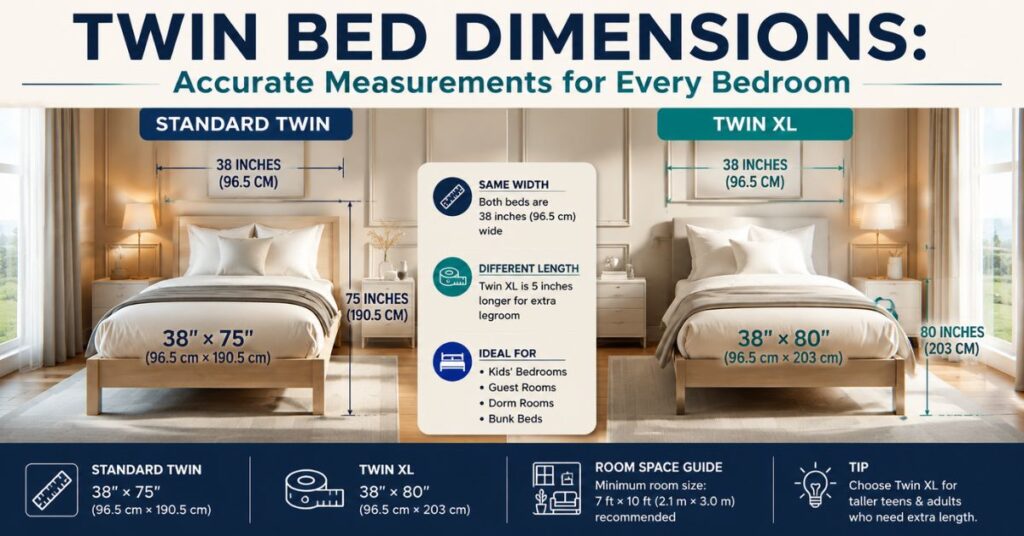
A standard twin bed is 38 inches wide and 75 inches long (96.5 cm × 190.5 cm). That makes it the narrowest adult-sized mattress sold in the United States today.
If you’ve ever wondered what the width of a twin bed is compared to other common mattress sizes, you’re not alone. Twin bed dimensions come up constantly when parents are furnishing a kid’s bedroom, when college students are packing for a dorm, or when someone is trying to fit a guest bed into a tight spare room. twin bed dimensions The standard twin bed dimensions look simple on paper, but the real-world sizing gets confusing fast once bed frames, bedding, and bunk setups enter the picture.
This guide breaks down twin mattress dimensions in every unit people search for inches, feet, and centimeters and compares them to six other common bed sizes so you can see exactly where a twin bed fits in. Something most articles skip: how twin bed frame dimensions differ from the mattress itself, which throws off a lot of room-planning measurements.
Read More: Standard Pool Table Dimensions The Simple Size Guide
How Wide Is a Twin Bed, Exactly?
To directly answer what’s the width of a twin bed: it measures 38 inches (3.17 feet) wide and 75 inches (6.25 feet) long. In metric terms, that’s roughly 96.5 cm wide by 190.5 cm long. These twin bed dimensions in inches have been the U.S. industry standard for decades, set by mattress manufacturers and reinforced by bedding companies like Serta and Beautyrest, who cut fitted sheets to this exact sleeping space.
The twin bed width of 38 inches gives one sleeper roughly the same shoulder room as a narrow twin bed frame allows comfort for a single person, but tight for two adults. Twin bed height, meaning the mattress thickness itself, typically runs 9 to 11 inches, not counting the box spring or bed foundation underneath.
Quick Conversion Table Twin Bed Dimensions
| Unit | Width | Length |
| Inches | 38 in | 75 in |
| Feet | 3.17 ft | 6.25 ft |
| Centimeters | 96.5 cm | 190.5 cm |
| Meters | 0.965 m | 1.905 m |
| Millimeters | 965 mm | 1905 mm |
This twin bed dimensions guide is the version most mattress protectors and fitted sheet packaging references, so it’s worth bookmarking if you’re shopping for bedding.
Quick Reference: How a Twin Bed Compares
| Bed Size | Approx. Measurement (W x L) | Closeness Score (vs. Twin) | Best Situation/Use |
| Twin XL | 38 in x 80 in | 9/10 | Dorm rooms, tall teens |
| Full (Double) | 54 in x 75 in | 6/10 | Solo adults, guest rooms |
| Queen | 60 in x 80 in | 4/10 | Couples, primary bedrooms |
| King | 76 in x 80 in | 2/10 | Couples wanting extra space |
| California King | 72 in x 84 in | 2/10 | Taller sleepers |
| Crib/Toddler Bed | 27.25 in x 51.625 in | 5/10 | Toddlers transitioning from a crib |
Twin XL vs. Twin: A Few Inches That Matter
Twin XL

A Twin XL mattress keeps the same 38-inch width as a standard twin bed but stretches to 80 inches long five inches longer. This is the twin size mattress used in nearly every U.S. college dorm room, a standard set by campus housing departments and confirmed by bedding retailers like Bed Bath & Beyond, which sell dorm-specific sheet sets built around that extra length. The single bed dimensions barely change, but that extra five inches matters a lot for taller sleepers.
For a growing teenager or an adult under 6’2″, a Twin XL solves the biggest complaint about a regular twin: feet hanging off the end. It’s a small upgrade in twin bed frame dimensions that makes a real difference in comfort without taking up significantly more bedroom floor space.
Full (Double) Bed
A Full bed, sometimes called a Double, measures 54 inches wide by 75 inches long. The length matches a standard twin bed exactly, but it’s 16 inches wider. Mattress makers like Sealy list the Full as the traditional “one adult” size before Queen mattresses became the default choice in most American homes. It’s a popular pick for guest rooms and smaller primary bedrooms where a Queen won’t comfortably fit.
Key distinction: unlike moving from Twin to Twin XL, moving from Twin to Full adds meaningful width, not length. That makes a Full a better upgrade for anyone who tosses and turns, while a Twin XL suits sleepers who mainly need more legroom.
Queen Bed
The Queen is the best-selling mattress size in the U.S., according to the International Sleep Products Association, measuring 60 inches wide by 80 inches long. Compared to standard twin bed dimensions, a Queen is 22 inches wider and 5 inches longer, giving one or two sleepers noticeably more sleeping space. Most primary bedrooms are built with a Queen bed frame size in mind.
Read More: King vs. California King Dimensions Complete Comparison With Size Chart
For anyone comparing twin bed measurements to a Queen while furnishing a shared bedroom, the difference is significant enough to change how much nightstand and walkway space is left in the room.
King Bed
A King mattress measures 76 inches wide by 80 inches long, making it 38 inches wider than a twin bed essentially two twin mattresses pushed together, which is exactly how split King frames are built for adjustable bed bases. Brands like Tempur-Pedic frequently market the King as the top choice for couples who want personal space or who co-sleep with kids or pets.
Because a King bed frame size takes up so much floor area, it’s rarely recommended for a bedroom under 12 by 12 feet, which is part of why twin and Twin XL beds remain common in smaller rooms.
California King Bed
The California King is 72 inches wide by 84 inches long narrower than a standard King but four inches longer, a mattress compatibility detail that trips up a lot of shoppers. Mattress specialty retailers like Mattress Firm typically position it as the choice for taller individuals who need extra legroom more than extra shoulder room.
Compared to twin bed dimensions in feet (roughly 3.17 by 6.25 feet), a California King’s 7-foot length is a full 9 inches longer, which matters most for anyone over 6 ‘4″.
Crib and Toddler Bed

A standard crib mattress measures about 27.25 inches wide by 51.625 inches long, based on the size regulated by the U.S. Consumer Product Safety Commission. A toddler bed frame is built around this same mattress, making it the natural stepping stone before a child moves into a full-sized twin bed for kids.
This comparison matters for parents planning ahead: a twin bed room size needs considerably more square footage than a nursery, so many families skip the toddler bed altogether and move straight to a twin.
Where Does a Twin Bed Appear in Daily Life?
Twin beds show up in more places than most people realize. They’re the standard choice for bunk bed mattress setups, since a bunk bed frame is engineered around twin bed dimensions for structural safety. Daybeds and trundle bed dimensions also default to twin size, letting a single frame serve as seating by day and a guest bed by night.
Children’s bedrooms almost always start with a twin, since it fits small bedroom furniture layouts better than a Full or Queen. College dorms lean on the Twin XL variation, and many guest rooms use a twin bed specifically because it leaves more open floor space for a desk or closet.
Ideal Room Size for a Twin Bed

A twin bed room size recommendation from most furniture retailers, including IKEA’s room-planning guides, suggests at least 7 by 10 feet of floor space to comfortably fit the bed plus a nightstand and walking room. Smaller rooms can work, but tight clearance around the bed frame makes it harder to change sheets or move furniture.
For bunk bed or twin-over-twin setups, ceiling height becomes just as important as floor space; most manufacturers recommend at least 8 feet of ceiling clearance for safety and headroom.
How to Measure a Twin Bed Without a Tape Measure
Not everyone has a tape measure handy when they’re checking whether twin bed dimensions will actually work in a room. A quick trick: a standard sheet of printer paper is 11 inches long, so laying seven sheets end to end roughly covers the 75-inch length of a twin bed. For the 38-inch twin bed width, about three and a half sheets placed side by side gets you close enough for a rough room-planning estimate.
Another everyday reference is a standard interior door, which is usually 30 to 36 inches wide, just slightly narrower than a twin bed. If a twin mattress looks a bit wider than a doorway standing next to it, that visual check lines up with the real twin mattress dimensions almost every time. These shortcuts won’t replace an actual tape measure, but they’re useful for a fast gut-check before moving furniture.
Read More: Kitchen Island Dimensions The Ultimate Guide to Size, Seating & Spacing
Twin Bed Frame vs. Mattress A Detail Most Guides Skip
Something no competitor explained clearly: twin bed frame dimensions are not identical to the mattress itself. Most frames add roughly 1 to 2 inches of clearance on each side so the mattress sits inside the rails without rubbing, and headboards or footboards can add several more inches to the frame’s total footprint. That means a room built around the “38 by 75 inch” twin mattress figure alone can end up too tight once the actual bed frame goes in.
This distinction matters most in small bedrooms and bunk bed installations, where every inch of clearance counts. Before buying furniture for a snug bedroom, it’s worth measuring the frame’s outer edges, not just the twin bed size printed on the mattress tag to avoid a surprise fit problem on delivery day.
FAQ’s
How wide is a twin-size bed?
A standard twin-size bed is 38 inches (96.5 cm) wide and 75 inches (190.5 cm) long. It provides enough space for one child or a single adult.
What are the widths of a twin bed?
A standard twin bed measures 38 inches (96.5 cm) in width. Twin XL beds have the same width but are 5 inches longer.
Can a 5’11” person fit on a twin bed?
A person who is 5’11” (71 inches) can fit on a standard 75-inch twin bed, but with limited extra legroom. A Twin XL (80 inches) offers a more comfortable fit.
Are twin and single beds the same size?
Yes, twin and single beds refer to the same standard mattress size in most countries. Both typically measure 38 × 75 inches (96.5 × 190.5 cm).
Final Thoughts
A twin bed’s dimensions 38 inches wide by 75 inches long make it the go-to choice for kids’ rooms, guest rooms, dorms, and bunk beds where space is limited. Compared to a Twin XL, Full, Queen, King, or California King, it’s the most compact option that still counts as a full-sized mattress rather than a crib or toddler bed.
So the next time someone asks what’s the width of a twin bed, the quick answer is 38 inches but the real decision usually comes down to length, room size, and who’s actually sleeping in it. Measure the room first, then match the mattress to the space rather than the other way around.