
 Abdul Moeed
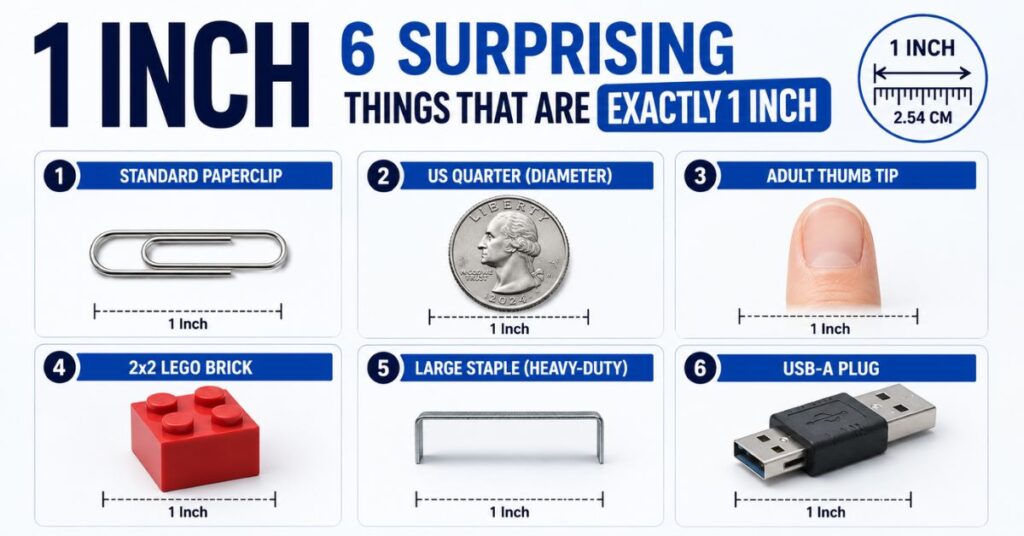
1 inch equals 2.54 centimeters (25.4 millimeters), and it’s about the width of a US quarter. That single fact answers the question most people search for, but knowing the number doesn’t always help you picture the size.
This guide covers 1 inch in a way most measurement articles skip: real objects you can hold, a full conversion chart, and a side-by-side comparison table so you can judge the measurement at a glance. You’ll also learn how to measure an inch without pulling out a ruler, using nothing but your own hand, plus how the standard inch measurement compares to a foot, a yard, and the metric system.
Most competitors list two or three vague examples and stop there. This article gives you six verified one-inch objects, each tied to a real brand, standard, or industry spec not a guess. If you’ve ever searched “what does 1 inch look like” and gotten a vague answer, the comparisons below are built to fix that with concrete, checkable references you can find around your own home.
How Big Is 1 Inch?
An inch is a unit of length in the US customary and imperial measurement systems. One inch is exactly 2.54 centimeters, a conversion fixed by international agreement since 1959. It’s roughly the length of the top joint of an adult thumb, which is why “thumb width” has been used as a rough inch scale for centuries.
Compared to other common units, 1 inch is small enough to measure fine details a screw, a bolt, a gemstone but too small to describe most furniture or rooms. That’s why builders switch to feet, and jewelers switch to millimeters, once precision matters. Understanding inch dimensions this way helps you judge both extremes without reaching for a calculator.
On a standard tape measure, the 1 inch mark is usually the first bold number after the tip, broken down further into sixteenths for finer work like carpentry or sewing. Reading an inch on a ruler correctly means counting from the “0” line, not the physical edge of the tool, since many tapes and rulers have a small metal lip that throws off a quick glance. That one habit of checking the zero line, not the edge is the most common source of small measuring mistakes people make at home. It’s a habit worth building whether you’re hanging a picture frame, hemming a pair of pants, or double-checking a package’s shipping dimensions before a post office run.
Read More About: Soccer Field Dimensions 10 Key Measurements Every Player Should Know
Quick Conversion Table
| Unit | Equivalent to 1 Inch |
| Centimeters | 2.54 cm |
| Millimeters | 25.4 mm |
| Meters | 0.0254 m |
| Feet | 0.0833 ft (1/12 ft) |
| Yards | 0.0278 yd (1/36 yd) |
| Typography Points | 72 pt |
| Picas | 6 picas |
This table covers every related unit you’re likely to need, whether you’re working a US customary tape measure or a metric one. Keep it bookmarked if you regularly switch between recipes, hardware specs, or international shipping labels that mix centimeters and inches.
Quick Reference Table
Rather than just listing the conversion math, the table below scores how close each everyday object actually lands to a true inch, so you know which comparisons to trust for precise work and which are only good for a rough glance.
| Object | Approx. Measurement | Closeness Score (X/10) | Best Situation/Use |
| US Quarter | 0.955 in diameter | 9/10 | Wallet-based quick check |
| 1-Inch Gumball | 1.0 in diameter | 10/10 | Exact visual reference |
| Adult Thumb (tip to knuckle) | ~1.0 in | 8/10 | No-ruler field estimate |
| Small Paper Clip (No. 1) | 1.0 in length | 10/10 | Desk or office reference |
| Table Grape | ~0.9–1.0 in diameter | 8/10 | Kitchen/produce comparison |
| Standard Wine Cork | 0.94 in diameter | 8/10 | Kitchen or bar reference |
Everyday Objects That Are 1 Inch
The US Quarter

The United States Mint lists the quarter’s official diameter as 0.955 inches, close enough to 1 inch that most people round up without a second thought. It’s one of the most common one-inch objects because nearly everyone carries one, making it the fastest gut-check for exactly 1 inch when you don’t have a tape measure handy.
Because a quarter is flat, rigid, and a fixed size by federal mint standard, it doesn’t warp or shrink the way fabric or produce can. If you need a repeatable, pocket-sized inch scale, a quarter is more reliable than eyeballing an object from memory. Coin collectors and hobbyists often use a stack of quarters the same way, lining several up edge to edge to rough out a foot when no tape measure is around.
The Standard 1-Inch Gumball
Vending machine suppliers like A&A Global Industries and Dubble Bubble manufacture their classic round gumballs to a 1-inch diameter as an industry standard size, which is why these machines are often labeled “1-inch gumball machines” on the packaging. It’s one of the few consumer products actually built to that exact spec rather than close to it. This makes it genuinely one of the best everyday objects that are one inch in size, with almost no rounding involved.
Because the size is standardized across manufacturers, a gumball gives a more dependable one-inch length reference than produce or hardware, which vary batch to batch. Key distinction: unlike the quarter or the grape, this object was engineered to hit the measurement, not just close to it by coincidence.
An Adult Thumb, Tip to First Knuckle
Anthropometric measurement guides, often used in scouting, woodworking, and DIY tutorials, commonly cite the average adult thumb measured from the tip to the first knuckle crease as roughly 1 inch long. It won’t be exact for every hand size, but it’s close enough for quick field estimates.
This is genuinely useful because it means you’re carrying a built-in inch ruler at all times. Something no competitor explained clearly: the accuracy depends heavily on hand size, so it works best as a rough check, not for cutting lumber or measuring a prescription dose.
Read More About: Badminton Court Dimensions Size in Feet The Surprising Truth
The Small Paper Clip (No. 1 Size)
Office supply manufacturers such as ACCO Brands produce the “No. 1” or small paper clip at a standard 1 inch long, distinct from the larger jumbo clips that run closer to 2 inches. If you’ve ever wondered how long is 1 inch in a desk-drawer context, this is the answer sitting in nearly every office supply box.
Because paper clips are mass-produced to a fixed wire-bending spec, they’re consistent from box to box, unlike food or hand-based comparisons. Keep one taped inside a notebook and you’ve got a portable, flat one-inch reference that survives in a wallet or drawer.
A Table Grape
USDA produce sizing references place an average table grape at roughly 0.9 to 1.0 inches in diameter, depending on the variety red seedless grapes and greener varieties can run slightly smaller or larger. It’s a useful, everyday example precisely because it’s imperfect: real produce varies, unlike a manufactured object.
This matters practically because it shows 1 inch compared to household items isn’t always a clean match nature doesn’t measure to spec. When a recipe or nutrition label references “one grape” as a portion cue, this rough one-inch size is usually what’s meant. Nutritionists sometimes use similarly sized produce, like a large grape or a small strawberry, as a quick visual portion guide, since most people find picturing food easier than picturing a ruler.
A Standard Wine Cork
Natural cork suppliers, including major producers like Amorim, manufacture standard wine bottle corks at approximately 0.94 inches (24mm) in diameter before compression into the bottle neck. Once removed and left to expand, a cork often reads as extremely close to a full one-inch object, making it a surprisingly handy kitchen-drawer reference.
This is a helpful one-inch length check because corks are already common household clutter most people have a few sitting in a drawer without ever having measured them. Next time one turns up, it doubles as an impromptu inch ruler for a quick size comparison, whether you’re eyeballing a craft project or checking a small gift box before wrapping it.
Where Does 1 Inch Appear in Daily Life?
Beyond single objects, the one-inch measurement shows up constantly in everyday design. Smartphone screens are measured diagonally in inches, hardware bolts and screws are sized in fractions of an inch, and clothing tags list seam allowances and cuffs in inch increments. TV and monitor sizes, picture frames, and binder rings are all built around inch scale dimensions because it remains the US customary default for consumer goods.
Even digital design leans on it: word processors and design software still default to 1-inch margins on a standard US Letter page, and printers calibrate resolution in dots per inch. Once you start looking, one-inch reference points are everywhere, not just on a ruler.
Home improvement is another place the standard inch measurement dominates. Lumber is sold in nominal inch widths, drill bits are labeled in fractions of an inch, and plumbing pipe diameters are almost always listed the same way. Even a small miscalculation of an inch on a shelf bracket or a pipe fitting can mean a return trip to the hardware store, which is exactly why contractors double-check measurements against a tape rather than trusting an eyeball estimate alone.
Read More About: Bowling Lane Dimensions Diagram 6 Surprising Facts
Shipping and packaging is a less obvious example. Postal carriers like USPS calculate dimensional weight using length, width, and height in inches, so a box that’s even an inch or two larger than it needs to be can bump a package into a pricier rate tier. Furniture retailers do something similar, listing every dimension width, depth, height down to the nearest inch so buyers can confirm a piece will actually fit through a doorway before it ships. Interior designers rely on the same habit when planning a room, since a couch or bookshelf that’s off by even a couple of inches can throw off an entire floor plan.
FAQ’s
How long is 1 inch in centimeters and millimeters?
1 inch equals 2.54 centimeters, or 25.4 millimeters. This conversion is fixed by international standards, so it never changes regardless of the ruler or tape measure brand you’re using.
What does 1 inch look like without a ruler?
It looks about as wide as a US quarter or the tip of an adult thumb. Both are commonly used as quick, no-tools visual size checks when a ruler isn’t available.
Is 1 inch a lot or a little?
For most everyday objects, 1 inch is smaller than a credit card’s width and shorter than a AA battery’s length. It’s useful for fine measurements but too small for describing furniture or room dimensions.
How to measure 1 inch without a ruler?
Use a US quarter, a small paper clip, or the top joint of your thumb as a stand-in. Each is close enough to exactly 1 inch for casual estimates, though none replace a tape measure for precise work.
How small is 1 inch compared to a foot?
1 inch is 1/12 of a foot, meaning twelve one-inch objects laid end to end roughly equal one foot. It’s also 1/36 of a yard, making it one of the smallest common units in the US customary measurement system.
What household items are close to 1 inch in width?
A US quarter, a small paper clip, a wine cork, and a large gumball are all close to one inch in width. These household measurements make handy stand-ins whenever a tape measure or ruler isn’t within reach.
Why do rulers and tape measures split 1 inch into smaller marks?
Rulers divide an inch into halves, quarters, eighths, and sixteenths so work like carpentry and sewing can be precise. Reading those smaller ruler markings correctly is what separates a rough estimate from an accurate inch measurement.
Final Thoughts
Across quarters, gumballs, thumbs, paper clips, grapes, and wine corks, one theme holds: 1 inch is small, but it’s everywhere once you start looking. Manufactured objects like the gumball and paper clip hit the measurement almost exactly, while natural items like grapes and corks land close, with some real-world variation.
Whether you’re estimating without a tape measure or just trying to visualize 1 inch on a page, these six comparisons give you a reliable mental ruler you can carry anywhere. The next time a project, a recipe, or a shipping label calls for a quick size check, you’ll already have six trustworthy references in mind instead of guessing. Reach for a quarter or your own thumb both get you within a fraction of a true inch.