
 Abdul Moeed
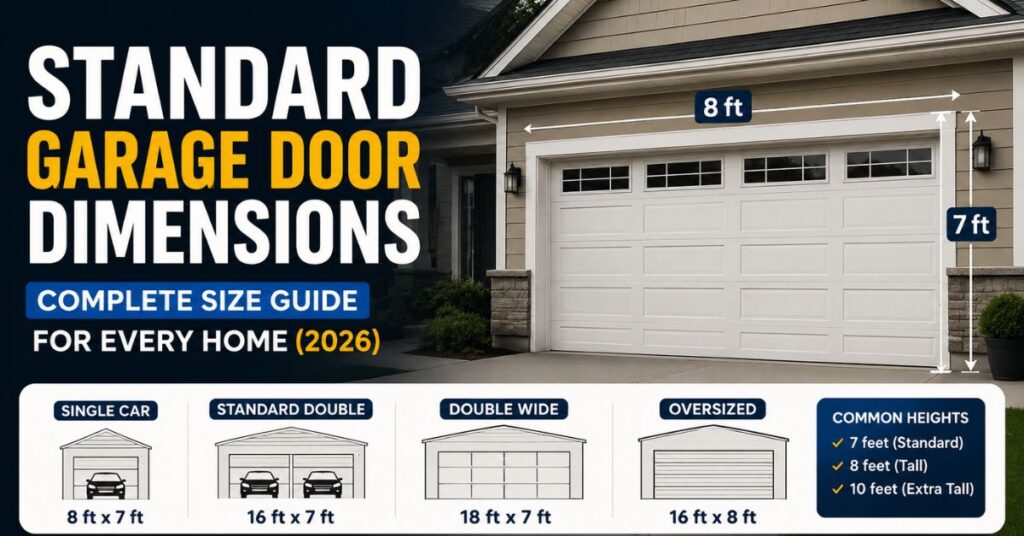
A standard single-car garage door measures 9 feet wide by 7 feet tall, while a standard double-car garage door measures 16 feet wide by 7 feet tall. These two sizes cover most residential homes, but several other common variations exist.
If you’ve ever stood in front of a garage entrance with a measuring tape, unsure whether you’re looking at a “standard” opening or something custom, you’re not alone.Standard Garage Door Dimensions This garage door sizes chart breaks down six of the most common residential garage door dimensions, from compact single-car openings to oversized RV bays, so you know exactly what you’re working with before a purchase or renovation.
What most guides skip is the difference between the garage door panel size and the actual rough opening the framed space in the garage frame that the door and track system sit inside. That gap is where a lot of measuring mistakes happen, and we’ll cover it below.
What Are the Standard Garage Door Dimensions?
Garage door dimensions aren’t one-size-fits-all.Standard Garage Door Dimensions They shift based on how many vehicles the garage entrance needs to fit, the age of the home, and whether the door was custom-built. Builders typically size the rough opening a few inches larger than the door panel itself to allow room for the track system, weather seal, and header.
Below is a quick conversion table so you can translate garage door width and height into feet, inches, and centimeters at a glance useful whether you’re ordering a replacement or checking building codes.
Read More: What Does 30 Feet Look Like? 6 Surprising Examples
Quick Conversion Table
| Unit | Single-Car Door (9×7) | Double-Car Door (16×7) |
| Feet | 9 ft × 7 ft | 16 ft × 7 ft |
| Inches | 108 in × 84 in | 192 in × 84 in |
| Centimeters | 274.3 cm × 213.4 cm | 487.7 cm × 213.4 cm |
| Meters | 2.74 m × 2.13 m | 4.88 m × 2.13 m |
| Millimeters | 2,743 mm × 2,134 mm | 4,877 mm × 2,134 mm |
Quick Reference Table
| Garage Door Type | Approx. Dimensions | Closeness to “Standard” (X/10) | Best Situation/Use |
| Compact single-car door | 8 ft × 7 ft | 7/10 | Older homes, narrow lots |
| Standard single-car door | 9 ft × 7 ft | 10/10 | Most single-car garages |
| Standard double-car door | 16 ft × 7 ft | 10/10 | Two-car residential garages |
| Oversized double-car door | 18 ft × 8 ft | 8/10 | Larger vehicles, trucks, SUVs |
| RV or oversized bay door | 12 ft × 12 ft (varies) | 4/10 | RVs, boats, tall equipment |
| Custom garage door | Varies | N/A | Unique openings, additions |
Standard Garage Door Sizes: 6 Common Examples
1. The Compact Single-Car Garage Door
Many homes built before the 1980s use a smaller single garage door dimension of 8 feet wide by 7 feet tall. This size was common when vehicles were narrower, and it still appears in older residential neighborhoods across the country.Standard Garage Door Dimensions The National Association of Home Builders has noted that older housing stock frequently carries these tighter garage openings compared to homes built in the last two decades.
This matters practically because a compact opening can make it hard to fit today’s wider trucks and SUVs without scraping mirrors.Standard Garage Door Dimensions If you’re doing a garage renovation, this is often the first dimension homeowners choose to upsize. Standard single garage door dimensions have generally grown wider over time for this exact reason.
2. The Standard Single-Car Garage Door
The most common single-car garage door dimensions today are 9 feet wide by 7 feet tall, sometimes listed as 9×7.Standard Garage Door Dimensions This is the size most manufacturers, including Clopay and Amarr, treat as their default residential single-door option. It fits most passenger vehicles with enough side room to open doors comfortably and walk around the car.
Key distinction: a “standard” size isn’t a legal requirement it’s an industry convention. Building codes generally require a minimum garage opening width and headroom clearance for the door opener and track, but the exact number can vary by municipality, so always confirm garage door installation dimensions with local codes before ordering.
Read More: Beer Can Label Dimensions Explained: Size Chart for Every Can
3. The Standard Double-Car Garage Door
Double garage door dimensions typically run 16 feet wide by 7 feet tall, making this the go-to option for two-car garages across the U.S. Rather than two separate single doors, most modern two-car garages use one wide sectional door, which the Door and Access Systems Manufacturers Association (DASMA) lists as the industry’s most common two-car configuration.
This single wide-panel approach reduces the number of moving parts and seals better against weather than two separate doors.Standard Garage Door Dimensions If you’re comparing a garage door sizes chart for a new build, this 16×7 size is the benchmark most contractors default to unless the homeowner requests otherwise.
4. The Oversized Double-Car Garage Door
Newer homes, especially those built for larger trucks and SUVs, often use an oversized double garage door dimension of 18 feet wide by 8 feet tall. Some custom builds push this to 20 feet wide.Standard Garage Door Dimensions This taller, wider profile gives extra backroom and side clearance, which matters more with today’s larger vehicle fleet.
Something no competitor explained: the extra foot of height (8 ft versus the standard 7 ft) also changes your headroom requirements above the door you typically need at least 10–12 inches of extra ceiling clearance for the torsion spring and track system to operate safely.
5. The RV or Oversized Bay Garage Door
RV and boat garages require significantly larger garage opening dimensions, often starting around 12 feet wide by 12 feet tall and going up to 14×14 or more depending on the vehicle.Standard Garage Door Dimensions RV manufacturers and dealerships commonly cite these wider, taller bay dimensions as the minimum needed to clear roof-mounted AC units and awnings.
This size category matters for anyone converting a garage entrance for hobby equipment, tall storage, or recreational vehicles. Because these doors are so much larger than a typical residential garage door, they usually require a reinforced garage frame, a heavier-duty door opener, and a commercial-grade track system rather than standard residential hardware.
6. The Custom Garage Door
When a garage opening doesn’t match any typical size common in additions, converted carriage houses, or architecturally unique homes manufacturers offer custom garage door sizes built to the exact garage opening dimensions. These are measured and fabricated after a professional visits the home to record the rough opening, header height, and side room available for the track system.
Custom sizing costs more and takes longer to fabricate than off-the-shelf sectional or roll-up garage door sizes, but it’s often the only option for non-standard garage entrances. If your garage door frame dimensions fall outside the common ranges above, expect to go this route rather than buying an off-the-shelf overhead door.
How to Measure a Garage Door Without Guessing
Measuring correctly means checking more than just the door panel. Use a tape measure to record the width and height of the garage opening itself not the door currently installed, since older doors can be undersized or ill-fitting. Then measure headroom (space above the opening for the track), backroom (depth needed for the door to travel when opening), and side room (space beside the opening for the track hardware).
For an insulated garage door or a heavier steel garage door, also confirm the header can support the added weight. Wooden garage doors and aluminum garage doors have different weight profiles that can change the framing requirements too. When in doubt, a garage door installer can confirm garage door rough opening measurements in under 15 minutes.
Read More: How Far Is 20 Feet Visually? The Surprising Truth
Where Garage Door Sizing Affects the Rest of Your Home
Garage door width and height decisions ripple into other parts of a garage renovation. A wider double garage door width often requires a stronger header beam, which can affect framing costs. Taller doors need more vertical garage ceiling clearance, which can conflict with storage shelving or attic access above the garage. Even the choice between a sectional door and a roll-up garage door changes how much backroom and headroom you need, since roll-up doors coil differently than panel-style sectional doors.
FAQ’s
What is the standard garage door size for a single-car garage?
The standard single-car garage door size is 9 feet wide by 7 feet tall. Some older homes use a slightly narrower 8-foot-wide version. Both fall within typical residential garage door sizes offered by most manufacturers.
What is the standard garage door size for a two-car garage?
The standard double-car garage door size is 16 feet wide by 7 feet tall. Larger trucks and SUVs often call for an 18×8 oversized version instead, which is becoming more common in newer construction.
How do I read a garage door sizes chart correctly?
A garage door sizes chart lists width first, then height, usually in feet (for example, 9×7 means 9 feet wide, 7 feet tall). Always cross-check the chart against your actual garage opening dimensions, not just the door currently installed.
What is the minimum headroom needed above a garage door?
Most residential garage doors need at least 10 to 12 inches of headroom above the opening for the track system and door opener. Larger oversized or RV garage doors often require more, so it’s worth confirming with an installer.
Can I install a custom garage door size myself?
Custom garage door sizes are technically installable as a DIY project, but because they involve non-standard garage door frame dimensions and heavier hardware, most homeowners hire a professional installer to avoid framing or alignment problems.
Final Thoughts
From the compact 8×7 single-car door to the sprawling 14×14 RV bay, garage door dimensions vary far more than most homeowners expect. The garage door sizes chart above covers the six sizes you’re most likely to encounter: compact single, standard single, standard double, oversized double, RV/oversized bay, and custom-built. Before ordering a replacement or planning a garage renovation, measure your actual garage opening width, height, headroom, backroom, and side room rather than assuming your door matches a “standard” size. That one extra step saves a return trip to the hardware store and a lot of frustration on installation day.