
 Abdul Moeed
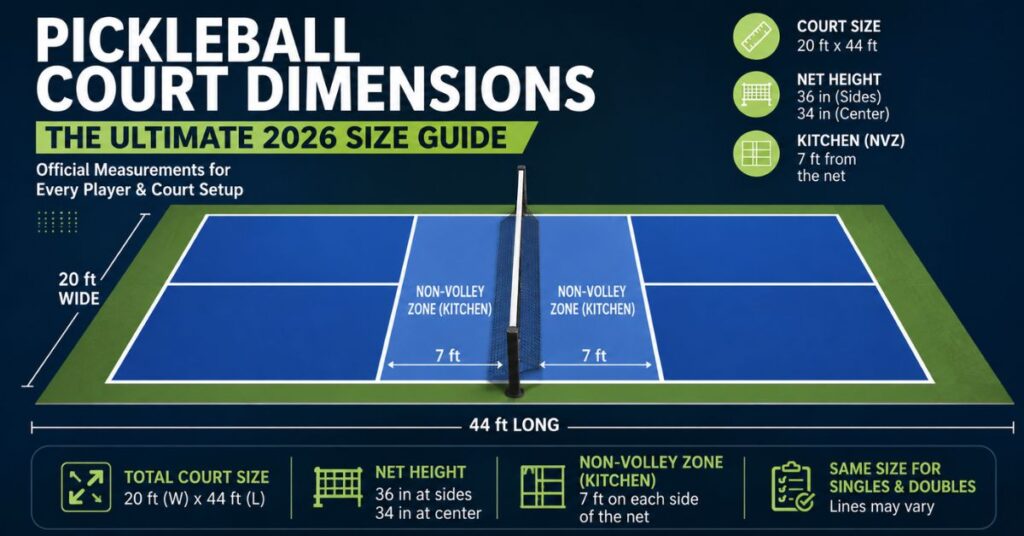
The Pickleball Court Dimensions are 20 feet wide by 44 feet long, the same size for both singles and doubles play. That single measurement is the foundation for everything else on the court, from the kitchen line to the net posts.
This guide breaks down the full official layout, the exact space you need at home, and how the dimensions of a pickleball court stack up against six everyday things you already recognize, like a school bus or a two-car garage. Most articles stop at the basic 20×44 number. Here, you’ll also get the total recommended footprint including buffer zones, which is the part most backyard builders get wrong.
Whether you’re installing a home pickleball court, converting a driveway, or just settling a debate with a friend, this covers the standard pickleball court dimensions in feet, meters, and inches, plus a full breakdown of the non-volley zone, service courts, and net height.
Read More About: Queen Size Bed Dimensions 14 Accurate Measurements for Every Bedroom
How Big Is a Pickleball Court?
According to official USA Pickleball rules, a regulation pickleball playing surface measures 20 feet by 44 feet, which equals 880 square feet of playing area. This applies equally to singles pickleball court dimensions and doubles pickleball court dimensions unlike tennis, pickleball doesn’t widen the court for doubles play.
The court is divided by a net into two 20-by-22-foot halves. Each half then splits again at the non-volley zone line, better known as the “kitchen,” and the centerline, which creates the service courts. Every regulation pickleball court layout, indoors or outdoors, follows this same basic structure.
Indoor pickleball court dimensions and outdoor pickleball court dimensions are identical in terms of playing lines. Pickleball Court Dimensions The difference is the recommended buffer space around the court, which we’ll cover next, since indoor gyms and outdoor courts handle run-off rooms differently.
Quick Conversion Table
| Unit | Court Width | Court Length | Total Recommended Space |
| Feet | 20 ft | 44 ft | 30 ft x 60 ft |
| Inches | 240 in | 528 in | 360 in x 720 in |
| Meters | 6.10 m | 13.41 m | 9.14 m x 18.29 m |
| Centimeters | 609.6 cm | 1341.1 cm | 914.4 cm x 1828.8 cm |
| Yards | 6.67 yd | 14.67 yd | 10 yd x 20 yd |
Quick Reference Table
| Object | Approx. Measurement | Closeness Score (X/10) | Best Situation/Use |
| Badminton doubles court | 44 ft x 20 ft | 10/10 | Visualizing exact court footprint |
| School bus (standard) | 40 ft long | 8/10 | Picturing court length |
| Two-car garage | 20 ft wide | 8/10 | Picturing court width |
| Bowling lane with approach | 60-63 ft long | 7/10 | Picturing total space needed |
| Tennis court (doubles) | 78 ft x 36 ft | 5/10 | Understanding it’s much bigger |
| Volleyball court | 60 ft x 30 ft | 6/10 | Comparing total footprint |
Understanding the Full Pickleball Court Layout
The Non-Volley Zone (Kitchen)
The non-volley zone, or “kitchen,” extends 7 feet from the net on both sides, running the full 20-foot width of the court. That gives each kitchen area an area of 140 square feet, and 280 square feet total for both sides combined, per USA Pickleball’s official rulebook. Players can’t volley the ball while standing inside this zone.
Read More About: Concrete Block Dimensions Made Easy 15 Common Sizes & Measurements
This is one of the most misunderstood pickleball court markings for new players. The kitchen line is what actually shapes pickleball strategy, since it forces players to let the ball bounce before hitting it near the net. Getting these non-volley zone dimensions wrong is a common building mistake for backyard courts.
Service Courts and the Centerline
Each side of the court, beyond the kitchen line, is split by a centerline into two service courts. Each service court measures 10 feet wide by 15 feet long, running from the kitchen line back to the baseline. This layout mirrors how USA Pickleball rules require the server to hit diagonally into the opposite service court, similar to tennis.
Knowing the pickleball service area dimensions matters most for serve accuracy drills. Coaches often use this 10×15 measurement to set up cone drills, since it’s a smaller, more forgiving target than the full baseline width.
Baselines and Sidelines
The baseline runs 20 feet across the back of each half of the court, matching the court’s width. The sidelines run 44 feet total, split 22 feet per side of the net, forming the pickleball court length. Together, the baseline length and sideline measurements form the outer boundary of the entire playing surface.
The Net
USA Pickleball specifies a net height of 36 inches at the posts and 34 inches at the center, where the net naturally sags slightly. The net itself stretches the full 20-foot width of the court, anchored just outside each sideline. These pickleball net dimensions are shorter than a tennis net, which is part of why pickleball games move faster and stay lower to the ground.
Getting the net height right changes the entire feel of the game. A net that’s too high slows down fast net exchanges, while one that’s too low makes the game too easy near the kitchen line, small differences that matter more than most players expect.
Detailed Comparisons 6 Everyday Things Close to a Pickleball Court’s Size
Badminton Doubles Court

A regulation badminton doubles court measures 44 feet by 20 feet, according to the Badminton World Federation nearly identical to a pickleball court’s own 44-by-20 footprint. This overlap isn’t a coincidence; early pickleball courts were often repurposed badminton courts. Anyone standing on a badminton court is basically standing on the dimensions of a pickleball court already.
Key distinction: despite matching outer dimensions, badminton courts have no kitchen zone or service-court markings like pickleball, so the internal layout is completely different even though the outer rectangle matches.
Standard School Bus
A typical American school bus runs about 40 feet long, based on standard specifications from manufacturers like Blue Bird and Thomas Built Buses. That’s just 4 feet short of a full pickleball court’s length, making it one of the easiest everyday things are pickleball court length comparisons to picture in a parking lot.
This comparison helps homeowners judge whether their driveway or side yard has enough room before committing to painting lines. If a school bus would barely fit in your space, a pickleball court probably won’t either.
Two-Car Garage
A standard two-car garage is typically 20 feet wide, matching the exact width of a regulation pickleball court, per common residential building code guidelines. It’s a useful gut-check: if two cars comfortably fit side-by-side in your garage, that’s the same width you’d need for a full court.
Homeowners planning a backyard pickleball court size often use their garage width as the fastest mental reference point, since most people already know roughly how wide their own garage is.
Bowling Lane With Approach

A regulation ten-pin bowling lane measures 60 feet from the foul line to the head pin, and including the approach area, the full length reaches roughly 63 feet, according to United States Bowling Congress specifications. This closely mirrors the total recommended space for a pickleball playing area, which USA Pickleball puts at 30 by 60 feet including buffer zones.
This comparison is especially useful for anyone converting an existing structure, like a barn or warehouse, into an indoor pickleball court dimensions layout, since bowling alleys and pickleball courts need surprisingly similar total footprints.
Read More About: Full Size Bed Dimensions in Feet Surprising Facts
Tennis Court (Doubles)
A regulation doubles tennis court measures 78 feet by 36 feet, according to the International Tennis Federation, making it significantly larger than a pickleball court in both directions. This is exactly why many facilities fit up to four pickleball courts inside the space of a single tennis court.
Something no competitor explained clearly: tennis-to-pickleball court conversions don’t need new concrete. Most conversions simply repaint lines and lower a portable net, since the existing tennis court surface easily contains multiple pickleball courts side-by-side.
Volleyball Court

An indoor volleyball court measures 60 feet by 30 feet, per FIVB regulation standards, which is close to the total recommended footprint for a single pickleball court with buffer space included. Gyms that already have volleyball court markings often have just enough clear floor to add temporary pickleball lines for open-play sessions.
This is a common setup at community recreation centers, where indoor pickleball court dimensions get taped directly onto existing volleyball or basketball flooring rather than requiring a dedicated space.
How Pickleball Court Dimensions Compare to Other Common Courts
Pickleball sits in an unusual middle ground. It’s smaller than a tennis court but close in outer footprint to a badminton court, and it needs less total space than a volleyball or basketball court. That’s a major reason pickleball has spread so quickly into shared gyms, driveways, and converted tennis facilities the dimensions of a pickleball court simply ask for less real estate than most other regulation sports courts.
For homeowners, this smaller footprint is the whole appeal. A backyard pickleball court size of 30 by 60 feet fits into many suburban lots where a tennis court never could.
FAQ’s
What are the dimensions of a pickleball court?
A standard pickleball court measures 20 feet wide by 44 feet long for both singles and doubles.
The non-volley zone (kitchen) extends 7 feet from each side of the net.
What is the cheapest way to make a pickleball court?
The most affordable option is to paint pickleball lines on an existing driveway or concrete slab.
A portable net lets you create a playable court without major construction costs.
Can I turn my driveway into a pickleball court?
Yes, if your driveway has enough flat space, you can add court markings and use a portable net.
A smooth concrete or asphalt surface provides the best playing experience.
How high of a ceiling do you need for a pickleball court?
For indoor play, a ceiling height of at least 18 feet is recommended.
Competitive venues often use 20–30 feet of clearance for comfortable overhead shots.
Final Thoughts
The dimensions of a pickleball court come down to one core number: 20 feet by 44 feet, with an extra 5-10 feet of buffer space recommended on every side. From the 7-foot kitchen zone to the 34-to-36-inch net height, every measurement on the court has a practical reason behind it, whether that’s shaping strategy or keeping players safe from fences and walls.
Comparing that footprint to things like a school bus, a two-car garage, or a badminton court makes the numbers easier to picture than a spec sheet ever could. If you’re planning a home court, start with the full 30-by-60-foot recommendation rather than just the bare 20×44 playing lines it’s the difference between a court that feels cramped and one that plays like the real thing.