
 Abdul Moeed
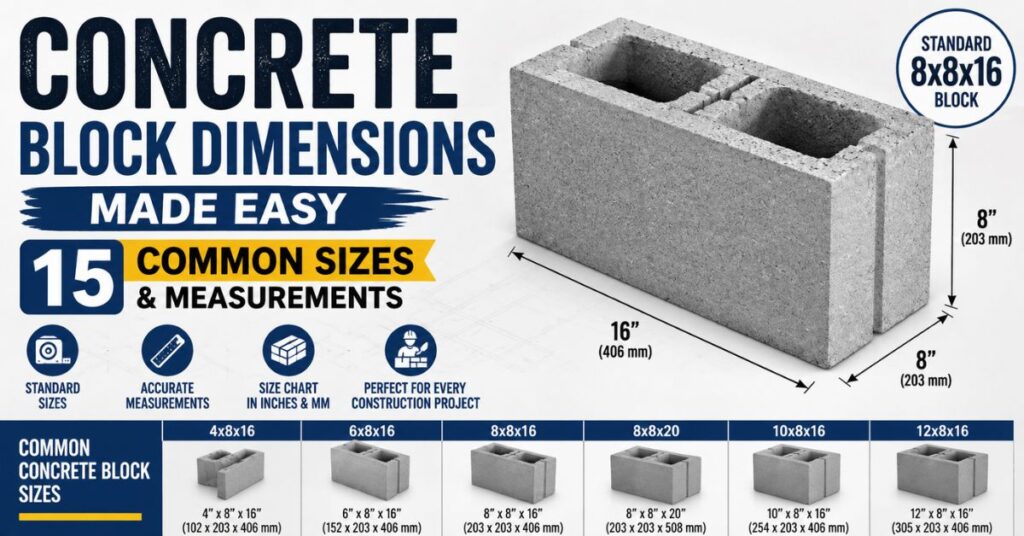
A standard CMU block dimensions measurement is 8 inches high by 8 inches deep by 16 inches long in nominal terms but the actual block is smaller, at roughly 7⅝ x 7⅝ x 15⅝ inches, to leave room for a ⅜-inch mortar joint.
That gap between “nominal” and “actual” trips up a lot of first-time builders, DIYers, and even some contractors ordering material for a job. concrete block dimensions This article breaks down CMU block dimensions for six everyday concrete masonry units from the classic 8x8x16 workhorse to thinner partition blocks and solid bricks using the actual inch, foot, centimeter, and millimeter measurements for each.
Along the way, you’ll get conversion charts, a quick-reference comparison table, and details many block-size guides skip entirely, like how nominal sizing actually works with mortar joints and why that ⅜-inch gap matters more than most people realize when ordering material for a wall.
What Is a CMU Block, and Why Do Dimensions Vary?
A concrete masonry unit, or CMU, is a hollow or solid rectangular block made from cast concrete, used in everything from foundation walls to garden retaining walls. Concrete block sizes are described two ways: nominal size (the size used for design and ordering, including the mortar joint) and actual size (the physical block itself, measured with a tape). concrete block dimensions Standard concrete block dimensions follow ASTM C90, the industry standard for hollow load-bearing concrete masonry units, which most U.S. manufacturers reference when producing blocks.
Read More: Full Size Bed Dimensions in Feet Surprising Facts
Concrete masonry units come in a range of widths, heights, and lengths depending on the job — a load-bearing foundation wall needs a thicker unit than an interior partition wall. Below is a quick look at how CMU block dimensions convert across common measurement units, followed by a comparison chart and six detailed examples.
Quick Conversion Table CMU Block Dimensions
| Unit | 8x8x16 Nominal CMU | 8x8x16 Actual CMU |
| Inches | 8 x 8 x 16 in | 7⅝ x 7⅝ x 15⅝ in |
| Feet | 0.67 x 0.67 x 1.33 ft | 0.64 x 0.64 x 1.30 ft |
| Centimeters | 20.3 x 20.3 x 40.6 cm | 19.4 x 19.4 x 39.7 cm |
| Millimeters | 203 x 203 x 406 mm | 194 x 194 x 397 mm |
Quick Reference Table: Common Concrete Block Sizes
| Block Type | Approx. Nominal Dimensions | Closeness Score (vs. Standard 8x8x16) | Best Situation/Use |
| Standard 8x8x16 CMU | 8 x 8 x 16 in | 10/10 | Load-bearing walls, basements |
| 4-Inch Partition Block | 4 x 8 x 16 in | 6/10 | Interior, non-load-bearing walls |
| 6-Inch CMU | 6 x 8 x 16 in | 8/10 | Garage walls, light structural use |
| 12-Inch CMU | 12 x 8 x 16 in | 7/10 | Retaining walls, heavy foundations |
| Solid Concrete Brick | 4 x 2 x 8 in | 3/10 | Veneers, edging, small projects |
| Half Block (Corner Block) | 8 x 8 x 8 in | 9/10 | Wall corners, ends, openings |
Detailed Look at Concrete Block Sizes
The Standard 8x8x16 Concrete Block
The most common CMU in U.S. residential and light commercial construction carries nominal CMU block dimensions of 8 x 8 x 16 inches, with an actual size of about 7⅝ x 7⅝ x 15⅝ inches once the mortar joint is factored in. concrete block dimensions This is the block most masonry supply yards stock by default, and it’s the size referenced in most ASTM C90 spec sheets. A standard unit typically weighs 28 to 38 pounds, depending on whether it’s normal-weight or lightweight aggregate.
This size matters because it’s the baseline nearly every wall calculator, permit application, and mason’s estimate is built around. If you’re pricing out a basement or garage wall, contractors are almost always quoting off this block. Concrete block sizes for this unit are standardized enough that mismatched pallets from different plants still stack true.
The 4-Inch Partition CMU
A 4-inch partition block runs 4 x 8 x 16 inches nominal, actual around 3⅝ x 7⅝ x 15⅝ inches, making it noticeably thinner front-to-back than a structural block. It’s a hollow concrete block dimension used almost exclusively for interior, non-load-bearing walls, and it shows up often in commercial buildout specs published by masonry associations like the National Concrete Masonry Association (NCMA).
Read More: Twin Bed Dimensions Accurate Measurements for Every Bedroom
Because it’s not built to carry roof or floor loads, a 4-inch block should never substitute for a structural wall unit, even though the length and height match a standard block. Builders sometimes confuse the two on a supply order, which is a mistake worth double-checking before delivery.
The 6-Inch CMU
A 6-inch block measures 6 x 8 x 16 inches nominal, with an actual size near 5⅝ x 7⅝ x 15⅝ inches. It sits between the thin partition block and the full 8-inch structural unit, and it’s a common choice for garages, sheds, and light load-bearing applications where a full 8-inch wall would be overkill. concrete block dimensions Concrete masonry unit sizes like this are popular with residential builders trying to control material cost without sacrificing strength.
Key distinction: unlike the 4-inch block, a 6-inch CMU can often carry modest structural loads when reinforced with rebar and grout, which is why it appears in code tables for one-story accessory structures. Always confirm local building code block sizes before treating it as load-bearing, since requirements vary by jurisdiction.
The 12-Inch CMU

Twelve-inch block carries nominal dimensions of 12 x 8 x 16 inches, actual around 11⅝ x 7⅝ x 15⅝ inches, and it’s the heavyweight of common concrete block dimensions. These units show up most often in retaining walls, foundation walls for larger structures, and basement walls that need to resist significant soil or water pressure. A 12-inch block can weigh 45 to 55 pounds, so laying it typically calls for two people or mechanical lifting on bigger jobs.
Something no competitor explained clearly: a 12-inch block isn’t just a scaled-up 8-inch unit — the web thickness inside the hollow cores is often engineered differently to keep the block from cracking under its own added weight during curing and shipping.
The Solid Concrete Brick
A solid concrete brick measures roughly 4 x 2 x 8 inches nominal, far smaller than a standard CMU, and it’s solid rather than hollow-core. concrete block dimensions Concrete brick dimensions like this follow ASTM C55 rather than C90, since it’s classified as a “concrete building brick” rather than a masonry unit. It’s commonly used for veneer work, garden edging, and small decorative walls rather than structural walls.
Because it’s solid and compact, a concrete brick is easier to cut and shape on-site than a hollow CMU, making it a go-to for detail work around corners, steps, and window openings where a full-size block won’t fit.
The Half Block (Corner Block)
A half block, sometimes called a corner or end block, measures 8 x 8 x 8 inches nominal essentially a standard CMU cut in half lengthwise at the factory. concrete block dimensions It’s a structural concrete block size used to finish wall ends, window and door openings, and corners where a full 16-inch block would overhang the edge of the wall.
Every block wall design accounts for these half units in the layout so the coursing lines up correctly without a mason having to cut full blocks on-site, which saves time and reduces waste on a job.
Read More: Standard Pool Table Dimensions The Simple Size Guide
How CMU Block Dimensions Compare to Other Building Materials

Standard clay bricks, by comparison, run about 3⅝ x 2¼ x 8 inches roughly a third the size of a standard CMU. That size difference is why concrete block wall construction moves faster than brick-by-brick masonry: fewer, larger units mean fewer mortar joints and less labor per square foot of wall. When comparing modular concrete blocks to clay brick or poured concrete forms, the CMU’s larger footprint is usually the deciding factor for foundation walls and basement walls, where speed and structural mass matter more than fine surface detail.
FAQ’s
What size is a standard concrete block?
A standard concrete block is 8 × 8 × 16 inches (nominal size). Its actual dimensions are typically 7⅝ × 7⅝ × 15⅝ inches to allow room for mortar joints.
What is the 4 2 1 rule for concrete?
The 4:2:1 rule is a common concrete mixing ratio of 4 parts gravel, 2 parts sand, and 1 part cement. It is often used for general-purpose concrete projects.
What is the actual size of an 8×8×16 block?
An 8×8×16 concrete block has actual dimensions of 7⅝ × 7⅝ × 15⅝ inches (194 × 194 × 397 mm). The smaller size leaves space for a ⅜-inch mortar joint.
What size is a concrete block in Ireland?
The most common concrete block size in Ireland is 440 × 215 × 100 mm for partition walls. Other standard sizes include 440 × 215 × 150 mm and 440 × 215 × 215 mm for structural walls.
Final Thoughts
Concrete block sizes look simple on paper, but the gap between nominal and actual CMU block dimensions catches plenty of people off guard especially when ordering material or planning a layout by hand. From the standard 8x8x16 unit to thinner partition blocks, heavier 12-inch retaining wall block, and compact solid bricks, each size serves a distinct role in residential and commercial construction. Knowing the real CMU block dimensions before you order, not just the rounded nominal figures, is what keeps a wall count accurate and a project on budget.