
 Abdul Moeed
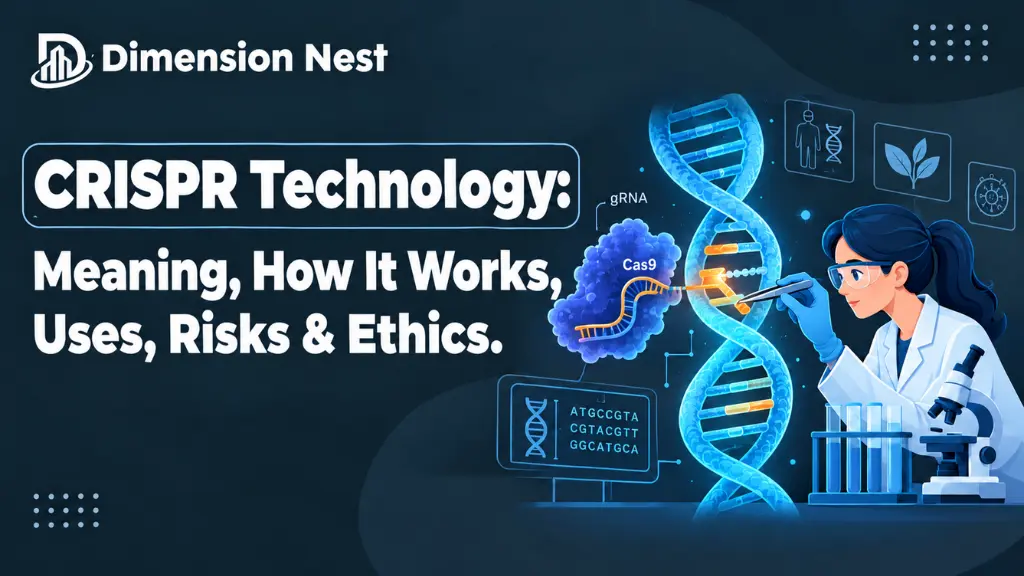
CRISPR technology lets scientists cut, delete, or rewrite DNA at chosen locations inside living cells. Researchers borrowed the method from bacteria, which use it to defend themselves against viruses. Since 2012, the tool has moved from basic biology labs into hospitals, farms and diagnostic kits.
Few modern tools have spread through science and medicine as quickly as gene editing. Likewise, digital twin technology builds virtual copies of physical systems for testing. Biologists also rely on computer models to predict gene edits before lab work begins.
This guide explains what the method means, how it works and where it helps. It also covers the risks, the costs and the ethical debates that surround editing human genes.
Quick Answer: What Is CRISPR Technology?
CRISPR technology is a gene-editing method that cuts DNA at a chosen spot. A guide RNA leads the Cas9 enzyme to the target sequence, and the cell repairs the cut. Results depend on the target, the delivery method, and the repair pathway the cell chooses.
CRISPR Technology at a Glance
| Item | Detail |
|---|---|
| Full name | Clustered regularly interspaced short palindromic repeats |
| Origin | Bacterial defense system against viruses |
| Core parts | Guide RNA and a Cas enzyme |
| Best-known enzyme | Cas9 from Streptococcus pyogenes |
| Main use | Editing DNA in cells, plants and animals |
| First approved therapy | Casgevy for sickle cell disease and beta thalassemia |
| Main risks | Off-target cuts, delivery limits and high cost |
Overall, the system has only two core parts, which explains why labs embraced it so quickly.
What Does CRISPR Stand For and Where Did It Come From?
Meaning of the name
The acronym CRISPR stands for clustered regularly interspaced short palindromic repeats, a pattern found in bacterial DNA. Each repeat sits between short spacer sequences that match DNA from past viral invaders. Bacteria keep these spacers as a genetic memory and use them to recognize returning viruses.
Bacteria add new spacers after surviving an infection, using the Cas1 and Cas2 proteins. Later, the stored spacers produce RNA guides that lead Cas enzymes to returning viruses.
Viruses that infect bacteria, called phages, are the most abundant biological entities on Earth. Because phages attack constantly, bacteria built many layered defenses against infection over time. CRISPR systems appear in roughly 40 percent of sequenced bacterial genomes and most archaeal genomes.
From odd repeats to an immune system
Yoshizumi Ishino and colleagues first noticed the unusual repeats in Escherichia coli in 1987. Francisco Mojica later found similar repeats in archaea and proposed an immune role around 2005. In 2007, Rodolphe Barrangou and Philippe Horvath showed that Streptococcus thermophilus used spacers to resist phages. Their experiment gave the first direct proof that the system works as bacterial immunity.
The 2012 breakthrough
A team led by Jennifer Doudna and Emmanuelle Charpentier published a landmark paper in 2012. The paper showed that scientists could reprogram Cas9 with a custom RNA to cut chosen DNA. In 2013, teams led by Feng Zhang and George Church applied the method in human cells. The Royal Swedish Academy of Sciences awarded the 2020 Chemistry prize to Doudna and Charpentier.
Milestones in CRISPR technology
| Year | Milestone | Who |
|---|---|---|
| 1987 | Unusual repeats noticed in bacterial DNA | Ishino and colleagues |
| 2005 | Immune role proposed for the repeats | Mojica and other groups |
| 2007 | Bacterial immunity shown in experiments | Barrangou, Horvath and colleagues |
| 2012 | Programmable Cas9 reported | Doudna, Charpentier and colleagues |
| 2013 | Editing shown in human cells | Zhang, Church and Doudna teams |
| 2016 | First base editor reported | Liu laboratory |
| 2019 | Prime editing reported | Liu laboratory |
| 2020 | Nobel Prize in Chemistry | Doudna and Charpentier |
| 2023 | First CRISPR therapy approved | Vertex and CRISPR Therapeutics |
The timeline shows that a basic curiosity about bacteria took about 36 years to reach patients.
How Does CRISPR Technology Work?
The system needs two working parts, and bacteria supply the original version of both. Researchers assemble both parts in the lab and send them into the cells they want to edit.
Guide RNA -> Cas9 binds -> Target DNA found -> Double-strand cut -> Cell repair -> Edited geneThe guide RNA finds the target
The guide RNA contains about 20 letters that match the DNA sequence scientists want to change. In nature, two RNA molecules, crRNA and tracrRNA, work together to guide the Cas9 enzyme. Scientists fused them into one single guide RNA, which made experiments easier to run.
Cas9 scans the genome and binds only where the match sits beside a short motif. That motif, called the PAM, reads NGG for the common Cas9 enzyme.
Cas9 cuts the DNA
After a match, Cas9 cuts both DNA strands about three letters before the PAM. The cut creates a double-strand break, which the cell treats as urgent damage.
The cell repairs the break
Cells repair the break through two main routes, and scientists try to steer the result. Non-homologous end joining glues the ends together and often adds or deletes single letters. Those small errors usually disable a gene, which makes this route useful for knockouts.
Homology-directed repair copies a supplied DNA template into the gap and allows precise rewrites. Because most cells prefer the first route, precise correction remains harder to achieve.
In simple words, CRISPR technology works like a find-and-replace tool for DNA text.
How editors reach cells
Delivery decides whether a laboratory tool ever becomes a usable medicine for real patients. Electroporation sends editing components into cells through brief electrical pulses in a dish. Adeno-associated viruses carry editing genes into tissues, but their cargo space stays small. Lipid nanoparticles carry editing mRNA to the liver and have reached clinical testing.
Enzyme size also matters a great deal when teams plan delivery into real tissues. SpCas9 contains 1,368 amino acids, which strains the cargo limits of viral vectors. Smaller enzymes from Staphylococcus aureus fit inside adeno-associated viruses more easily during delivery.
Switching genes on or off without cutting
Scientists can disable the cutting ability of Cas9 and create a variant called dCas9. The dead enzyme still binds DNA, so it can block a gene or recruit activating proteins. These methods, called CRISPR interference and CRISPR activation, change gene activity without altering the DNA sequence. Epigenome editors extend the idea by adding or removing chemical marks on DNA.
Which Cas Enzymes and Editors Do Scientists Use?
Scientists group natural CRISPR systems into two classes and six main types. Class 1 systems use a complex of many proteins, while Class 2 systems rely on one large protein. Cas9, Cas12 and Cas13 all belong to Class 2, which explains their popularity in laboratories.
Cas9 remains the best-known tool, but newer enzymes solve problems that Cas9 leaves open.
| Tool | What it does | Typical use |
|---|---|---|
| Cas9 | Cuts both DNA strands | Gene knockouts |
| Cas12a | Cuts DNA and leaves staggered ends | Multiple edits, diagnostics |
| Cas13 | Cuts RNA instead of DNA | RNA knockdown, detection |
| Base editors | Swap one DNA letter without a full cut | Point-mutation fixes |
| Prime editors | Write short new sequences from an RNA template | Precise small edits |
| dCas9 | Binds DNA without cutting | Switching genes down or up |
Teams match each tool to the goal, since cutting, swapping, and silencing need different editors.
Feng Zhang’s team reported the Cas12a enzyme, originally named Cpf1, in 2015 as a Cas9 alternative. David Liu’s laboratory built the first base editors in 2016 and prime editors in 2019. Neither method needs a full double-strand break, which lowers the chance of messy repairs.
CRISPR, Cas9 and Gene Therapy: Terms That Confuse Readers
Media reports often mix related terms, which creates confusion about what each one means.
| Term | Meaning | Example |
|---|---|---|
| CRISPR | The bacterial repeat system and the tools built from it | CRISPR-Cas9 editing |
| Cas9 | The enzyme that cuts DNA | Streptococcus pyogenes Cas9 |
| Guide RNA | The RNA that points the enzyme to a target | A 20-letter sequence |
| Gene editing | Any method that changes DNA at a chosen site | CRISPR, TALENs, ZFNs |
| Gene therapy | Any treatment that adds, removes, or changes genes | Viral gene delivery or CRISPR editing |
| GMO | An organism with altered DNA, often with foreign genes | Bt corn |
Overall, CRISPR is one gene-editing method, and gene editing can serve as one form of gene therapy.
CRISPR Technology vs ZFNs and TALENs: Differences Explained
Zinc finger nucleases and TALENs came first, and both still appear in research and early clinical trials.
| Feature | ZFNs | TALENs | CRISPR-Cas9 |
|---|---|---|---|
| Targeting method | Protein domains | Protein repeats | Guide RNA |
| Design effort | High, new protein per target | High, long repeat assembly | Low, new RNA per target |
| Cost | Highest | High | Lowest |
| Multiple edits at once | Hard | Hard | Practical |
| Maturity | Oldest | Established | Newest, widest use |
Because a guide RNA costs little to order, CRISPR made gene editing routine for small labs. Older tools still matter when a protein-based system suits a clinical design better.
Where Do Researchers Use CRISPR Technology Today?
Medicine and gene therapy
Casgevy became the first approved CRISPR-based therapy after regulators cleared it in late 2023. Doctors use it to treat sickle cell disease and transfusion-dependent beta thalassemia. Other teams test edits for inherited blindness, high cholesterol, amyloidosis and certain cancers. Doctors in Philadelphia reported in 2025 that a custom base editor helped an infant with metabolic disease. That case suggests future therapies could match each edit to one patient’s exact mutation.
Intellia Therapeutics reported in 2021 that one infusion lowered a disease protein in patients. This in vivo method edits cells inside the body instead of in a lab dish. Cancer researchers also edit immune T cells to improve their ability to attack tumors.
Agriculture and food
Breeders use CRISPR to create crops with higher yields, longer shelf life, or disease resistance. Japan cleared a tomato edited to contain more GABA, and sales began in 2021. The United States Department of Agriculture also let a non-browning mushroom proceed without extra review in 2016. Regulators in each country treat edited crops differently, so rules vary widely by market.
Diagnostics
Scientists also repurposed Cas12 and Cas13 as sensors that detect genetic material from pathogens. The SHERLOCK and DETECTR platforms, built on those enzymes, produce detectable signals when a target sequence appears. Developers aim for cheap, fast tests that work outside a full laboratory.
Animal research and gene drives
Scientists create mouse, zebrafish, and pig models that carry human disease mutations. Gene drive projects aim to spread a trait through wild mosquito populations to reduce malaria. Because releases could alter ecosystems, field trials face intense scientific and regulatory scrutiny.
Drug discovery and disease models
Pharmaceutical teams use CRISPR screens to find genes that make tumors resist treatment. Edited stem cells can also grow into organoids, which act as miniature disease models for drug testing. These models let researchers test drugs on human tissue before any patient takes a dose.
Basic research and industry
Genome-wide CRISPR screens test about 20,000 human genes in one pooled experiment. Researchers use the results to find cancer drug targets and explain disease mechanisms. Industrial biologists edit yeast and bacteria to produce fuels, foods and medicines.
Key Characteristics That Make CRISPR Technology Useful
These traits explain why the method spread across so many scientific fields:
- The system is programmable, because a new guide RNA redirects the same enzyme to a new target.
- Guide RNAs cost little to order, so small laboratories can run large experiments.
- The same core method works in bacteria, plants, animals and human cells with small changes.
- Researchers can edit two or more genes at once by supplying matching guide RNAs.
- Newer editors change single letters without cutting both DNA strands, which improves precision.
- Edits can last permanently and pass to daughter cells, which suits long-term therapies.
Is CRISPR Technology Safe? Risks and Limits
CRISPR technology is not inherently safe or unsafe, because outcomes depend on design, delivery, and dose.
| Risk | Cause | How researchers reduce it |
|---|---|---|
| Off-target cuts | Guide RNA matches similar sites | Better guide design, high-fidelity Cas9, sequencing |
| On-target damage | Large deletions at the cut site | Base and prime editors, careful screening |
| Mosaicism | Edit happens after cell division begins | Edit early, verify cell populations |
| Immune response | The body reacts to the Cas protein or vector | Patient screening, short-lived delivery |
| Delivery limits | Large cargo and tissue barriers | Lipid nanoparticles, engineered viruses |
Teams manage these risks through careful design, thorough sequencing, and slow clinical testing.
Off-target effects and mosaicism
Off-target effects remain the best-known concern, since a guide can match DNA sequences elsewhere in the genome. Researchers now use high-fidelity Cas9 variants and whole-genome sequencing to find unwanted cuts. Another concern, mosaicism, appears when only part of the cells in an embryo or tissue carry the edit.
Delivery and cost
Delivery creates a second hurdle, because large editing tools must reach the right cells. Doctors often edit blood cells outside the body, then return them to the patient. Liver-directed treatments use lipid nanoparticles, because those particles naturally collect in that organ.
Cost adds another barrier, since the first approved therapy carries a list price near $2.2 million. Doctors, patients and regulators weigh these risks against the severity of each disease.
Immune reactions
Studies have found immune responses to Cas9 in healthy adults, which complicates certain therapies. Transient delivery with messenger RNA limits how long the editor stays in the body.
Long-term monitoring
Regulators often ask developers to follow patients who receive genome-edited cells for up to fifteen years. Those long studies check for delayed cancers, immune problems, and unexpected edits.
Ethics and Law: Somatic vs Germline Editing
| Feature | Somatic editing | Germline editing |
|---|---|---|
| Cells changed | Body cells of one patient | Embryos, eggs or sperm |
| Inherited by children | No | Yes |
| Current status | Approved therapies and trials | Prohibited or tightly restricted in many countries |
| Main concern | Safety and fair access | Safety, consent of future generations, enhancement |
Somatic editing changes only the treated patient, so regulators judge it like other new medicines. Germline editing changes embryos, eggs or sperm, so every later generation inherits the edit.
In 2018, He Jiankui announced the birth of gene-edited twins in China. Scientists and regulators condemned the work, and a Chinese court jailed him in 2019 for three years. Many countries now prohibit or tightly restrict editing embryos that doctors plan to use for pregnancy.
Fair access raises a separate debate, because approved treatments cost more than many patients can afford.
Treatment versus enhancement
Public debate separates editing to treat serious disease from edits meant to boost traits such as height. Correcting a fatal inherited disorder draws wider support than boosting traits does.
Global access
Sickle cell disease affects millions of people, and sub-Saharan Africa carries the largest share. Complex hospital-based therapies priced near $2.2 million cannot reach most of those patients soon. Researchers are exploring in vivo editing, which could cut costs and remove the need for transplants.
Common Myths About CRISPR Technology
| Myth | Reality |
|---|---|
| CRISPR always edits with perfect precision | Cells repair cuts imperfectly, so sequencing must verify every edit |
| CRISPR already cures every genetic disease | Few therapies have approval, and each targets one disease |
| Edited crops equal classic GMOs | Rules often treat edits without foreign DNA differently |
| Designer babies are now routine | Germline editing for pregnancy is prohibited or restricted in many countries |
| Scientists invented CRISPR in 2012 | Bacteria used the system for ages, and scientists reprogrammed it in 2012 |
These myths usually overstate precision, cures, or speed, so careful sources matter.
How Does Digital Modeling Support CRISPR Research?
Computer models now predict which guide RNAs cut well and which ones risk off-target damage. Machine learning tools rank candidate guide sequences within seconds, long before researchers order any reagents. Teams also simulate how guide RNAs fold, because RNA shape affects cutting strength. Open databases list known variants and predicted effects, which speeds early planning.
Digital twin technology follows the same logic by simulating a real system in software first. Researchers have discussed virtual cell and patient models that could one day test edits safely. Still, a model only predicts outcomes, so laboratory verification remains a required final step. Do not treat a predicted score as proof that an edit works safely.
Real-World Example: How Casgevy Reached Patients
Vertex Pharmaceuticals and CRISPR Therapeutics developed Casgevy, a therapy for sickle cell disease. Doctors collect a patient’s blood stem cells and edit them in the laboratory. The edit disrupts a regulatory region of the BCL11A gene, which normally silences fetal hemoglobin.
Higher fetal hemoglobin helps red blood cells carry oxygen normally and reduces painful sickling episodes. Patients receive chemotherapy to clear old marrow, then get their edited cells back by infusion. The United Kingdom approved the therapy in November 2023, and the United States followed in December.
The case shows the full path from bacterial immunity to a regulated medicine in roughly eleven years. The process takes months and requires hospital stays, so access remains limited.
Practical Guide: How a Typical CRISPR Experiment Runs
Step 1: Define the goal and the edit type
Decide first whether the project needs a knockout, a precise correction or a gene switch. That choice sets the tool, the template and the checks that follow.
Step 2: Design and test guide RNAs
Use a design tool to list candidate guides and score their predicted off-target risk. Choose two or three guides per target, because performance varies between sequences.
Step 3: Choose a delivery method
Cells in a dish accept plasmids, mRNA, or pre-assembled Cas9 and guide RNA complexes. Pre-assembled complexes act fast and clear quickly, which lowers the risk of off-target cutting.
Step 4: Edit the cells and grow them out
Introduce the editing components, wait two to three days, and collect the cells. Many protocols also isolate single cells so each colony carries one uniform edit.
Step 5: Verify the edit by sequencing
Sequence the target region to confirm the intended change and measure editing efficiency. Add protein or function tests to prove the edit changed the gene’s behavior.
Step 6: Check for off-target effects
Screen the top predicted off-target sites, or run unbiased genome-wide detection methods. Clinical programs require this step, and regulators expect a thorough report before any trial begins.
Best Practices for Responsible CRISPR Projects
Responsible teams document every design choice, so other laboratories can reproduce the result. Likewise, they publish negative results and unexpected edits instead of hiding them. Institutional review boards, biosafety committees, and national regulators oversee human and animal work.
Teams also follow guidance from the World Health Organization and international genome editing summits. Public engagement matters too, because patients and communities help decide which uses deserve support. Laboratories also validate every guide RNA batch, because impurities can change editing results. Clear data sharing lets reviewers check claims about editing efficiency and unwanted changes.
Common Mistakes With CRISPR Technology
1. Treating CRISPR as a perfectly precise tool
Many news stories describe the method as exact, but cells repair cuts imperfectly. Every edit needs verification by sequencing, because assumed success often hides unintended changes.
2. Confusing somatic and germline editing
Approved therapies edit body cells and leave no inherited trace in the patient’s children. Mixing the two categories fuels needless fear and weakens honest public debate about real risks.
3. Using a single guide RNA
One guide may cut poorly or hit unwanted sites in the genome. Testing two or three guides per target gives a fair view of performance.
4. Skipping delivery planning
A perfect guide RNA fails when the editor never reaches the target tissue. Teams should choose the delivery route before they finalize the editing design.
5. Ignoring regulation and ethics early
Projects that involve people, embryos, or released organisms need approval before any experiment begins. Late reviews waste months of work and can end a promising study.
6. Trusting hype over evidence
Headlines often promise cures for every disease, yet approved CRISPR treatments remain rare. Readers should check clinical trial registries and peer-reviewed papers before trusting a claim.
7. Forgetting controls
Experiments without control cells cannot show whether an edit caused the observed change. Include unedited cells and cells that received a non-targeting guide in every run.
CRISPR Technology Checklist
Use this list to review any CRISPR project plan before work begins:
- Define the edit goal as a knockout, a correction, or a gene switch.
- Select a Cas enzyme or editor that matches the edit type and the target cell.
- Design two or three guide RNAs and score each one for off-target risk.
- Plan delivery for the target cell type before ordering any reagents or materials.
- Confirm the edit by sequencing the target region in every edited cell population.
- Screen predicted off-target sites and record every unintended change that appears in the results.
- Obtain ethics, biosafety and regulatory approvals before starting any work with people or animals.
- Report methods, controls and negative results so other laboratories can reproduce the work.
CRISPR Technology Interview and Exam Questions
Students and job candidates often meet the same core questions in genetics courses and interviews.
What does the PAM sequence do?
The PAM marks the spot where Cas9 may bind and cut, so it limits possible targets.
Why does homology-directed repair work less often than end joining?
Homology-directed repair needs a template and works mainly in dividing cells, while end joining works anytime.
How do base editors differ from standard Cas9?
Base editors change one DNA letter directly and avoid a full double-strand break. Standard Cas9 cuts both strands and relies on the cell to repair the damage.
How would a team reduce off-target effects?
Teams pick guides with unique matches, use high-fidelity enzymes, shorten exposure and sequence the results. They also compare edited cells against untouched controls to confirm that the change came from the editor.
Next Step: Connect Gene Editing With Digital Modeling
Readers who want a wider view of virtual modeling can start with the Digital Twin Technology guide. That guide explains how simulated copies of real systems support planning and testing. Together, the two topics show how software and biology now work side by side.
Frequently Asked Questions
What is CRISPR technology in simple words?
CRISPR technology is a gene-editing method that cuts DNA at a chosen location. A guide RNA finds the target, and the Cas9 enzyme makes the cut. The cell repairs the break afterward, and that repair step changes the gene.
Who invented CRISPR technology?
No single person invented CRISPR technology, because many researchers contributed over decades. Ishino, Mojica, Barrangou, Horvath, Doudna, and Charpentier each added a major step. Doudna and Charpentier received the 2020 Nobel Prize in Chemistry for the gene-editing tool.
Is CRISPR technology approved for human use?
CRISPR technology has reached patients through Casgevy, which regulators approved in late 2023. Most other CRISPR therapies remained in clinical trials at the time of writing. Developers continue to test CRISPR technology in diseases of the eye, liver and blood.
Can CRISPR technology cure genetic diseases?
CRISPR technology can correct or bypass certain disease-causing mutations, but proven cures remain limited. Casgevy offers the strongest evidence so far, and long-term follow-up studies continue to track patients. Most patients with other inherited conditions still wait for approved edits to reach clinics.
How is CRISPR technology different from GMOs?
CRISPR technology edits genes already inside an organism, while classic genetic modification often adds foreign DNA. Regulators in many countries treat edited crops without foreign DNA more lightly than transgenic crops. Labeling and trade rules still differ, so food companies track each market separately.
What does Cas9 stand for?
Cas9 stands for CRISPR-associated protein 9, the enzyme that cuts DNA in the best-known system. CRISPR technology relies on Cas9 plus a guide RNA to find and cut matching sequences.
Is CRISPR technology safe?
CRISPR technology is not inherently safe or unsafe, because risk depends on the target and delivery. Off-target cuts, immune reactions, and incomplete edits remain the main concerns in clinical research.
How much does CRISPR therapy cost?
CRISPR technology therapies cost far more than standard drugs, because makers prepare each dose from patient cells. The list price of Casgevy in the United States reached $2.2 million per patient.
Can CRISPR technology edit human embryos?
CRISPR technology can edit human embryos in a laboratory, but many countries prohibit using them for pregnancy. The 2018 case in China drew worldwide condemnation and led to tighter oversight rules.
What is the future of CRISPR technology?
CRISPR technology will likely grow through safer editors, better delivery and wider disease targets. Progress still depends on solid clinical evidence, fair pricing and sustained public trust in the field.
Key Takeaways
- CRISPR technology edits DNA by pairing a guide RNA with a Cas enzyme.
- Bacteria developed the system as a defense against viruses long before scientists used it.
- Doudna and Charpentier showed in 2012 that scientists can reprogram the system with custom RNA.
- Cells repair the cut through end joining or homology-directed repair, and each route yields different results.
- Base editors and prime editors change DNA without making a full double-strand break.
- Casgevy became the first approved CRISPR-based therapy for sickle cell disease and beta thalassemia.
- Farmers and food companies use edited crops, and rules differ by country.
- Cas12 and Cas13 enzymes support fast diagnostic tests that detect genetic material from infectious pathogens.
- Off-target cuts, delivery limits, and cost remain the main technical and practical barriers.
- Somatic editing changes one patient, while germline editing changes every later generation.
- Computer models predict guide performance, but laboratory sequencing must confirm every edit.
- Responsible projects document methods, seek approvals early, and report unexpected results openly.
- Readers should judge CRISPR claims by trial registries and peer-reviewed evidence, not headlines.
Final Thoughts
CRISPR technology turned a bacterial defense system into a flexible tool for editing life. Its promise is real, but safety, fairness, and honest evidence must guide every new use. Readers who follow the science closely should expect more approved therapies, better editors and clearer rules.
Explore more technology guides on Dimension Nest to keep learning about science and innovation.