
 Abdul Moeed
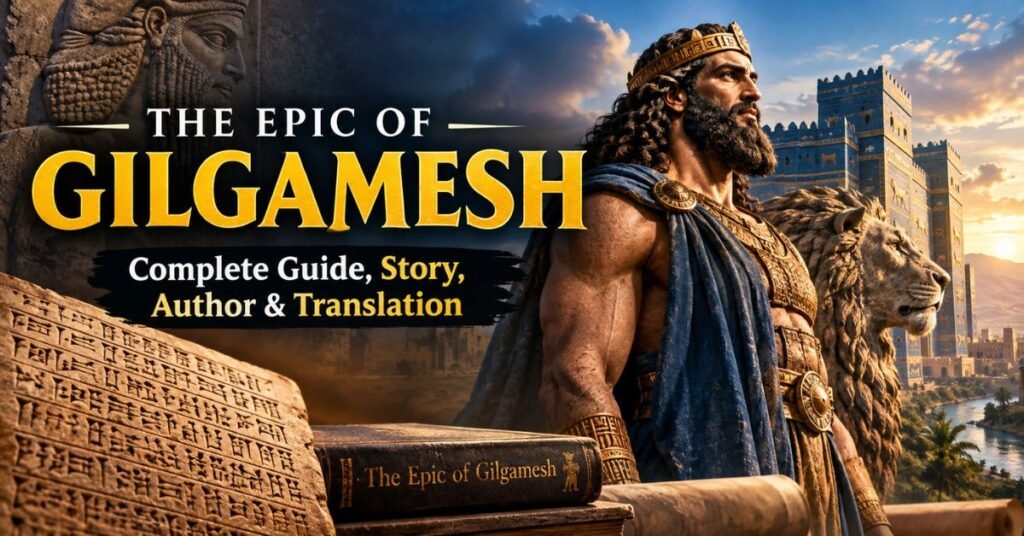
Epic Gilgamesh By Anonymous introduces one of the oldest surviving literary works in human history: The Epic of Gilgamesh. What would you do if your best friend died and you feared you’d be next? That question sits at the heart of this ancient Mesopotamian story. Nearly 4,000 years old, the epic still feels remarkably relevant today. This guide explores the story of Gilgamesh, the history of The Epic of Gilgamesh, its different versions, major themes, and the Sophus Helle translation. Grab a cup of tea and settle in as we explore this remarkable ancient epic.
Epic Gilgamesh By Anonymous
The Epic of Gilgamesh is a Mesopotamian epic about a proud ruler and his hunt for life without end. Scribes wrote it on cuneiform tablets made of clay. They used Sumerian poems first and later Akkadian literature. Many readers call it the oldest epic poem and one of the oldest surviving literature pieces on Earth. It grew out of ancient Sumerian literature and matured in Babylonian literature. Epic Gilgamesh By Anonymous The tale also draws on rich Mesopotamian mythology and Sumerian mythology.
Here’s the quick view. You can also read the Five Books entry for this translation to see the edition featured in this guide. Below, you’ll meet the author, the plot, the themes, and the book itself.
| Fact | Detail |
| Title | The Epic of Gilgamesh |
| Author | Anonymous (ancient Mesopotamian scribes) |
| Featured translator | Sophus Helle |
| Original languages | Sumerian and Akkadian |
| Writing system | Cuneiform on clay tablets |
| Main theme | Mortality and the search for meaning |
Who Wrote The Epic of Gilgamesh?
Nobody knows for sure who wrote The Epic of Gilgamesh. No single person sat down and composed it. Instead, storytellers in Sumer shared short tales about King Gilgamesh for generations. Later, Babylonian epic poets stitched those tales into one long poem. Epic Gilgamesh By Anonymous That’s why the Five Books page lists the author as “Anonymous”. Think of it like a village recipe. Many cooks added a pinch here and there.
Read More: Best Books to Read in 2026: Expert Recommendations, Popular Genres & Book Lists
Still, one name does appear in the tradition. Ancient sources credit a scribe named Sîn-lēqi-unninni with the later, polished text. He worked around 1200 BCE. However, scholars treat this as a tradition rather than proven fact. He likely edited older material and gave it a fixed shape. Epic Gilgamesh By Anonymous So the best answer stays simple. Many hands wrote this ancient epic poem over many centuries.
Who Is Sophus Helle?
Sophus Helle is a Danish scholar who studies Assyrian literature and Babylonian literature. As an Assyriologist, he reads cuneiform writing for a living. He’s also a gifted Sophus Helle translator who wants ancient poems to sound alive. His work shows that these texts aren’t dusty relics. Epic Gilgamesh By Anonymous They’re real literature with rhythm, jokes, and heart.
Helle has translated more than one famous work. Besides the Gilgamesh volume, he also produced Enheduana: The Complete Poems of the World’s First Author. You can browse his Five Books profile to see his listed books. His Epic of Gilgamesh translation has won many new fans. Readers say it feels clear and modern.
What Is The Epic of Gilgamesh About?
So, what is The Epic of Gilgamesh about? In short, it’s about a king who learns he must die. Gilgamesh rules Uruk and behaves badly at first. The gods send a wild man named Enkidu to stop him. The two fight and then become close friends. Together they kill monsters. Epic Gilgamesh By Anonymous Then Enkidu dies. Gilgamesh grieves and sets out to find a cure for death.
You could call it a road trip that starts with ego and ends with humility. The hero leaves home believing he can beat fate. He returns home wiser and calmer. Along the way, he meets a tavern keeper and a survivor of the great flood. Each meeting teaches him something. Epic Gilgamesh By Anonymous This Gilgamesh story works because we all fear loss. Gilgamesh simply says it out loud.
The Story and Main Themes of The Epic of Gilgamesh
The Epic of Gilgamesh complete story moves in three big steps. First, a proud king meets his match. Second, he loses his friend. Third, he searches the world for an answer. The plot and the themes of The Epic of Gilgamesh work hand in hand. Every adventure pushes the hero closer to one hard truth. Life is short, so it matters.
Three ideas run through the poem, and the sections below explore them. They are friendship, the hunt for immortality, and death and mortality in Gilgamesh. Read on to see how each one shapes the meaning of The Epic of Gilgamesh.
Gilgamesh and Enkidu
Early on, King Gilgamesh is a bully. He is two-thirds god and one-third human, and he’s strong and restless. His people cry out for help. The gods answer by creating Enkidu, a wild man who lives with the animals. When the two meet, they wrestle. Neither wins. Then they laugh and hug. That moment starts the Gilgamesh and Enkidu friendship, the emotional core of the whole Gilgamesh epic. Epic Gilgamesh By Anonymous Together they travel to the cedar forest and defeat the guardian Humbaba, with a boost from the sun god Shamash. Later, the goddess Ishtar offers to marry Gilgamesh. He refuses and mocks her. She sends the Bull of Heaven to punish him, and the friends kill it. As Stephen Cave explains on Five Books, the gods decide Enkidu must die. You can read his retelling of the story for a lively summary. This shows Gilgamesh and the gods in open conflict.
The Search for Immortality
After Enkidu dies, Gilgamesh can’t rest. He wanders the wilderness in rough clothes. His Gilgamesh search for immortality leads him to Utnapishtim, the only human who survived the great flood. Along the way, the tavern keeper Siduri gives him a gentle warning. She tells him to enjoy food, love, and family instead. Gilgamesh doesn’t listen at first. Utnapishtim tells the Gilgamesh flood story and then sets a test. Stay awake for a week. Gilgamesh fails and falls asleep at once. Finally, he wins a magic plant that renews youth. On the trip home, a snake steals it. This journey and adventure ends in loss. Epic Gilgamesh By Anonymous Yet the loss teaches him something real.
Death, Friendship, and Human Mortality
Grief changes Gilgamesh more than any battle. He sees Enkidu’s body and finally understands that human mortality comes for everyone. The poem doesn’t hide that pain. Instead, it turns the pain into wisdom. When Gilgamesh returns to Uruk, he looks at its great walls with pride. He can’t live forever, but his city can last. Epic Gilgamesh By Anonymous That’s a quiet and powerful ending. As Tuva Kahrs notes on Five Books, the tale speaks of “love and loss, our fear of death, and search for meaning”. Readers today still feel that. Have you ever lost someone and wondered what really lasts?
The Historical Origins of The Epic of Gilgamesh

The history of The Epic of Gilgamesh starts with a real person. Historians think Gilgamesh king of Uruk ruled around 2600 BCE in ancient Iraq. Over time, people turned him into a legend. Poets in Sumer wrote separate poems about his deeds. Then, around 1800 BCE, Old Babylonian writers joined those tales into one story. This shows how Mesopotamia blended memory with mythology and literature. It’s a fine window into Mesopotamian civilization and the wider ancient Near East.
The modern rediscovery reads like a detective story. Epic Gilgamesh By Anonymous Diggers found thousands of Epic of Gilgamesh tablets in the library of King Ashurbanipal at Nineveh. Nobody could read them at first. Then, in 1872, a self-taught scholar named George Smith made a stunning announcement. He had read a flood myth on one tablet that matched the Bible’s story. The news shocked the public.
| Period | Event |
| About 2600 BCE | The historical Gilgamesh likely rules Uruk |
| About 2100 BCE | Sumerian poems about Gilgamesh appear |
| About 1800 BCE | Old Babylonian version takes shape |
| About 1200 BCE | Standard Babylonian version is compiled |
| 1872 | George Smith announces the flood tablet |
The Different Versions of The Epic of Gilgamesh
There isn’t just one version. The oldest are the stand-alone Sumerian tales. The Old Babylonian version came next, and it’s shorter and rougher. Later came the Standard Babylonian Version, which is longer and more polished. It runs across twelve tablets. Scholars often call it the most complete Babylonian epic. Each stage reflects how ancient Mesopotamian literature changed over time. Epic Gilgamesh By Anonymous Together, these are the best ancient literary texts we have from that world.
Gaps make things tricky. Many clay pieces are broken or missing. So translators must guess at some lines. Every edition therefore looks a little different. One translator may fill a gap with a careful note. Another may leave a blank. That’s normal for ancient literary texts. It also means no two English versions feel quite alike.
| Version | Approximate Date | Key Trait |
| Sumerian poems | About 2100 BCE | Separate short tales |
| Old Babylonian | About 1800 BCE | Early single story |
| Standard Babylonian | About 1200 BCE | Longest and most polished |
Sophus Helle’s Translation of The Epic of Gilgamesh
The Sophus Helle translation comes from Yale University Press. It’s a fresh Epic of Gilgamesh translation built for modern readers. Helle treats the poem as living art. He pays close attention to rhythm and repeated phrases. So the Epic of Gilgamesh book reads smoothly instead of stiffly. Its lines feel clear and direct. Check the introduction of the book itself for the exact details of his method.
Read More: Connectivity HSSGamepad Reviews: 7 Tips for Stable, Lag-Free Gaming
Many English translations exist. Some stay close to the scholarly text. Others aim for pure poetry. Helle’s version tries to balance both goals. That makes it a good pick for first-time readers. You can find the edition through the Five Books buy page. Five Books earns money from qualifying Amazon purchases, so keep that in mind.
Why The Epic of Gilgamesh Is Important

The importance of The Epic of Gilgamesh starts with its age. It’s a cornerstone of world literature. It shows that people in ancient mythology asked the same questions we ask now. Its flood story also echoes the tale of Noah. That link fascinates historians. It proves stories traveled across the ancient world. This is why The Epic of Gilgamesh is important to scholars of religion, history, and writing.
It matters to everyday readers too. You may have felt grief or wondered what you’ll leave behind. So did Gilgamesh. His answer isn’t magic. It’s love, memory, and the work we build. That idea still comforts people. It also makes the Gilgamesh epic a great gift for anyone who enjoys deep stories.
Other Ancient Books and Epic Texts to Explore
If you loved this ancient Mesopotamian story, don’t stop here. Many other early works are worth your time. Each one shows a different corner of the old world. They also help you see how ancient literary texts compare across regions. Here’s a quick chart before we dive in.
| Book | Region | Approximate Era | Form |
| Enheduana poems | Mesopotamia | About 2300 BCE | Hymns |
| The Rig Veda | South Asia | About 1500 BCE | Sanskrit hymns |
| The Book of Songs | China | About 1000 BCE | Poem anthology |
Enheduana: The Complete Poems of the World’s First Author
Enheduana was a high priestess who lived around 2300 BCE. She was the daughter of Sargon of Akkad. She wrote hymns to the goddess Inanna in ancient Sumerian literature, which makes her the first named author in history. Sophus Helle translated her poems too. That gives fans of the Gilgamesh volume a natural next step. You can find the Amazon listing here.
The Rig Veda and The Rigveda
These two titles aren’t duplicates. They’re separate translations of the same ancient Sanskrit hymns. One is by Wendy Doniger. The other is by Stephanie Jamison and Joel Brereton. Doniger offers a selection, while Jamison and Brereton give a full scholarly rendering. Both open the door to early Indian religion and poetry.
The Book of Songs (Shi-Jing)
This is a classic Chinese poetry collection of 305 poems. It covers love, war, farming, and court life. Two translations stand out. One is by James Trapp. The other is by Arthur Waley. Reading either one shows how ordinary feelings echo across cultures and centuries.
Frequently Asked Questions About
What is The Epic of Gilgamesh about?
It’s about a king named Gilgamesh who loses his best friend, Enkidu. Grief pushes him to seek life without end. He fails, but he gains wisdom. In the end, he accepts that everyone dies and that lasting work and love give life meaning.
Who wrote The Epic of Gilgamesh?
No single named author wrote it. Many Mesopotamian scribes and storytellers shaped it over centuries. Tradition credits the scribe Sîn-lēqi-unninni with the later standard text. Still, most experts call the author anonymous.
Is The Epic of Gilgamesh the oldest book in the world?
Not exactly. It’s among the oldest surviving literature in the world, yet earlier written works exist. Enheduana’s poems are older, and so are some Sumerian and Egyptian texts. For more on this topic, see Five Books’ list of the world’s oldest books.
Why is The Epic of Gilgamesh important?
It shows how people wrestled with death thousands of years ago. It also shaped later stories, including flood tales in other cultures. Best of all, it still moves modern readers.
Who translated The Epic of Gilgamesh?
Many scholars have translated it over the years. This guide features Sophus Helle, whose edition from Yale University Press reads clearly and smoothly.