
 Abdul Moeed
Your cart looks ready for the road. The law may see it differently. Every year, drivers learn that street legal golf carts California rules are tougher than they seem. A headlight and a mirror won’t do the job. State law draws clear lines. On one side you get a relaxed ride through town. On the other you get a ticket.
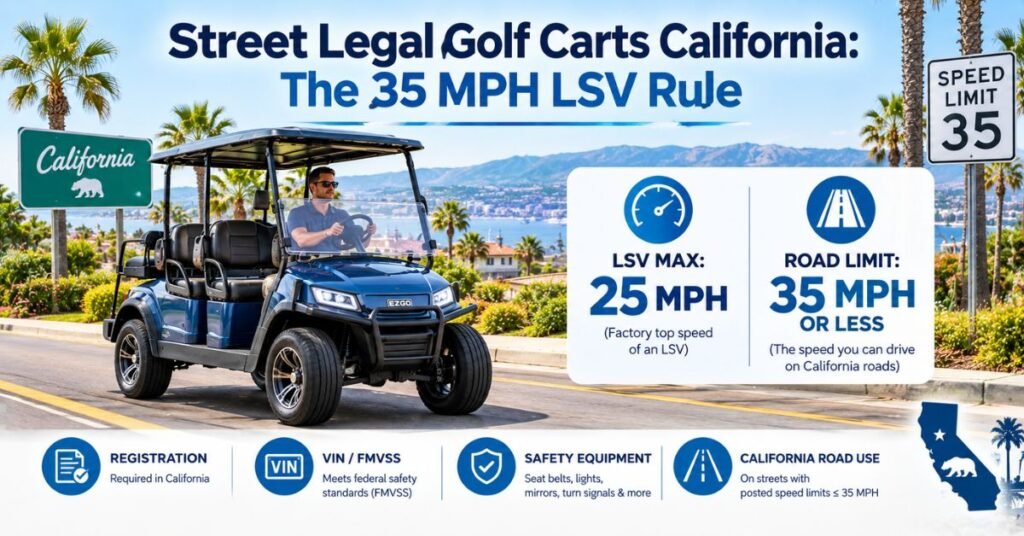
Here’s the good news. The rules make sense once you see them. A low-speed vehicle (LSV) may use any roadway posted at 35 mph (about 56 km/h) or less. A basic golf cart may not. These are California and US rules. Metric numbers appear in brackets for readers elsewhere.
Quick answer: Yes, golf carts can be street legal in California. The cart must be a factory-built LSV with a VIN, registration, insurance and a licensed driver. Then it can use roads posted at 35 mph or less.
| Topic | Short answer |
| LSV top speed | 25 mph (40 km/h) |
| Road limit for LSVs | 35 mph (56 km/h) or less |
| Must-haves | VIN, registration, plate, insurance, license |
| Minimum liability limits | 30/60/15 |
| Can you convert a basic cart? | Not into an LSV |
Street Legal Golf Carts California?
Two carts can look almost alike. Their legal status can differ a lot. Under the California Vehicle Code, section 345, a golf cart is built for the course. The California Department of Motor Vehicles says it may not exceed 15 mph (24 km/h) and can’t use roadways posted above 25 mph unless local government allows it. It carries no more than two people. It weighs under 1,300 lb (about 590 kg) empty. Modify it to go faster or carry more people and it counts as a regular motor vehicle.
Read More: ICON Golf Carts Models, Pricing: 7 Essential Tips for Buyers in 2026
An LSV plays by different rules. Low-speed vehicle California law covers a vehicle that goes faster than 20 mph but no more than 25 mph (32 to 40 km/h). Its gross vehicle weight rating must stay under 3,000 lb (about 1,360 kg). Many people call it a neighborhood electric vehicle, or NEV. So what’s the answer to golf cart vs LSV California? A factory build and full paperwork make the difference.
| Feature | Standard golf cart | Registered LSV |
| Top speed | 15 mph (24 km/h) | 20 to 25 mph (32 to 40 km/h) |
| Weight | Under 1,300 lb unladen | Under 3,000 lb GVWR |
| Roads | 25 mph roads with local approval | Roads posted 35 mph or less |
| Registration | Generally not required | Required |
| Plate | None | California plate |
| Insurance | Recommended | Liability required |
| Driver’s license | Needed on public roads | Needed |
| Safety belts | Not required | Required |
California Street Legal Golf Cart Requirements
Think of the rules as a checklist with no partial credit. California golf cart requirements for road use come from federal and state law together. A street legal LSV needs factory certification and a vehicle identification number. It also needs registration, a plate and insurance. Miss one piece and the cart isn’t a road-ready golf cart.
These California LSV laws sound heavy. They aren’t. Buy the right cart and most items arrive built in. The next three sections cover equipment, speed and identification. Together they make up the low-speed vehicle requirements the DMV checks.
Required Safety Equipment
Start with the gear you can see. The Federal Motor Vehicle Safety Standards, known as FMVSS 500, list what an LSV must carry. The list covers lighting, reflectors, mirrors, a parking brake, windshield glazing, seat belts, rear visibility and a VIN. That means headlights, tail lights, brake lights and turn signals. It also means rearview mirrors, a windshield, a parking brake and safety belts at every seat. Treat this golf cart safety equipment as a package from the maker. Adding parts later doesn’t count.
Street legal golf cart equipment checklist
| Item | Why it matters |
| Headlights | Help you see and help others see you |
| Tail lights | Mark the rear of the cart at night |
| Brake lights | Warn drivers behind you |
| Turn signals | Show your next move |
| Rearview mirrors | Show traffic behind you |
| Windshield | Uses safety glass to shield you from debris |
| Parking brake | Holds the cart on a slope |
| Safety belts | Protect every rider |
| Reflectors | Add visibility in low light |
Speed, Lighting and Vehicle Standards
Speed matters as much as lights. LSV speed capability must land between 20 and 25 mph. The golf cart speed limit for a standard cart is 15 mph. A factory label shows the vehicle meets federal safety standards as a low-speed vehicle. Don’t tune the motor for more speed. A vehicle modified to exceed 25 mph loses the relaxed federal standards and must meet all passenger vehicle standards. Lights must work too. Decorative bulbs won’t pass.
License Plate and Identification Requirements
Every LSV carries a 17-digit VIN from the manufacturer. The DMV builds your record from that number. You’ll find it on the frame and on the certification label. Once approved, you get a standard license plate for the rear. That makes a golf cart license plate the same as a car plate. You also receive a registration certificate and a vehicle title. Keep both safe.
California DMV Registration: Step-by-Step Guide

Registering an LSV feels a lot like registering a small car. The DMV treats it as a motor vehicle. So normal California vehicle registration steps apply. California LSV registration requirements include a title, an application, insurance and fees. Standard carts follow a different path. That’s why California golf cart registration can mean two very different things.
You have two routes. Buying from a licensed dealer is the easy one. The dealer files most of the paperwork for you. Private and out-of-state buyers apply through the DMV themselves. So how do you register a golf cart in California? Start with a factory LSV. Then follow the steps below.
| Step | What you do |
| 1 | Gather your documents |
| 2 | Confirm the equipment works |
| 3 | Submit the application |
| 4 | Pay the fees |
| 5 | Receive your plate and papers |
Documents You Need
Pack your paperwork before you head out. The DMV lists an application (REG 343), proof of ownership such as a title or manufacturer’s certificate, and often a Verification of Vehicle form (REG 31). New LSVs come with a manufacturer’s certificate of origin. Bring proof of insurance too. A bill of sale helps. These California golf cart DMV requirements keep the counter visit short. A clean golf cart title California record also makes resale easier.
Registration and Title Process
Dealers usually submit the file for you. Private buyers visit a DMV office. You pay the fees. Then the DMV issues your registration certificate, plate and title. Fees run close to a regular car. Golf cart DMV registration for a standard cart is different. The DMV allows it for unmodified carts. Most owners of basic carts skip it because they stay on private property.
When Registration Must Be Renewed
Expect to renew each year like any other car. The DMV sends a notice before the due date. Pay on time to dodge late fees. Keep your registration certificate and insurance card in the cart. An officer may ask for both. Set a phone reminder to save yourself the hassle.
California Golf Cart Insurance Requirements
One fender-bender can turn a fun cart into a costly lesson. Golf cart insurance California rules for an LSV work like car rules. Since January 1, 2025, minimum liability insurance stands at 30/60/15 under SB 1107. That covers injuries and damage you cause to others. So do golf carts need insurance in California? An LSV does. Skip it and you break the law.
| Number | Coverage |
| $30,000 | Bodily injury per person |
| $60,000 | Bodily injury per accident |
| $15,000 | Property damage |
Standard carts face looser rules. Insurance still makes sense. Homeowner and umbrella policies often don’t cover public roads. An insured golf cart protects your savings. One Northern California dealer guide says to plan on roughly $200 to $500 per year. Rates vary by carrier and coverage. Shop around before you buy.
Where Can You Drive a Street Legal Golf Cart in California?
The speed limit sign is your real map. The 35 MPH LSV rule is easy to remember. Stay off any road posted above 35 mph. Golf cart road rules California depend on your cart type. They also depend on your city. Can golf carts drive on California roads? Yes, if the cart is a registered LSV or if a local route allows it.
Cities can add their own limits. Cross-check every trip against posted signs. Freeways and fast arterials are off limits. Quiet neighborhoods usually work fine. The table below shows the big picture.
| Road type | LSV | Standard golf cart |
| Residential streets at 25 mph | Yes | Only if locally approved |
| Roads posted 30 to 35 mph | Yes | Generally no |
| Roads above 35 mph | No (crossing only) | No |
| Freeways | No | No |
Roads Where LSVs Are Allowed
Neighborhood streets are your home turf. State law bars an LSV from any roadway posted above 35 mph, with one main exception. That exception is crossing. You may cross a faster road if the crossing starts and ends on a road posted 35 mph or less and happens at an intersection of roughly 90 degrees. Signals aren’t required. Crossing an uncontrolled intersection with a state highway needs approval from the enforcing agency. Read the full text of
Roads Where Golf Carts Are Restricted
Standard carts face tighter golf cart operating restrictions. They can’t use freeways or any road posted above 25 mph without local approval. Local authorities may designate roads for golf carts near a golf course, and generally not more than one mile (1.6 km) from it unless the road lies inside a development. Those speed restrictions protect riders. The details sit in
Read More: Golf Cart Prices 2026: New & Used Models, Costs and Buying Guide
Local City and Community Rules
Your city can say no even when state law says yes. Local authorities may restrict or prohibit LSV use by ordinance or resolution. Each local jurisdiction writes its own local golf cart ordinances. HOAs add community golf cart regulations on top. Statewide, there’s no separate California golf cart permit for LSVs. Your registration and plate do that job. Some cities or communities may still ask for a decal. Call the city clerk to check. Follow all traffic laws as well. Stop at signs and yield to walkers.
Golf Cart-Friendly Communities in California

Some towns roll out the welcome mat for carts. California golf cart communities often share flat streets and slow traffic. Short trips feel natural there. Nick’s Golf Cars runs showrooms in five of these cities: Fresno, Rocklin, Chico, Benicia and Napa. Those places also share a common thread. Most daily errands sit close to home.
Still, local rules can change. Check the city code before you buy. The table below points you in the right direction. It doesn’t replace the actual ordinance.
| City | What to know | Where to check |
| Fresno | Big grid of streets with mixed speed limits | |
| Rocklin | Master-planned neighborhoods with low-speed roads | City hall and your HOA |
| Chico | Flat valley streets and many 25 mph blocks | City public works |
| Benicia | Compact grid near the waterfront | City clerk |
| Napa | Town streets mixed with faster valley roads | City public works |
Fresno
Fresno stretches wide. That means route planning matters. A local dealer guide says an LSV can use any road posted 35 mph or less there. Summer heat is real in the Central Valley. The same guide suggests asking about lithium batteries and buying from a dealer with local service. Read your local Fresno golf cart rules before you drive.
Rocklin
Rocklin’s newer neighborhoods suit carts well. A dealer guide names Whitney Ranch and Sun City Lincoln Hills as cart-friendly areas. It also warns that Blue Oaks Boulevard tops 35 mph in places. So map your route first. Never head onto an on-ramp. Ask your HOA about Rocklin golf cart rules too.
Chico
Chico sits on flat valley floor. Older neighborhoods follow a simple grid. A local guide notes that many of those streets are posted at 25 mph and that a cart must stay at 25 mph or less to keep its LSV status. Check Chico golf cart rules with the city before you ride near campus or downtown.
Benicia
Benicia has a walkable grid and a waterfront downtown. A dealer guide says the town follows state rules, so an LSV may use roads posted 35 mph or less there. That covers most residential streets. Still, confirm Benicia golf cart rules with the city clerk. Local signs and closures can change your route.
Napa
Napa follows the same state baseline. Its mix of town streets and faster valley roads calls for careful planning. Check each road’s posted limit before you go. Ask city hall about current Napa golf cart rules. Then plan short hops close to home.
Buying a Street Legal Golf Cart vs. Converting One
Bolting on a headlight doesn’t make a cart legal. How to make a golf cart street legal in California starts at the factory. The DMV needs a maker-assigned VIN and FMVSS 500 certification. A golf cart conversion can’t create either. Even an LSV conversion kit adds parts but not paperwork. You end up with a cart that looks legal yet can’t earn LSV plates.
Rules for modified carts back this up. The DMV treats a cart modified to exceed 15 mph or carry more than two people as a regular motor vehicle that must meet passenger vehicle standards. That’s a steep hill for a backyard project. A street legal electric golf cart from a dealer skips the trouble. Nick’s explains the difference in its LSV guide and registration guide.
| Factor | Factory LSV | Converted cart |
| VIN | Assigned by the maker | Missing or unsuitable |
| FMVSS 500 label | Included | Not available |
| Safety features | Built in | Added later |
| DMV path | Standard LSV process | Blocked or complex |
| Risk | Low | High |
How Much Does a Street Legal Golf Cart Cost in California?
The sticker price is only chapter one. One Fresno dealer guide says a clean used cart costs a few thousand dollars while a new street-legal model can run well over ten thousand. A Napa showroom listing showed a new 2025 Denago Nomad XL at $9,995. Prices change often. Always confirm current numbers with the dealer. A low-speed electric vehicle costs less to run than a car.
Ongoing costs matter too. Registration, insurance, service and batteries all add up. The same guide calls battery replacement the biggest hidden cost when buying used. Plan your budget with these pieces in mind.
| Cost item | What to expect |
| Purchase | A few thousand dollars used to $10,000 or more new |
| Registration | Fees similar to a regular car |
| Insurance | Often a few hundred dollars per year |
| Batteries | Biggest long-term expense |
| Service | Routine checks and repairs |
What Happens If Your Golf Cart Isn’t Street Legal?
A ticket is the mild outcome. Driving a non-compliant cart on public roads can bring citations. Fines vary by violation and by county. Officers may also order you off the road. Missing safety belts or lights counts as an equipment violation. So does a missing plate.
The bigger risk is liability. Picture Dan, who bought a used cart and added lights and mirrors himself. He drives across a 45 mph road and gets hit. His cart has no VIN match and no registration. His insurer refuses the claim. Dan now faces repair bills and medical costs from his own pocket. That’s a case study you want to avoid.
A cart that looks legal isn’t the same as a cart that is legal.
How to Keep Your California Golf Cart Compliant
Compliance is a habit rather than a one-time chore. Good golf cart compliance means keeping paperwork current and gear working. Renew registration on time. Keep insurance active. Check lights, mirrors and belts often. A five-minute walk-around before each ride catches most problems.
Rules also change. Check your city’s site once a year for updates. Read HOA notices carefully. Stay inside the 35 MPH LSV rule on every trip. That habit protects your cart and your wallet. Use the table below as a simple routine.
| Task | How often |
| Walk-around of lights and belts | Before each ride |
| Tire and brake check | Monthly |
| Insurance review | Yearly |
| Registration renewal | Yearly |
| Local rule check | Yearly |
Frequently Asked Questions
Are golf carts street legal in California?
Yes, but only some. A factory-built LSV can use roads posted 35 mph or less. A standard golf cart faces tight limits and may only use roads posted 25 mph or less with local approval. So are golf carts street legal in California? It depends on the cart and the city.
Can a golf cart go on a 35 MPH road in California?
A registered LSV can. A standard 15 mph cart generally can’t. The California 35 mph LSV rule applies to roads posted 35 mph or less. Cities can still restrict LSVs on certain streets. Check local signs and ordinances before you go.
Do street legal golf carts need registration in California?
Yes. An LSV needs registration, a title and a plate. Standard carts usually don’t need registration. The DMV does let owners of unmodified carts register them. Most owners of basic carts skip that step.
Does a golf cart need insurance in California?
An LSV needs liability insurance with at least 30/60/15 limits. Standard carts face looser rules. Insurance is still wise. Homeowner policies often exclude public roads. A stand-alone cart policy fills that gap for a modest yearly cost.
Do you need a driver’s license to drive an LSV in California?
Yes. You need a driver’s license on public roads. A driver’s license or a learner’s permit works for an LSV. One dealer guide adds that a permit holder must ride with a licensed driver aged 25 or older. Confirm current details with the DMV. Rules for permit holders can change.
Where can you legally drive a golf cart in California?
Registered LSVs may use roads posted 35 mph or less. Standard carts may use private property and locally approved routes. Both types must avoid freeways. Check your local jurisdiction first. It has the final say on where you can ride.