
 Abdul Moeed
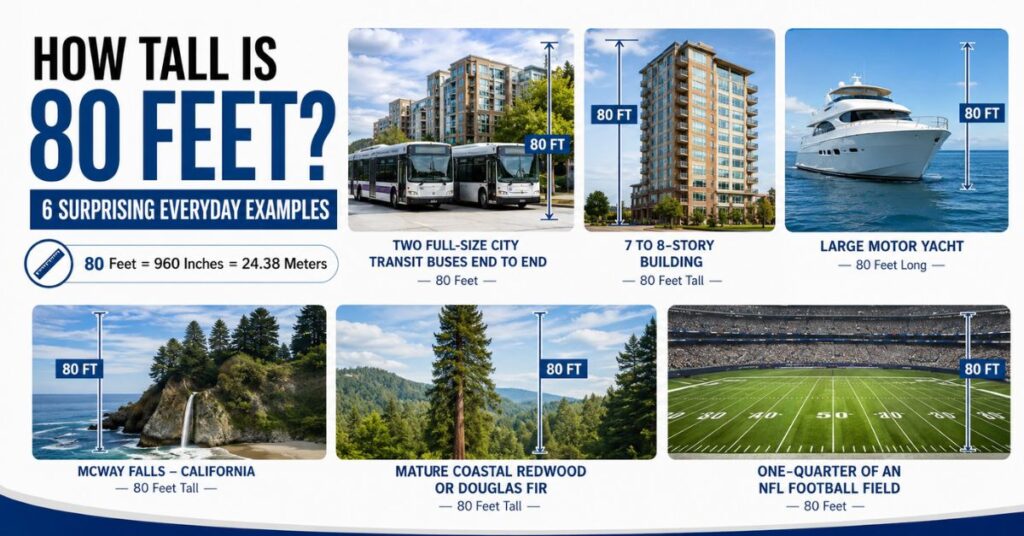
80 feet tall is about the height of an eight-story building, or roughly 24.4 meters. That single number is hard to picture on its own, which is exactly why comparisons help.
If you’ve ever wondered how tall is 80 feet in terms you can actually picture, you’re not alone. This measurement shows up constantly in construction, sports, nature, and engineering, yet most people have no reference point for it beyond a tape measure they’ve never unrolled that far. This guide breaks 80 feet down using six everyday objects, from a full-grown blue whale to a stretch of transmission poles, so you can visualize it instantly.
What most size-comparison articles skip is the practical side: how architects actually plan for 80-foot heights, why utility poles are built to that exact range, and how close a tennis court comes to matching it. We’ll cover that here, along with quick conversion and reference tables you can scan in seconds.
What Is 80 Feet in Other Units?
Before comparing 80 feet to real objects, it helps to see the number in other common units. Whether you’re doing construction measurements or just curious, here’s the full breakdown of 80 feet in metric and imperial terms.
Read More: How Big Is 13 Inches? 6 Surprising Comparisons
Quick Conversion Table
| Unit | Value |
| Feet | 80 ft |
| Inches | 960 in |
| Yards | 26.67 yd |
| Meters | 24.38 m |
| Centimeters | 2,438.4 cm |
| Miles | 0.0152 mi |
These conversions matter because feet, meters, and yards each show up in different contexts construction blueprints usually use feet, sports fields often use yards, and most of the world outside the U.S. uses meters for height comparison. Knowing 80 ft to meters (about 24.4 m) makes it easier to compare with international sources.
Quick Reference Table: 6 Things That Are 80 Feet Tall or Long
Here’s a fast overview of the six comparisons covered in this guide, ranked by how close each one gets to the exact 80-foot mark.
| Object | Approx. Measurement | Closeness Score (X/10) | Best Situation/Use |
| Blue whale | 80–100 ft | 9/10 | Understanding marine animal size |
| Tennis court (length) | 78 ft | 9/10 | Visualizing 80 feet on the ground |
| Eight-story building | ~80 ft | 10/10 | Estimating building height |
| Two city buses end-to-end | ~80 ft | 8/10 | Picturing 80 feet as a distance |
| Utility/transmission pole | 80–100 ft | 8/10 | Understanding infrastructure height |
| Mature white oak tree | ~80 ft | 7/10 | Visualizing natural height |
Real-World Examples of 80 Feet
To really answer how tall is 80 feet, it helps to line it up against things you already have a mental picture of animals, buildings, sports courts, and everyday infrastructure. Below are six real-life examples, each with practical context.
The Blue Whale

An adult blue whale typically measures between 80 and 100 feet long, according to NOAA Fisheries, making the shorter end of that range a near-perfect real-world example of 80 feet. That’s longer than three school buses parked bumper to bumper. Blue whales are the largest animals ever known to have existed on Earth, even bigger than most dinosaurs.
This comparison matters because it’s easy to underestimate ocean animals when you’ve only seen photos. Something no competitor explained: a blue whale’s tongue alone can weigh as much as an elephant, which gives a sense of just how much mass is packed into that 80-foot length. For anyone doing height comparison or length comparison research, the blue whale is one of the most reliable real-life size reference points available.
A Tennis Court’s Length

A regulation tennis court, per official U.S. Tennis Association (USTA) specifications, measures 78 feet long from baseline to baseline just two feet short of a true 80-foot height or distance. That makes it one of the most accessible everyday size comparisons, since public tennis courts are common in nearly every U.S. neighborhood.
Standing at one baseline and looking to the other gives a genuinely useful visual size guide for 80 feet, even though the court itself is a length rather than a height. Key distinction: unlike a building or a tree, a tennis court is horizontal, so it’s the best option for picturing 80 feet as ground distance rather than something towering overhead.
Read More: 10 Feet Example 6 Surprising Everyday Comparisons
An Eight-Story Building

Architects commonly use roughly 10 feet per story as a planning standard for commercial buildings, according to general U.S. building code guidance, which puts an eight-story structure at approximately 80 feet tall. This makes “eight stories” one of the most direct answers to how tall is 80 feet in an urban setting.
This comparison is especially useful in cities, where mid-rise apartment buildings and small office towers commonly fall in the six-to-ten story range. If you’ve ever looked up at a modest downtown building and wondered about its height, there’s a good chance it’s close to 80 feet a helpful benchmark for anyone estimating residential building height without a tape measure.
Two City Buses, End to End

A standard city transit bus measures about 40 feet long, based on specifications from the American Public Transportation Association (APTA), meaning two of them parked nose-to-tail equal approximately 80 feet. This is one of the easiest ways to measure 80 feet without a ruler, since city buses are a common everyday object almost everyone has seen up close.
Because most people have boarded or waited near a city bus, this comparison converts an abstract number into something tangible. It also works well for teaching distance visualization to kids, since two buses in a row is a distance most people can walk in under 20 seconds.
A Tall Utility or Transmission Pole

While standard wooden utility poles along residential streets typically run 35 to 45 feet, taller transmission poles that carry high-voltage power lines are commonly built in the 80 to 100 foot range, according to specifications used by U.S. utility companies. These taller poles are engineered specifically for utility measurement and load-bearing requirements over long distances.
Seeing a transmission pole next to a smaller residential pole is a striking way to visualize scale, since the height difference is almost double. For engineering measurements and outdoor measurements involving power infrastructure, the 80-foot pole represents a common industry benchmark rather than an unusual outlier.
A Mature White Oak Tree

According to U.S. Forest Service arboretum data, a mature white oak can grow to around 80 feet tall under good growing conditions, with some specimens exceeding that height over many decades. This makes the white oak one of the most recognizable examples of natural 80-foot height, especially in older neighborhoods and parks across the eastern United States.
Trees are a particularly useful real-life size reference because their growth is gradual and visible over time, unlike a building that appears at full height all at once. A tree height comparison like this also helps explain why older, established neighborhoods often feel more shaded and enclosed than newly built ones.
Where Does 80 Feet Appear in Daily Life?
Eighty feet shows up more often than most people realize. It’s the rough height of a mid-rise apartment complex, the approximate length of two city buses, and a common span for transmission poles carrying electricity across neighborhoods. It’s also close to the length of a tennis court and within the size range of a mature oak tree or a full-grown blue whale.
Construction crews, arborists, and utility engineers all work with 80-foot measurements regularly, even if the average person never thinks about the number directly. Once you have a few solid mental anchors a building, a bus, a whale the question of how tall is 80 feet stops being abstract and starts being something you can spot on your own street.
Sports facilities offer another common touchpoint. A tennis court’s 78-foot length, a bowling lane’s 60-foot approach, or the layout of a basketball court all sit in a similar range, which is part of why athletic facilities are so often used in scale comparison guides. Builders also lean on 80-foot benchmarks when planning setback distances, fire access routes, and crane clearance on job sites, since a wrong estimate at that scale can affect safety planning.
Even hobbyists run into this measurement. Drone pilots frequently fly at altitudes close to 80 feet to photograph property boundaries, landscapers use it as a rough guide for mature tree canopy spread, and film crews reference similar heights when scouting locations with tall backdrops. None of these fields require exact precision from memory, but having a mental reference like the eight-story building or two-bus comparison covered above makes on-the-spot estimation far more reliable.
Read More: 50 Feet Visualized 6 Surprising Everyday Comparisons
FAQ’s
How many feet is a story building?
A typical building story is about 10 to 14 feet tall, depending on the building type and ceiling height. Residential stories are usually shorter than commercial ones.
How tall is 80 in into feet?
80 inches equals 6 feet 8 inches (6.67 feet). Divide 80 by 12 to convert inches into feet.
What is the 5’7″ height?
A height of 5 feet 7 inches equals 67 inches or about 170 centimeters (1.70 meters). It is a common adult height in many countries.
How many feet high is a two story house?
A typical two-story house is 18 to 25 feet tall, depending on ceiling heights and roof design. Most average around 20 feet from ground to roof peak.
How tall is 80 feet compared to a building?
80 feet is roughly the height of an eight-story building, using the common architectural standard of about 10 feet per floor. This makes it a useful benchmark for estimating the height of mid-rise apartments or small office buildings.
How long is 80 feet in a real-world object?
80 feet is close to the length of two city buses parked end to end, or a single adult blue whale, which can reach up to 100 feet. Both are widely used as everyday length comparison references.
What is 80 feet in meters?
80 feet equals approximately 24.38 meters. This conversion is useful for comparing U.S. measurements to metric building codes or international height comparison data.
Is 80 feet a lot for a tree to grow?
Yes, 80 feet is considered a tall, mature tree height, typically reached by species like white oaks after several decades of healthy growth. Not all trees reach this height, which makes it a notable size in most residential settings.
How can I visualize 80 feet without a tape measure?
The easiest way is to picture two city buses parked bumper to bumper, or count up eight stories of a building. Both give a fairly accurate, real-life size reference without needing any measuring tools.
Final Thoughts
Eighty feet is easier to picture than it sounds once you attach it to something familiar. Whether it’s an eight-story building, a full-grown blue whale, two city buses in a row, a tall transmission pole, a mature white oak, or the length of a tennis court, each example answers the same core question: how tall is 80 feet, in terms you can actually see in daily life.
Next time you’re estimating a building’s height or picturing a large animal’s length, one of these six comparisons should give you a quick, reliable mental measuring tape no ruler required.