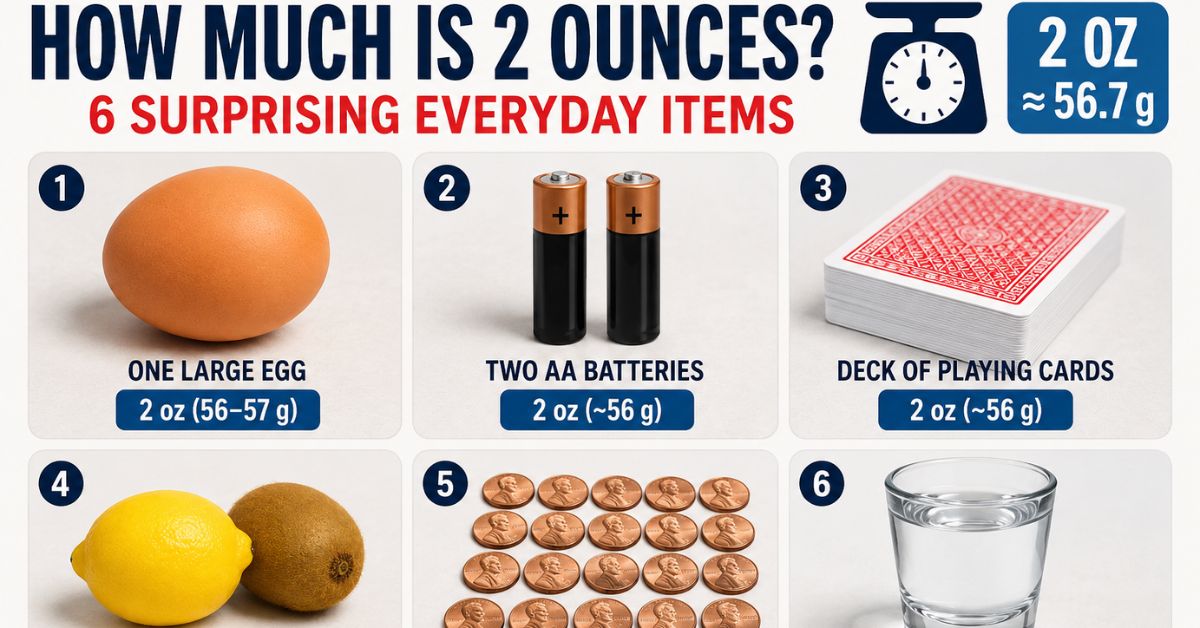
How Much Is 2 Ounces? 6 Surprising Everyday Items
How much is 2 ounces? Two ounces equals 56.7 grams, or about 59 milliliters if you’re measuring a liquid. That’s roughly the weight of a large chicken egg or ten U.S. quarters stacked in your palm.
This guide breaks down exactly how much is 2 ounces in every unit you’re likely to need grams, pounds, cups, tablespoons, teaspoons, and milliliters. You’ll also see six everyday items that weigh close to 2 ounces, so you can picture the amount even without pulling out a kitchen scale.
Most conversion charts stop at grams and stop there. This one goes further, covering the difference between dry ounces and fluid ounces a mix-up that trips up even experienced home cooks plus a few practical tricks for measuring 2 oz without any tools at all.
How Much Is 2 Ounces, Really?
An ounce isn’t just one thing. In the US customary system, “ounce” can describe weight (mass) or volume (how much space a liquid takes up), and those two are not interchangeable. This is the detail a lot of quick conversion charts skip entirely.
- A dry ounce measures weight how heavy something is on a scale. Flour, sugar, meat, and coins are all measured this way.
- A fluid ounce measures volume how much space a liquid fills in a cup or bottle. Water, milk, and oil use this measurement.
Here’s the catch: 2 dry ounces of flour and 2 fluid ounces of water don’t weigh the same amount, because flour is less dense than water. For water specifically, the two happen to line up closely (2 oz of water weighs almost exactly 2 fluid oz), which is why recipes sometimes blur the line. But for anything else sugar, oil, shredded cheese dry ounces and fluid ounces can diverge quite a bit.
So when someone asks “how much is 2 ounces,” the honest answer depends on whether they’re weighing something solid or measuring a liquid. We’ll cover both below.
Read More: 20 Grams 6 Surprising Things That Weigh This Much
Quick Conversion Table: 2 Ounces to Other Units
| Unit | Equivalent to 2 Ounces |
| Grams | 56.7 g |
| Kilograms | 0.057 kg |
| Pounds | 0.125 lb |
| Milliliters (fluid) | ~59 ml |
| Liters | 0.059 L |
| Cups (fluid) | 0.25 cup (¼ cup) |
| Tablespoons (fluid) | 4 tbsp |
| Teaspoons (fluid) | 12 tsp |
| Fluid ounces | 2 fl oz |
These numbers assume a standard liquid like water. Dry ingredients such as flour or sugar will fill a different volume for the same 2 oz of weight, since density changes the math. If a recipe calls for 2 oz of flour, weighing it on a kitchen scale is always more accurate than eyeballing a cup measurement.
Quick Reference: Everyday Things That Weigh About 2 Ounces
| Object | Approx. Measurement | Closeness Score | Best Situation/Use |
| Regulation tennis ball | 56–59.4 g | 9/10 | Visualizing weight without a scale |
| 10 U.S. quarters | 56.7 g | 10/10 | Exact DIY weight check |
| Large chicken egg (in shell) | ~56.7 g | 9/10 | Cooking and baking portions |
| Two slices of sandwich bread | ~56 g | 8/10 | Food serving size reference |
| Two first-class letters | up to 56.7 g | 9/10 | Mail and shipping estimates |
| Five AAA batteries | ~57.5 g | 7/10 | Household weight comparison |
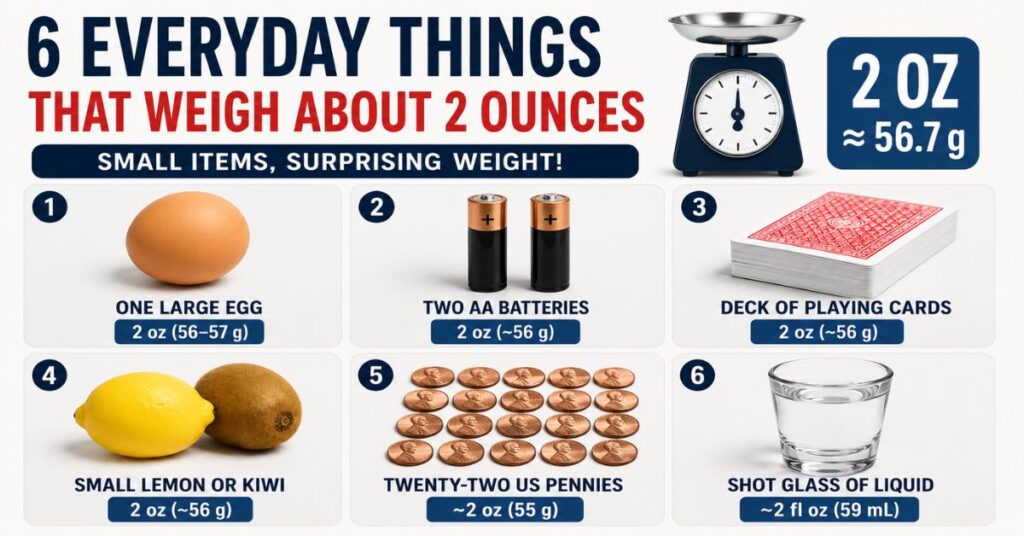
6 Everyday Things That Weigh About 2 Ounces
1. A Regulation Tennis Ball
The International Tennis Federation (ITF) requires official tennis balls to weigh between 56 and 59.4 grams, which lands almost exactly on the 2 ounces weight mark. Brands like Wilson and Penn, which supply balls for professional tournaments, manufacture to this exact spec, making a tennis ball one of the most reliable physical stand-ins for 2 oz you can find in a junk drawer or garage.
This matters practically because a tennis ball is something most households already own. If you’re trying to eyeball a portion size or check whether a package feels roughly right before shipping, holding a tennis ball gives you an instant, tactile reference — no kitchen scale required.
Read More: White Claw Can Dimensions 6 Surprising Size Comparisons (2026)
2. Ten U.S. Quarters
Here’s a fact most conversion guides leave out: a single U.S. quarter, per official United States Mint specifications, weighs exactly 5.670 grams. Multiply that by ten, and you land on 56.70 grams — an almost perfect match for 2 ounces of weight. Nickels and dimes work too, but quarters make the cleanest, roundest math.
Key distinction: unlike a tennis ball or an egg, coins give you a way to build a precise 2 oz measurement rather than just approximate one. Stack ten quarters on a DIY balance scale (a ruler balanced on a pencil works in a pinch) and you have a legitimate, mint-standard reference weight for measuring 2 ounces without a scale.
More Posts: [How Much Does a Gallon of Water Weigh? A Full Breakdown]
3. One Large Chicken Egg
Under USDA grading standards, a dozen “Large” eggs must weigh a minimum of 24 ounces total, which averages out to 2 ounces per egg in the shell. This is one of the most useful everyday comparisons for anyone measuring 2 oz in a kitchen context, since eggs show up in nearly every baking recipe.
This is especially handy for food portion size questions. If a recipe calls for 2 oz of a mix-in chopped nuts, chocolate chips, dried fruit picturing “about one egg’s worth” gives home cooks a fast mental shortcut that beats guessing.
4. Two Slices of Sandwich Bread
A standard slice of sandwich bread, based on typical nutrition labeling from brands like Sara Lee and Wonder Bread, weighs close to 1 ounce each. Two slices together land right around 2 ounces, making a basic sandwich one of the most literal everyday ounce comparisons out there.
This one’s useful for anyone tracking food portion size or calorie counts, since bread weight is printed directly on most packaging. It’s a good real-world check: next time you make a sandwich, you’re holding almost exactly 2 ounces of bread before anything else goes on it.
More Posts: [Kitchen Measurements 101: A Beginner’s Conversion Guide]
5. Two First-Class Letters
The United States Postal Service sets its base First-Class Mail rate for letters weighing up to 1 ounce; anything heavier requires additional postage. Two standard letters, stacked together, land right at the 2 ounces mark the point where USPS pricing tiers shift.
This is a distinction most everyday-measurement articles skip entirely: postage weight limits are a genuinely practical use case for knowing how much is 2 ounces. If you’re sending a thicker envelope, weighing it against two typical letters can save you a trip to the post office counter.
6. Five AAA Batteries
A single AAA battery from major manufacturers like Duracell or Energizer weighs approximately 11.5 grams. Five of them together come out to roughly 57.5 grams, close enough to serve as a decent household stand-in for 2 ounces weight when you need a quick comparison and don’t have coins or a tennis ball handy.
Batteries are a good example of everyday items weighing 2 ounces because most homes have a stash of them in a junk drawer. Grouping five together gives you a rough, no-tools way to sanity-check a small package before mailing it or weighing an ingredient.
Read More: What Weighs 300 Grams 6 Surprising Everyday Items
How to Measure 2 Ounces Without a Scale
Not everyone owns a kitchen scale, and dry ounces don’t always translate cleanly into cups. A few reliable workarounds:
- For liquids: 2 fluid ounces is exactly ¼ cup, or 4 tablespoons, or 12 teaspoons. Any standard measuring cup or spoon set handles this without extra math.
- For dry ingredients: weight is more accurate than volume, since flour, sugar, and shredded cheese all pack differently. If a scale isn’t available, use the quarter comparison above — ten quarters equal almost exactly 56.7 grams.
- For a rough visual check: picture a tennis ball, a large egg, or two slices of bread. None of these are lab-precise, but they’re close enough for everyday cooking measurements, portion control, or a quick mailing estimate.
Weight vs. volume confusion is the single biggest source of measuring mistakes in home kitchens. When precision actually matters baking especially a cheap digital kitchen scale removes the guesswork entirely.
FAQ’s
What is 2 ounces equal to in cups?
Two fluid ounces equal 1/4 cup in U.S. measurements. This conversion is commonly used for cooking and baking recipes.
Do 2 ounces equal 2 tablespoons?
No. 2 fluid ounces equal 4 tablespoons, not 2 tablespoons. Each fluid ounce contains 2 tablespoons.
How much is 2 oz in ml?
Two U.S. fluid ounces are approximately 59.15 milliliters (mL). It’s often rounded to 60 mL for convenience.
Is two ounces a half a cup?
No. 2 fluid ounces equal 1/4 cup, while 1/2 cup equals 4 fluid ounces. Half a cup is twice as much as 2 ounces.
How much is 2 ounces in cups?
2 fluid ounces equals ¼ cup. This conversion only applies to liquid measurements dry ingredients measured by weight won’t always match this volume exactly, since density varies by ingredient.
Is 2 ounces a lot for a food serving?
It depends on the food. 2 ounces is a modest single-food portion about two slices of bread or one large egg’s worth. For meat or cheese, 2 oz is generally considered a light-to-moderate serving size in most US dietary guidelines.
How much is 2 ounces to pounds?
2 ounces equals 0.125 pounds, or one-eighth of a pound. This is a simple weight conversion, since there are 16 ounces in every pound by US customary standard.
What common household item weighs about 2 ounces?
A regulation tennis ball or ten U.S. quarters both weigh almost exactly 2 ounces. Both are widely available household items, making them reliable stand-ins when a kitchen scale isn’t within reach.
Calculation
So, how much is 2 ounces? In everyday terms, it’s 56.7 grams of weight or about 59 milliliters of liquid volume roughly a large egg, ten quarters, a tennis ball, two slices of bread, two standard letters, or five AAA batteries. Each comparison gives you a slightly different, tangible way to picture the same small amount.
The main thing worth remembering is the split between dry ounces and fluid ounces: one measures weight, the other measures volume, and mixing them up is the most common kitchen measurement mistake people make. Whether you’re cooking, mailing a letter, or just curious, keeping a mental image of “about one egg” or “ten quarters” is often faster than reaching for a scale.